


On November 18, 2026, Chargebee opened early access to Arc, an AI agent platform built for contracts, billing, and revenue recognition. The core design choice is deliberate: Chargebee Arc's AI agents for finance prepare work but never finalize it, leaving every action in draft until a human approves it. In a domain where one slip produces a miscoded invoice or a misrepresented revenue line, the boundary between proposal and decision matters far more than raw processing speed.
For this coverage, we reviewed the Chargebee press release on GlobeNewswire, the PYMNTS article, the TRACEABLE event page, and Chargebee's own e-invoicing documentation. The Arc website was not accessible with our tools. PYMNTS republishes the press release without independent verification.
What Is Arc, in Practice?
Chargebee sells billing and monetization infrastructure to software, AI, and subscription businesses. Its customer list, cited in the press release, includes Zapier, DeepL, and Condé Nast. Arc is Chargebee's attempt to run a complete financial process as a single traceable thread: from contract to invoice to recognized revenue. At launch, the platform ships with three pre-built agents and Agent Studio, a workspace where finance teams can build their own agents on the same underlying framework.
The unveiling happened during TRACEABLE, Chargebee's virtual AI summit for finance teams, anchored by a keynote titled “One Full Arc, From Quote To Cash.” “AI adoption doesn't automatically translate into transformation,” said co-founder and CEO Krish Subramanian, as quoted in the press release. Early access is requested through the Arc website; the press release gives no pricing, qualification criteria, or general availability date.
What the Three Agents Actually Do
The first agent reads a signed contract and proposes the billing configuration, flagging open questions. Every extracted field, from the customer name and pricing through to payment terms, links back to the precise clause in the contract it was drawn from.
The second agent works on receivables. It builds a map of each customer's contracts, consumption history, and payment record. From there, it prepares collection activities: drafting responses to a payment promise or answering usage-cost queries.
The third handles revenue recognition. It breaks contracts into individual performance obligations, applies company policy on prepaid credits, overages, and residuals, and reallocates the transaction price when a contract is modified. A useful analogy: Arc functions like a junior accountant at a firm. It prepares the file, cites its sources, flags uncertainties, but the partner signs off.
Where the Agent Stops
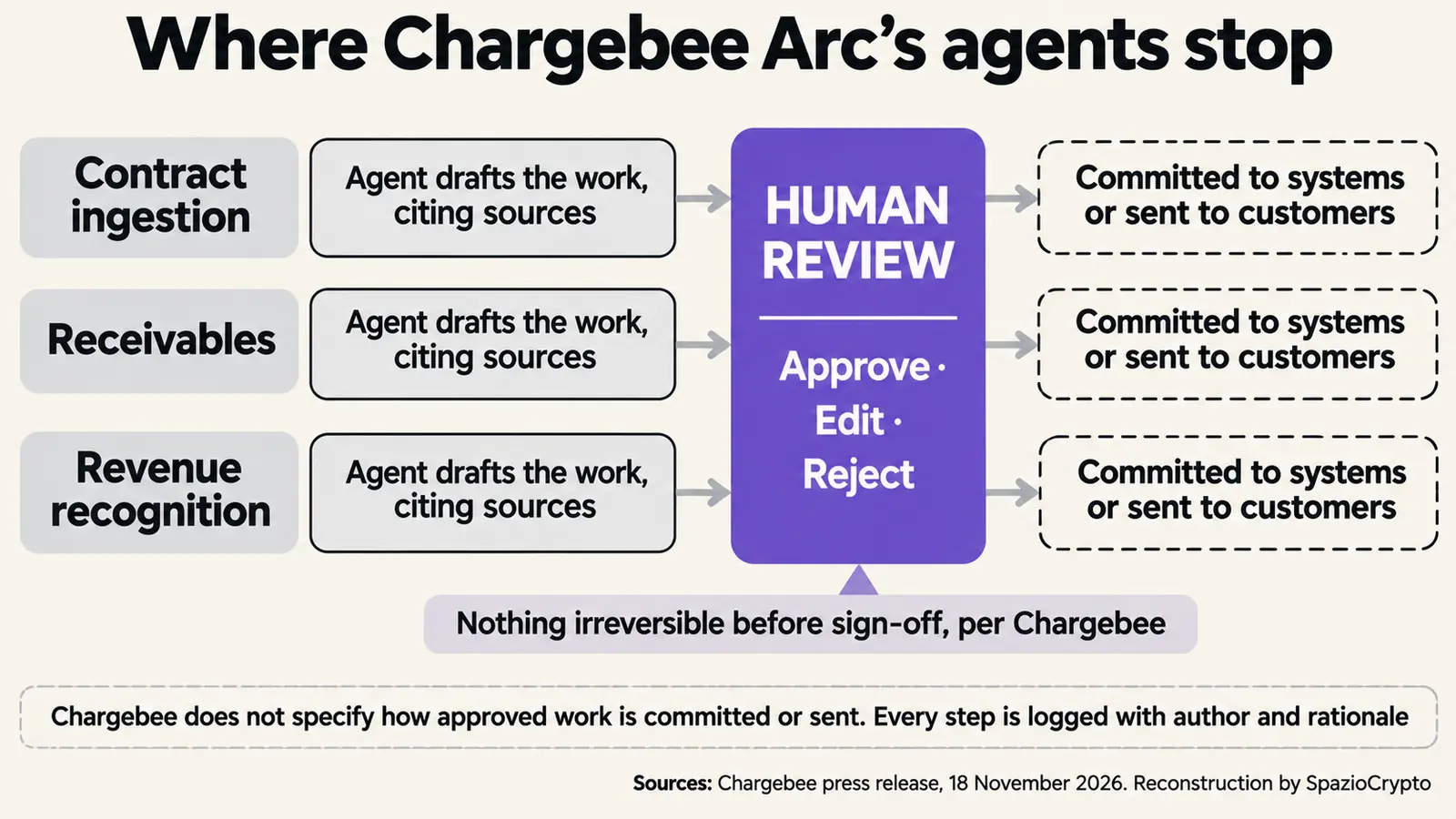
Chargebee's stated operating model revolves around five elements: tasks, drafts, comments, citations, and approvals. According to the press release, every action is “shown, cited, and held for review before anything is confirmed.” Every step is logged with the author and the reason behind it, whether that author is an agent or a person. When someone corrects an agent, Arc remembers the correction for next time.
“We designed Arc so an agent can take ownership of a task, explain its reasoning, and ask for help when something is ambiguous,” said co-founder and CTO KP Saravanan, as quoted in the press release. One thing the press release doesn't clarify: after approval, do the agents actually write to the accounting systems or send messages to customers? It states only that nothing irreversible happens before the human signs off.
Why Traceability Matters More Than the Model
In accounting, an error doesn't stay as a wrong answer on a screen. It becomes a misfiled invoice, a collection notice sent to the wrong client, or revenue misstated on the balance sheet. That's why Chargebee frames the audit trail of every step as a core product feature, not an afterthought bolted on later. Arc pulls context from contract management systems, CRMs, and email, though the press release names no specific integrations.
The question of who controls AI-driven financial tools extends well beyond software companies. Banks and insurers are already committing substantial resources to artificial intelligence, as reflected in the investment patterns of banks and insurers in AI. The governance question also cuts to the core of European finance's reliance on foreign AI systems.
What We Don't Know Yet
Quite a lot. The press release omits pricing, general availability date, the AI models used, data residency details, Arc-specific certifications, autonomy limits, and error rates. No independent tests of the system's contract extraction accuracy or revenue recognition precision have been published. Arc should not be presented as a system already capable of replacing human accounting controls.
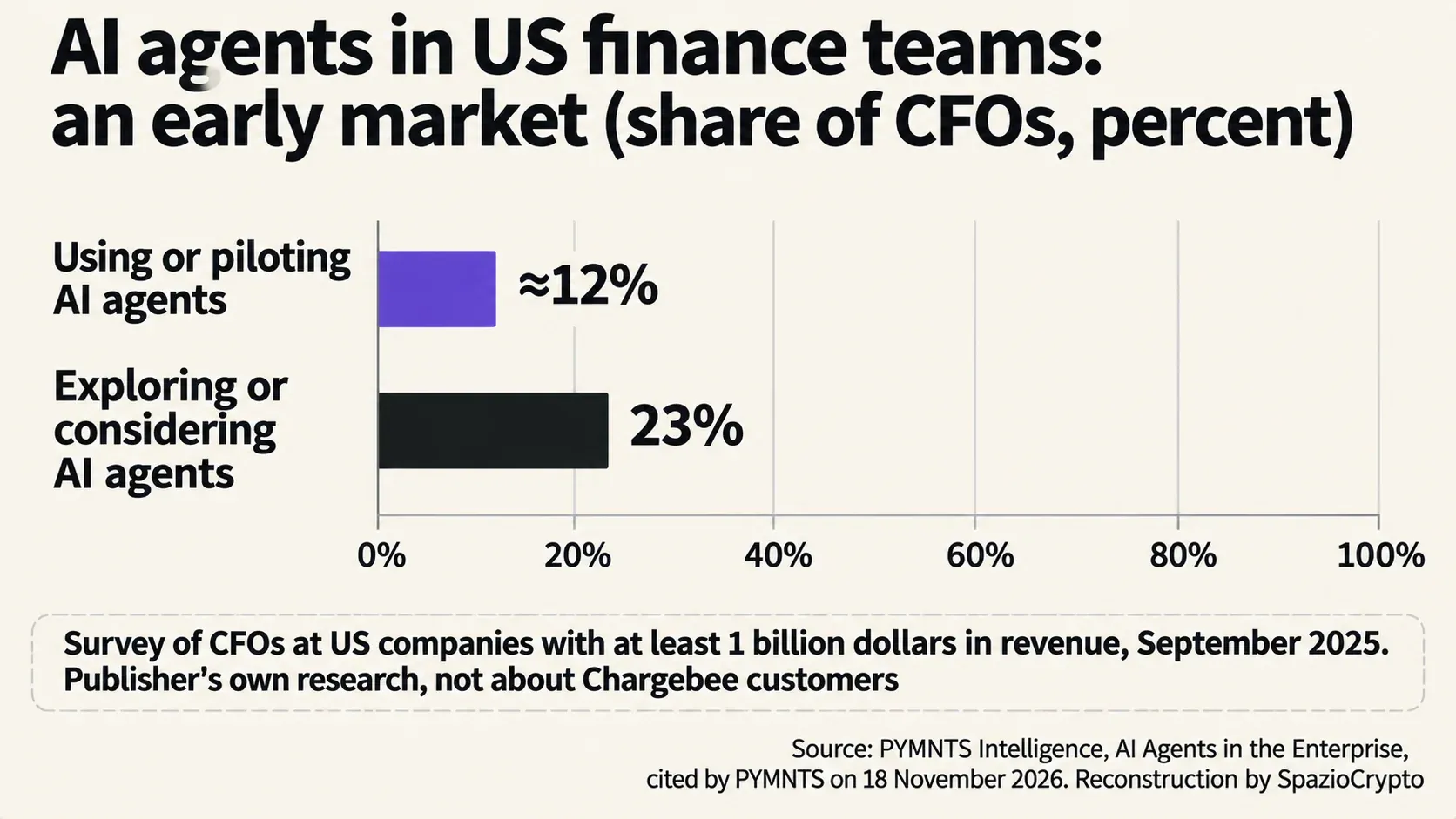
The broader market is still in early stages. According to a PYMNTS Intelligence report from September 2025, based on a sample of CFOs at U.S. companies with at least one billion dollars in annual revenue, roughly 12% were actively using or piloting AI agents, while another 23% were evaluating them. That figure predates the Arc launch by more than a year and comes from the same publisher that covered the announcement.
What This Means for European Businesses
The press release says nothing about availability for European companies. What is confirmed is that Chargebee's existing e-invoicing function covers the Peppol network in select EU countries, according to its own documentation, but the specifics vary by market. Teams in jurisdictions with mandatory structured e-invoicing requirements should verify local compliance independently before treating Arc as a compliant workflow tool.
Our reading, stated as such: the requirement for human sign-off before any irreversible step resembles the human oversight that the EU AI Act demands for high-risk systems. A finance agent operating between businesses doesn't automatically fall into that category, but the structural parallel is worth noting as the regulation matures.
Chargebee Arc at a Glance
What's confirmed, what isn't:
- Confirmed: early access from November 18, 2026; three agents covering contracts, receivables, and revenue recognition; Agent Studio; human-approval drafts before every irreversible step; full action log.
- Not disclosed: pricing, general availability date, underlying AI models, data residency, certifications, autonomy limits, error rates, European availability.
- To watch: technical and privacy documentation, the permissions model, early data on errors and human interventions, and the general availability date.
The Bigger Picture
Our editorial read: a financial agent doesn't just need to show its reasoning. It needs to know when to stop. Granular permissions and a full audit trail of who authorized each action matter more than the conversational interface. The parallel with crypto is direct: whoever holds the keys to a wallet can move the funds, as we explain in the guide on how to open a crypto wallet. The question of who custodies what is the subject of our guide on self-custody, exchanges, and wallets.
The second issue concerns customer-facing messages. If an agent drafts collection notices and payment responses, the authenticity of those communications becomes a security concern, much like the scams that impersonate exchanges and regulators. Major payment operators are meanwhile expanding their scope, as illustrated by the World Money project across 150 countries. The signals to track are the permissions documentation, early error data, and the general availability date.
Sources
Chargebee: press release on GlobeNewswire (November 18, 2026), TRACEABLE event page, and Arc website (not read). Coverage: PYMNTS (November 18, 2026). E-invoicing context: Chargebee e-invoicing documentation and Voxloud customer case.