


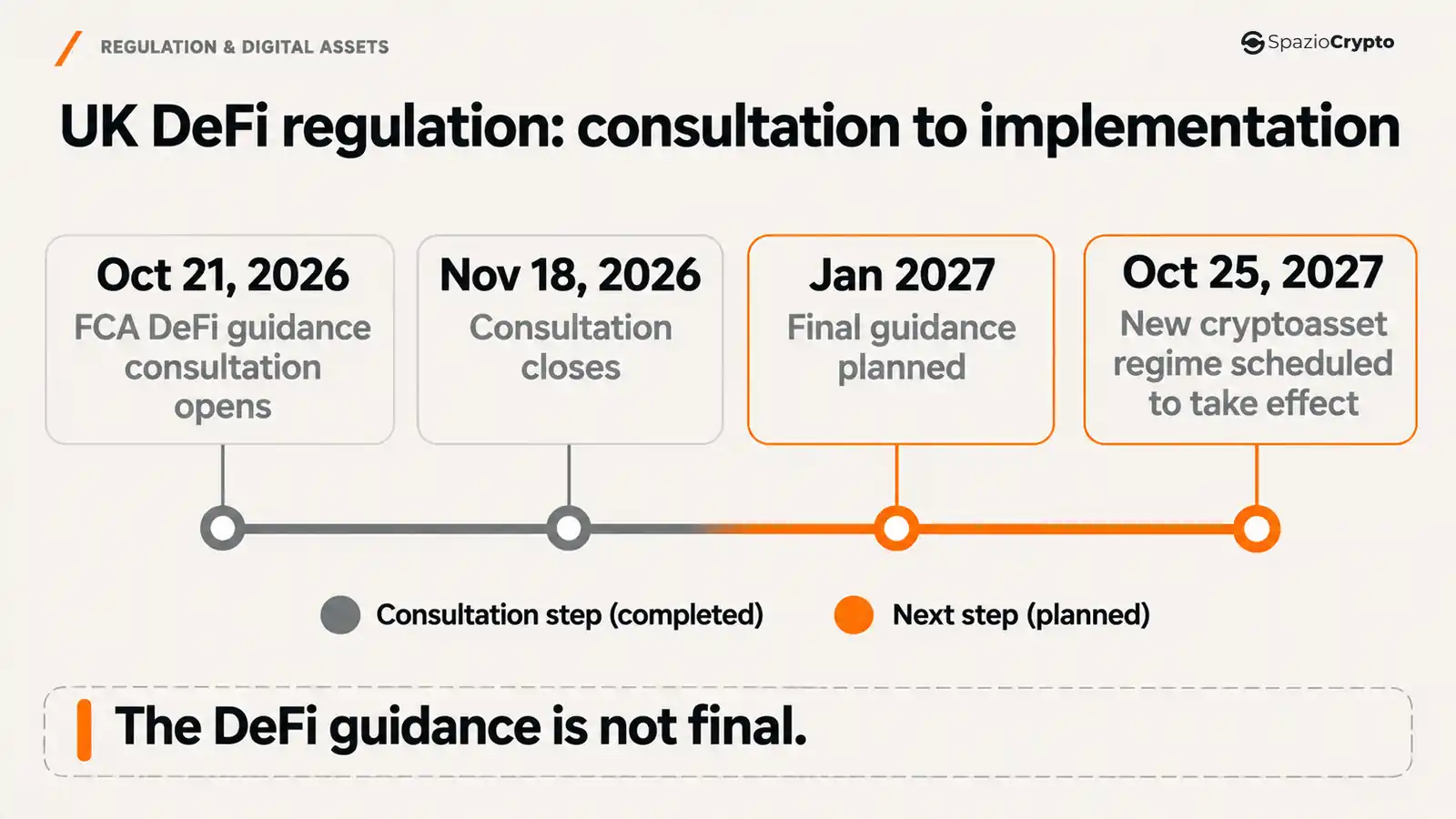
The Financial Conduct Authority is moving toward stricter oversight of DeFi-linked retail activity, according to the Financial Times. Authorized platforms would become the required gateway for UK retail orders, including those involving tokenized equities. The final guidance is expected in January 2027, with the full UK crypto regime launching on October 25, 2027.
The FCA is preparing a more restrictive framework for financial services built on decentralized infrastructure. As reported by the Financial Times on November 26, 2026, the regulator intends to require authorization for firms conducting regulated crypto activities and to route retail DeFi access through licensed intermediaries. If confirmed in its final form, this position could make it significantly harder for UK crypto platforms to send client orders directly to decentralized protocols.
What the FCA Consultation GC26/7 Actually Says
The FT report must be read alongside the FCA's own public documents. Consultation GC26/7, opened on October 21 and closed on November 18, 2026, proposes non-binding guidance within the FCA Handbook for already-regulated firms that use DeFi. The consultation focuses on operational resilience, financial crime controls, and anti-money laundering obligations, not a blanket prohibition on DeFi access. The FCA plans to publish the final version of this guidance in January 2027.
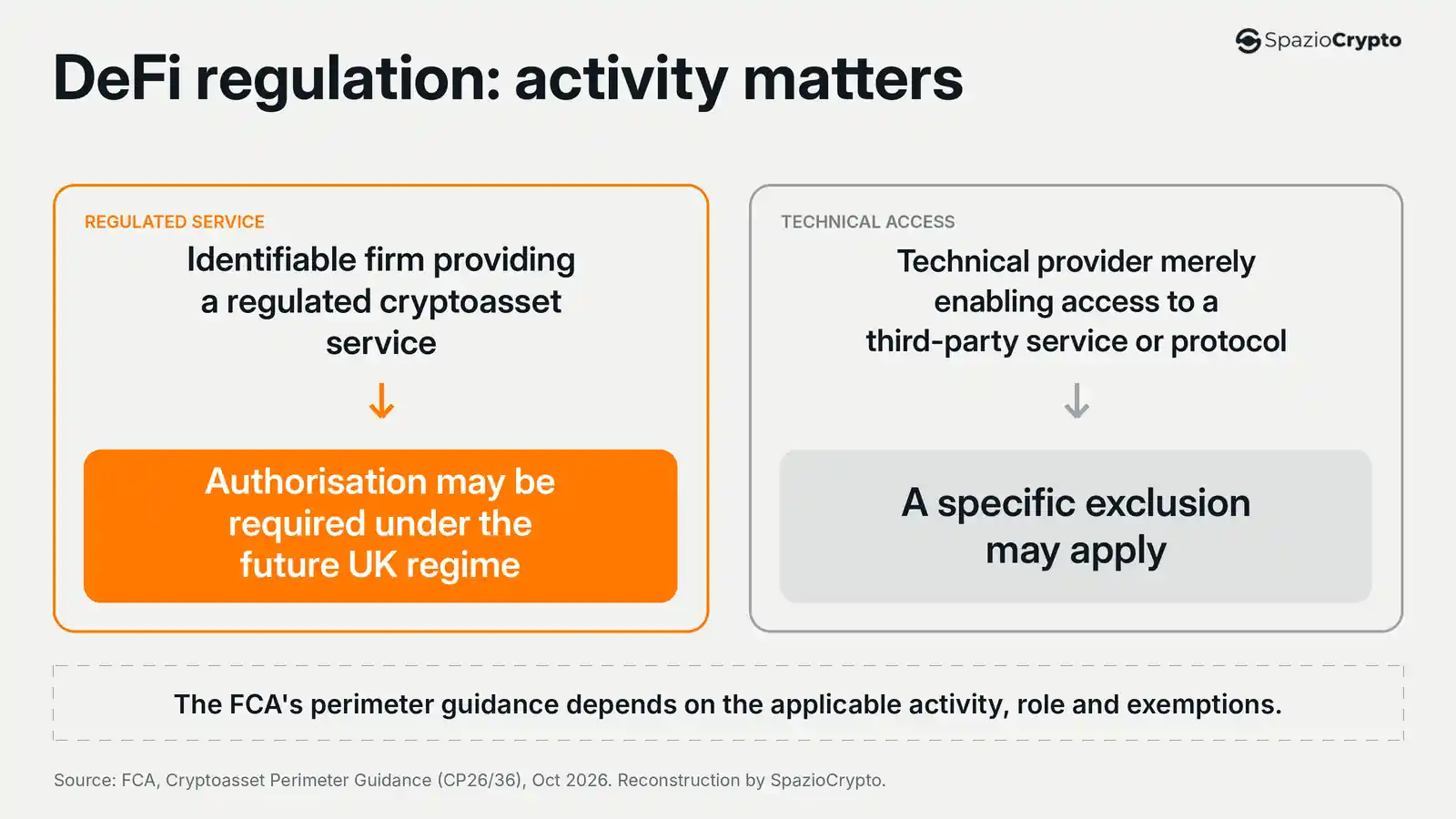
A separate FCA consultation (CP26/36) also proposed clarifications for technical service providers that do no more than enable access to a third-party service or a decentralized protocol. Those providers may fall under specific exclusions from the regulated perimeter, a nuance the broader press coverage has largely overlooked.
Protocol vs. Regulated Activity: Where the Line Falls
Under the proposed UK framework, regulation doesn't hinge solely on whether the underlying software is decentralized. The new perimeter targets crypto activities conducted on behalf of others, carried out by firms operating in the UK, subject to defined exemptions. The critical question becomes: who is actually performing the service, and what role do they play?
Developer, intermediary, platform, or purely technical provider: each classification carries a different regulatory consequence. A protocol's smart contract code doesn't automatically constitute an authorizable entity. Equally, branding an operation as “DeFi” doesn't exempt a commercial activity from oversight when there is an identifiable party managing or offering it. The FCA's position here aligns with the approach it signaled in its September 2026 final perimeter guidance (PS26/18).
Retail Access: The Most Contested Point
The sharpest point of contention, as flagged by the Financial Times, concerns access channels. The FT reports that the FCA wants retail orders on equities, including tokenized shares, to flow exclusively through regulated platforms. The same logic would restrict authorized crypto platforms from routing retail client orders directly toward DeFi services.
This position is not yet law. GC26/7 is a guidance consultation, a proposal of controls firms should consider, not a binding rule. The broader regime governing regulated crypto activities doesn't take effect until October 25, 2027. The actual scope will depend on the final text and how the FCA applies the perimeter across different activity types and market participants.
Consumer Protection vs. Protocol Access
The FCA argues that DeFi use can heighten operational and financial crime risks for both firms and their clients. The proposed framework aims to protect consumers and market integrity. For users, though, the trade-off is real: routing through licensed platforms would reduce direct access to non-intermediated protocols and markets.
That trade-off is still being negotiated. Final guidance arrives in January 2027, and the regime goes live the following autumn. Until those texts are published, the FCA orientation reported by the FT should be treated as a press-reported policy signal, not a definitive restriction on all UK retail crypto users.
For UK-based crypto firms and their compliance teams, the window between now and October 2027 is the operational preparation period. Platforms that currently route retail orders to DeFi protocols need to map their activity against the emerging perimeter, assess whether exclusions apply, and begin engaging with the FCA's authorization process where required. The January 2027 guidance publication will be the clearest indicator yet of where the regulator intends to draw the line.
Sources
- FCA, consultation GC26/7 on DeFi guidance
- FCA, consultation CP26/36 on crypto activity perimeter guidance
- FCA, final crypto perimeter guidance published September 2026
- Financial Times, report on FCA's DeFi approach, November 26, 2026