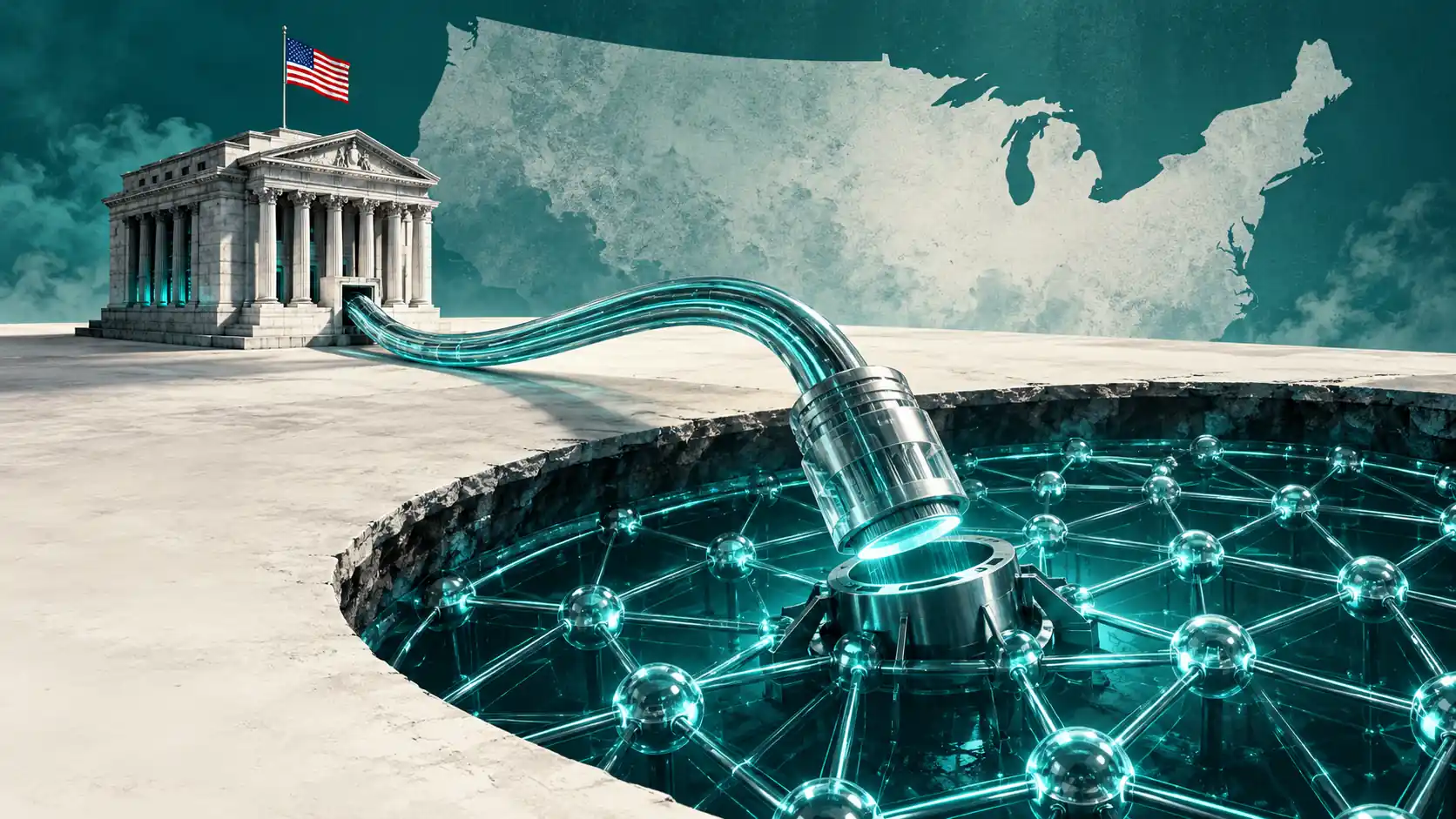


One of crypto's most emblematic products, born deliberately outside the reach of regulation, may be closing in on an official gateway to the world's most important financial market. Hyperliquid, the leading decentralized platform for perpetual futures contracts, is in advanced talks to bring its products to American investors through a regulated structure, leveraging Kraken's parent company, Payward, according to Bloomberg reporting from August 31, 2026. The deal isn't done, and the regulatory green light hasn't arrived. But the architecture being proposed is worth examining carefully, because it touches one of the most contested fault lines in crypto.
How the Deal Would Actually Work
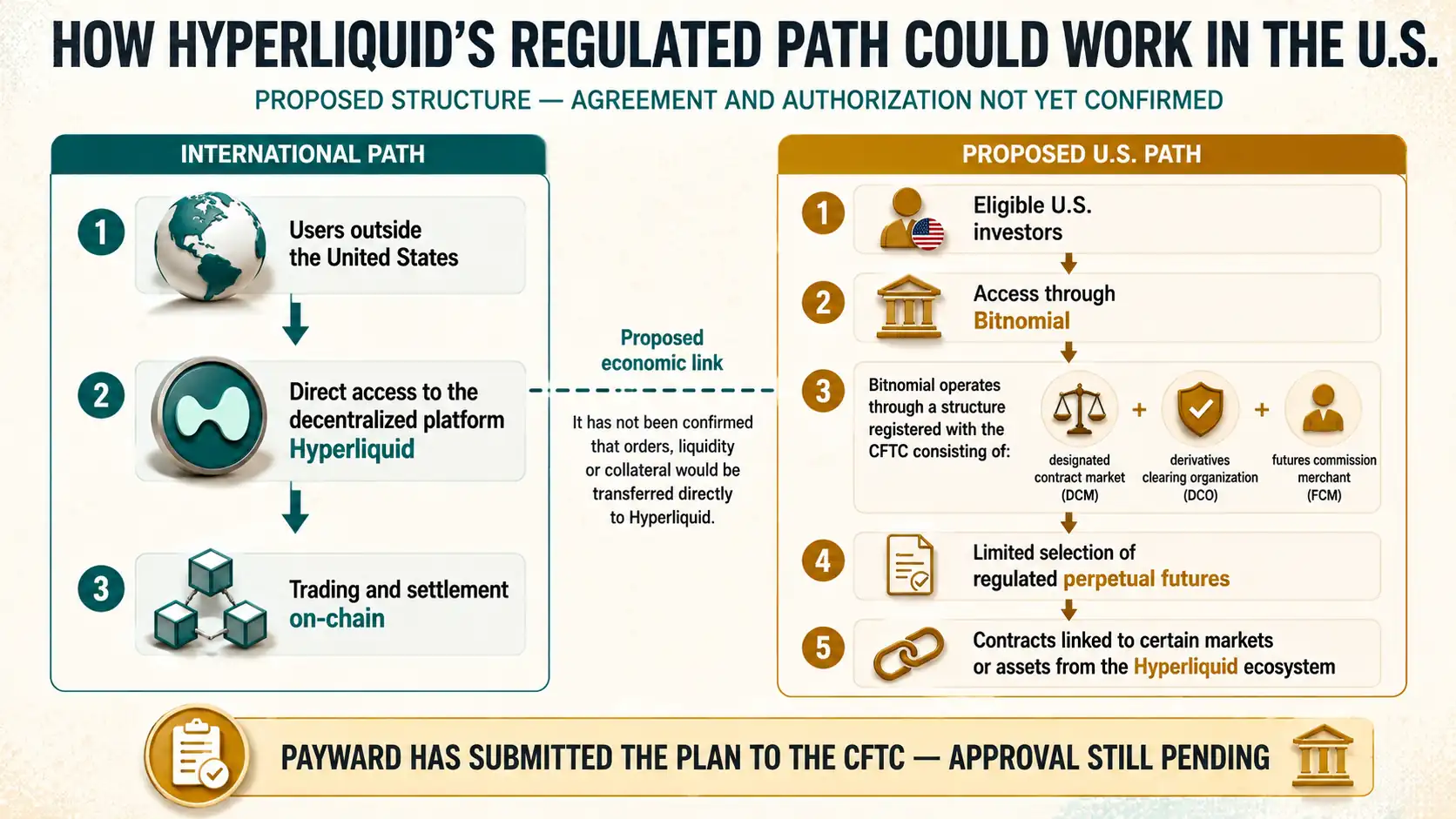
The structure is precise. US investors wouldn't access Hyperliquid's platform directly. Instead, they'd operate through Bitnomial, a fully CFTC-regulated US derivatives exchange that Kraken's parent company, Payward, acquired earlier this year specifically to build out a compliant American infrastructure.
In practice, Bitnomial would offer its registered users a selection of contracts tied to token prices from Hyperliquid's ecosystem, shouldering all compliance and oversight obligations itself. The separation is deliberate: on one side, the original decentralized platform remains accessible to the rest of the world; on the other, a “packaged” regulated version of its products, reserved for Americans and mediated by a licensed entity. Payward has already submitted a draft of this arrangement to the relevant US derivatives regulator, but formal approval has not yet been granted.
Hyperliquid Labs is in advanced talks to bring its perpetual futures to US traders through Kraken's parent company Payward, just weeks after President Trump said his administration was working to bring the fast-growing platform into the US. https://t.co/3TyQg0jgLi
— Bloomberg (@business) August 31, 2026
The Core Problem: Regulating Something Without an Owner
Here's where the story gets genuinely interesting. The reason Hyperliquid has always stayed out of the US isn't strategic reluctance. It's structural. Hyperliquid is a permissionless platform: no central operator, no controlling company capable of registering with US authorities. It's decentralized software that anyone, anywhere, can theoretically access.
That characteristic is a feature in the crypto world and a headache for regulators worried about price manipulation, sanctions evasion, and accountability gaps on a platform with no identifiable responsible party. The proposed structure sidesteps the impossible ask. Rather than forcing a decentralized platform to “centralize” itself to obtain a license, it inserts Bitnomial as a regulated bridge. The intermediary absorbs the legal responsibility, separating the products offered to Americans from the underlying open platform. It's a concrete attempt to answer a question that surfaces whenever regulators confront permissionless protocols: how do you reconcile borderless innovation with national rules? The same tension appeared in the case of Polymarket's regulatory encounters.
A Circle Closing
This news doesn't arrive from nowhere. Weeks before the Bloomberg report, President Trump publicly indicated that US authorities were working to bring Hyperliquid into the country, a political signal we covered in our earlier piece on the CFTC's opening toward the perpetual DEX. Then, it was a statement of intent. Now, with a specific deal structure visible, that intent is taking a concrete shape.
This is one piece of a broader, deliberate push to build a coherent regulatory path for crypto derivatives in the US. The coalition advocating for Hyperliquid's interests has formally asked both the CFTC and the SEC to align their positions and issue clearer rules. That request intersects with the SEC's own proposed new framework for crypto assets and with recent episodes involving the CFTC itself on prediction markets. The pattern is clear: crypto derivatives, long operating in a legal grey zone, are being pulled toward the regulatory light from multiple directions at once.
For a product trading hundreds of billions in volume, perpetual contracts still don't have a settled answer to the most basic question under U.S. law: are they futures, or are they swaps?
, Hyperliquid Research Collective (HRC) (@HyperliquidR) August 24, 2026
One federal judge described the exercise as deciding "whether tetrahedrons belong in… https://t.co/YjpwaV4fwh pic.twitter.com/dOcZtu1Ujq
The Timeline and the Unknowns
Realism is warranted here. Even if talks succeed, the path to actual operations is long. A former US regulatory official familiar with the process estimated that a full approval could take ten to twelve months, and that's in the optimistic scenario where nothing stalls.
The complexity stems from the fact that the arrangement touches both securities law and derivatives law, potentially requiring sign-off from two separate regulators: the SEC and the CFTC. Both would need to revisit their interpretations on thorny issues like custody of client funds in a hybrid decentralized-centralized model. The direction may be set, but the destination is not close. Anyone expecting to trade these products from a US account in the near term should recalibrate expectations. As with most regulatory processes at this complexity level, the gap between a reported negotiation and an operational product can span years, not months, and outcomes are never guaranteed.
The Bigger Picture
Whatever happens with this specific deal, the episode illustrates a broader trend reshaping the entire sector: the systematic effort to build bridges between decentralized finance, which grew up without borders or gatekeepers, and the traditional regulated financial system. The model being explored here, a licensed intermediary acting as a conduit to a decentralized platform, could become a replicable template for bringing other “wild” crypto products inside the regulatory perimeter.
Two lessons emerge. First, the progressive institutionalization of an asset class once considered purely peripheral: perpetual futures, products that were born and scaled outside any regulatory framework, are now knocking on the front door of the US financial system. Second, this episode shows that when an innovation reaches sufficient scale, regulators don't simply block it. They find ways to absorb and adapt it, usually through ingenious structures that preserve the product's core mechanics while fitting it into existing rules. Whether this deal closes or not, the direction is clear. The future of finance will be decided increasingly on the boundary where technological openness meets regulatory necessity. Reading these structural moves early is one of the clearest edges available to investors and market participants today.