


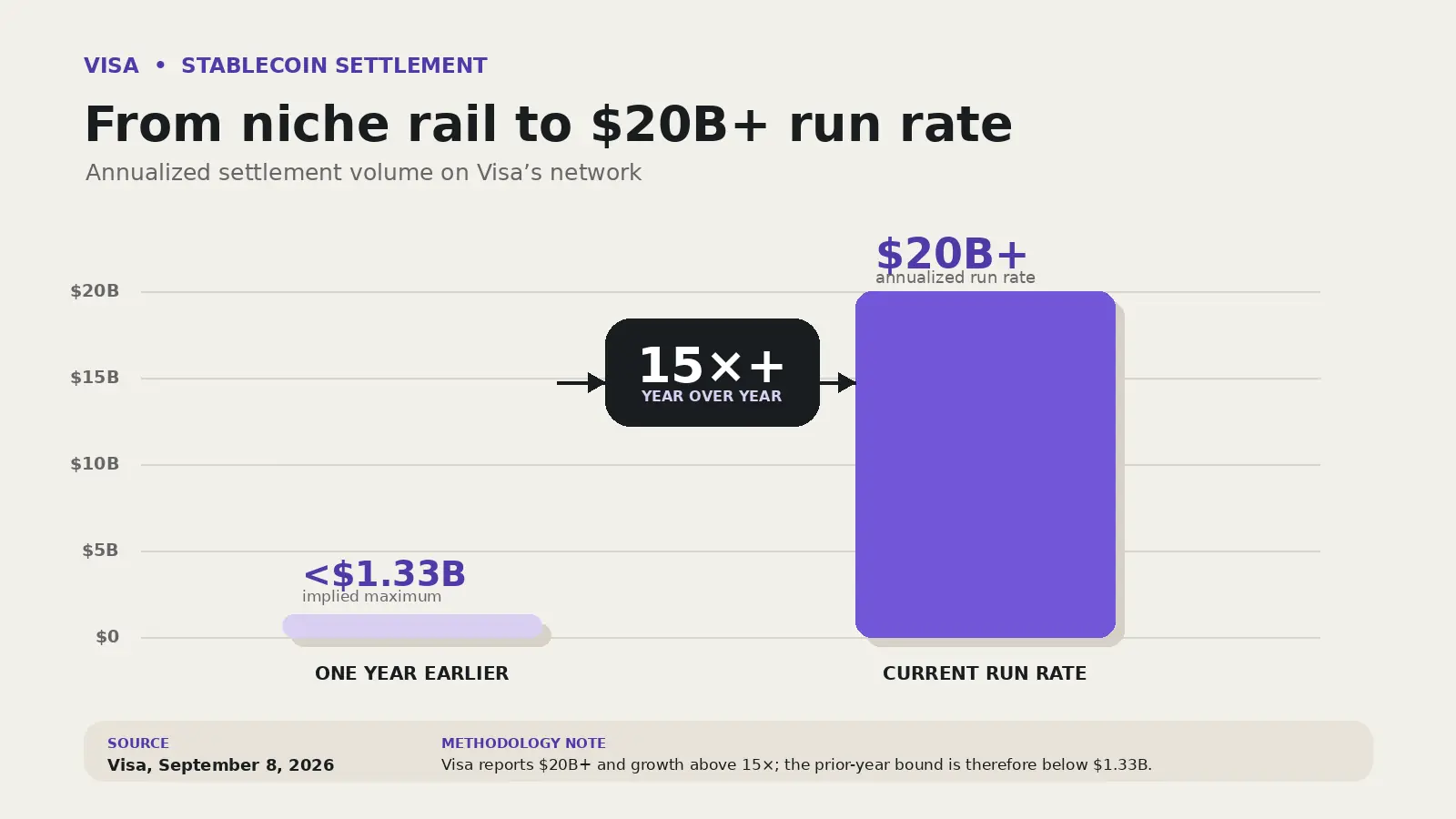
Visa, the payments giant whose card sits in millions of wallets, has just made a move that deserves attention well beyond the crypto world. The company announced a new model linking its transaction settlement data to credit issued directly on the blockchain, designed to fund stablecoin-linked card programs. The scale of the shift is visible in the numbers: according to Visa, stablecoin settlement volume on the Visa network has surpassed an annualized run rate of over $20 billion, more than fifteen times the level of a year ago. Visa’s on-chain lending is now entering the real economy of everyday payments.
But the volume figure, impressive as it is, isn’t the most interesting part of this story. What Visa is actually trying to solve is the genuinely important part: not a new way to speculate, but a concrete and age-old problem in commerce, working capital. Here’s what’s happening and why it matters.
The Problem Visa Wants to Solve
To understand what’s at stake, start with a very practical pain point that afflicts fintech companies running payment card programs, including those tied to stablecoins. Every day, these companies must front the money to settle their customers’ transactions before the corresponding funds actually arrive. It’s a classic short-term liquidity crunch: capital is needed immediately, while receipts land with a delay. For smaller or fast-growing companies, accessing that capital through traditional financing channels can be slow and bureaucratic. Often requires an operating track record these firms simply don’t have yet.


This is where Visa’s idea comes in. On-chain credit markets already exist and have grown enormously. According to data from Visa’s own Onchain Analytics Dashboard, since 2020 more than $694 billion in stablecoin-denominated loans have been issued through decentralized protocols, creating a credit market that runs around the clock. The problem is that this vast pool of liquidity has remained almost entirely confined inside crypto markets, without meaningfully touching the businesses and payments people use day to day. Visa wants to be the bridge that carries this capital beyond that fence. The theme connects to the broader trend of stablecoins becoming invisible payment rails for end users.


Rubail Birwadker, Global Head of Growth Products and Partnerships at Visa:
“Trusted payment data and onchain technologies can work together to unlock new forms of liquidity.”
How It Works, With Real Examples
The concrete mechanism is built on a partnership with specialized financing firms. The model combines VisaNet transaction settlement data with information recorded directly on the blockchain, producing a reliable, real-time picture of how a given payment program is performing. On the basis of that data, and with customer consent, a smart contract automates the entire process: it disburses the financing, manages collateral, and organizes repayment, all without lengthy manual paperwork.
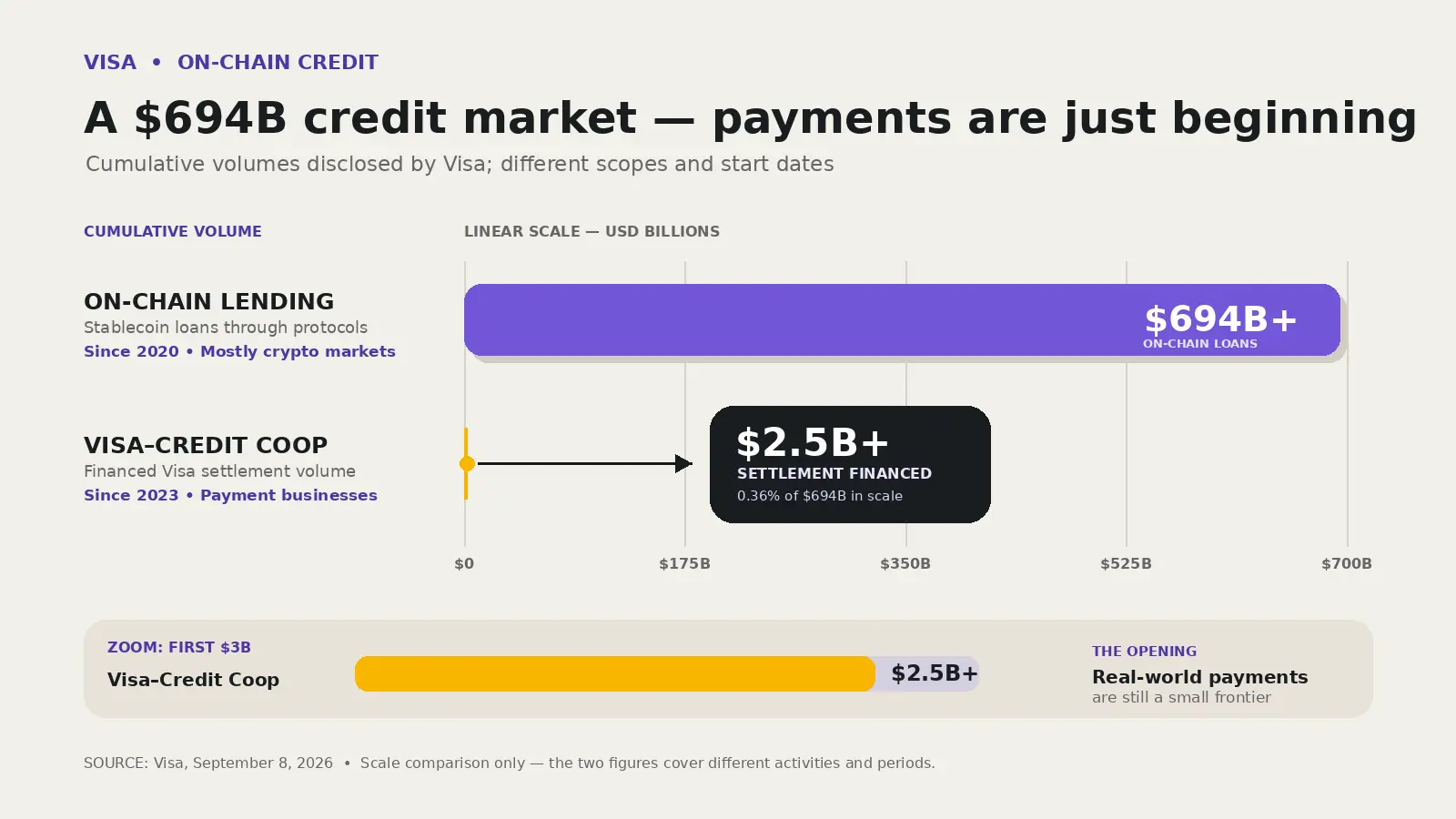
The early results are striking. According to Visa, the model has already financed over $2.5 billion in settlement volume since 2023, with zero defaults among participating firms. Two concrete cases illustrate how it works in practice. One payments company has used this mechanism since 2023 to fund its daily settlements, moving roughly $2 billion through thousands of automated on-chain lending and repayment transactions, again with no defaults. A second company, focused on travel cards, used this type of financing as part of its market launch, raising significant capital from prominent institutional investors. A further sign of the system’s maturity: as more lenders have entered the mechanism, the cost of credit for participating companies has fallen by around 30%.
Visa and On-Chain Credit: The Numbers
The infrastructure in figures. Source: Visa, 2026
- Stablecoin settlement: over $20 billion annualized, fifteen times higher than a year ago.
- Credit financed: over $2.5 billion since 2023, zero defaults among participants.
- Active programs: over 160 stablecoin card programs, with payment volumes nearly tripling.
Why This Is a Real Convergence Signal, Not Hype
This is the detail that separates this announcement from the wave of breathless headlines the sector routinely produces. The distinction matters: this is not a case of decentralized finance used for purely speculative ends, like borrowing one crypto asset to bet on another. It is the use of on-chain credit to fund a concrete, traditional economic activity, the kind that happens every time someone swipes a card.


That distinction is precisely what makes Visa's initiative a genuine signal of convergence between decentralized finance and traditional financial infrastructure, not a marketing experiment. A payments giant with decades of history is deploying blockchain tools, including smart contracts and on-chain data transparency, to solve a substantive problem affecting thousands of real businesses. The same underlying logic appeared when a consortium of major European banks chose a public blockchain for their digital euro, as SpazioCrypto reported in its coverage of the Qivalis stablecoin project involving UniCredit, Intesa, BPER, and Banca Sella: established institutions no longer fear public infrastructure; they are learning to exploit it.
The technical rationale comes directly from Chris Walker, founder and CEO of Credit Coop, who explained the structural reason the model can work:
“Payment companies have always had good collateral in their settlement receivables.”
The Bigger Picture
Visa's move tells a broader story about where genuine innovation in digital payments is heading. For years, decentralized finance was viewed mainly as a playground for sophisticated investors and traders, a self-referential parallel world largely disconnected from the real economy. This initiative suggests its actual utility may surface precisely when its tools, data transparency, smart-contract automation, round-the-clock operability, get applied to concrete everyday problems like working-capital financing.
Two lessons emerge for anyone watching the space. First, this case illustrates what crypto “adoption” can realistically mean: not millions of retail buyers accumulating tokens, but underlying infrastructure quietly embedded into the processes of companies the scale of Visa, improving efficiency in ways the end user never notices. Second, cases like Rain and Karta sketch a replicable path for other fintechs, opening a payment-data-driven credit market that could scale quickly over the coming years. The broader point is straightforward: the blockchain's real transformation of traditional finance may not arrive through loud announcements, but through these quiet technical steps, capable of making a business problem as old as commerce itself cheaper and more efficient to solve. For a grounding in the instruments at the centre of this shift, our guide on what stablecoins are remains a useful starting point.