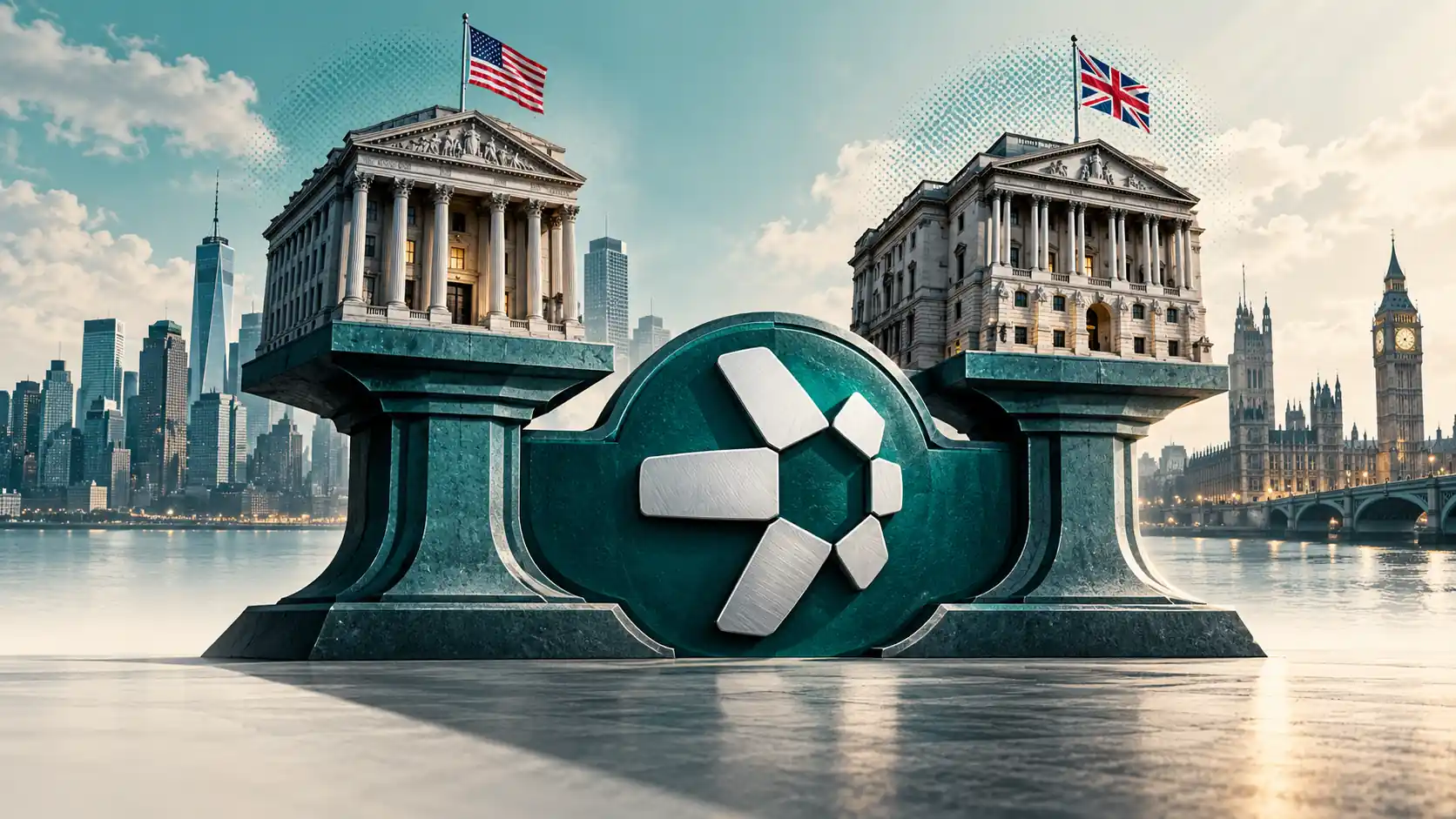
Imagine buying Apple or Nvidia shares not through your bank or a traditional broker, but directly on a blockchain, holding them in your own digital wallet and using them around the clock inside decentralized finance applications. That's exactly what Coinbase, one of the world's largest crypto exchanges, has just made possible by launching tokenized versions of shares in four major tech giants on its Base blockchain.
This is a meaningful step in the tokenization story: no longer just government bonds and Treasuries, but the equity of the world's most valuable companies landing inside the crypto ecosystem. Behind the excitement, though, sits a question every investor should ask before buying: do you actually own an Apple share when you buy one of these tokens? The answer, as we'll see, is more layered than the announcement suggests.

What Coinbase Actually Launched
Start with the facts. Coinbase has made four tokenized stocks available on its Base blockchain, tracking the value of Apple, Nvidia, Meta, and Alphabet, the parent company of Google. These tokens can be purchased, held in a personal wallet, and used freely across decentralized finance applications. In theory, an investor could post them as collateral for a crypto loan, swap them on a decentralized exchange, or deploy them in other on-chain strategies.
Coinbase states that each token is backed by a real share, held on a one-to-one basis by a regulated custodian, in a structure designed to protect assets in the event of company difficulties. One regulatory constraint is worth noting immediately: these products are restricted to eligible investors outside the United States. To make the whole system work, Coinbase also created a new technical standard called B20, which adds compliance controls and event-handling features (such as stock splits) on top of a standard token.
 Base
Base
Do You Actually Own the Stock?
Here's the question that separates enthusiasm from real understanding. Buying one of these tokens does not mean buying an Apple share issued by Apple and magically converted into a digital token. The structure, as analysts who reviewed the documentation have noted, is more layered and deserves careful reading before any investment.
Here's how it works in practice. A special purpose vehicle (SPV) created by Coinbase and domiciled in Abu Dhabi buys the underlying shares and holds them in custody. Against those shares, the SPV issues tokens on the blockchain. The token buyer does not directly own the share; instead, they hold an “economic interest” in it, a right tied to the value of the share held by that intermediate entity. It's a subtle but material difference: the soundness of the investment depends not only on Apple's performance, but also on the reliability of this intermediate structure.
One concrete detail makes the gap tangible. According to the official documentation, dividends that the underlying share would pay are not necessarily distributed in cash to the token holder in the same way a traditional shareholder would receive them. Price exposure is there, but the bundle of rights is not identical to owning the “classic” share.
Tokenized Stocks on Base: Key Points
What investors need to know. Source: Base, Galaxy Research, 2026
- What: Apple, Nvidia, Meta, and Alphabet tokenized on Base, usable in DeFi 24 hours a day.
- How: Real shares held 1:1 by a regulated custodian; tokens issued under the new B20 standard.
- Watch out: The token is an economic interest through an SPV, not a classic share. The rights differ in important ways.
The Real Leap: Stocks Enter DeFi
Beyond the legal structure, what makes this genuinely significant is where these tokenized stocks end up: inside decentralized finance. Until recently, tokenization focused mainly on government bonds and investment-grade debt, instruments considered safer and more institutional. Bringing the volatile, high-profile equities of major tech companies on-chain, and making them composable inside dozens of DeFi applications, is a bolder and qualitatively different move.
In practice, an investor could in theory deposit tokenized Nvidia shares as collateral to borrow stablecoins, or provide them as liquidity on a decentralized exchange to earn trading fees. Stocks stop being a “static” asset held at a broker and become a composable building block inside the crypto ecosystem. Proportionality matters here, though: in the first days of trading, volumes remained modest, according to Base's own blog post, a fraction of overall DeFi activity. This is a beginning, a potential rather than a completed revolution. The development fits within the broader real-world asset (RWA) tokenization movement that has already produced examples in European markets, including tokenized bond issuances settled in central bank money.
The Bigger Picture
Coinbase's tokenized stock launch is a meaningful milestone in the long convergence of traditional finance and crypto. The idea of trading shares in the world's most valuable companies on a blockchain, without market opening hours, with the ability to plug them into new financial services, is powerful. It points in a clear direction: a more open, continuous, and programmable financial system.
For any investor, the lesson is twofold. The opportunity is real: tokenization promises to make access to financial markets more democratic, more efficient, and geographically unrestricted. But awareness is equally indispensable. Behind the convenience of a token that tracks a stock price lies a complex legal and financial structure that deserves thorough due diligence. Knowing exactly what you own, what rights you hold, and what risks you carry, from the SPV's reliability to dividend treatment, is the difference between an informed position and a blind leap. Tokenized equities are likely one of the defining themes of the next several years in finance. As with every new instrument in this space, the rule holds: before you buy something, understand precisely what you're buying.