


On October 20, 2026, FINMA authorized Switzerland's first Bitcoin ETF open to retail investors, a publicly traded fund that invests directly in Bitcoin. This is a live regulatory decision, not a project under consideration. The Swiss regulator frames it as a step toward giving non-professional investors access to a Swiss-law fund with direct Bitcoin exposure, while attaching strict requirements on custody, transparency, and risk disclosure.
FINMA's official announcement does not identify the manager, ticker, listing venue, or trading start date. Authorization and commercial availability are two separate milestones. Without the fund's full documentation, fees, initial assets under management, and precise replication details beyond the regulator's stated direct investment remain unknown.
TL;DR: FINMA approved Switzerland's first public Bitcoin spot ETF on October 20, 2026, granting a diversification waiver under Swiss fund law. The manager, ticker, and trading date have not been disclosed.
What Was Actually Authorized
FINMA explicitly describes a publicly traded fund that invests directly in Bitcoin. Under Swiss law, the product belongs to the category of “other funds for alternative investments,” a classification the regulator flags as carrying particular risk. That framing matters: the green light does not turn Bitcoin into a low-risk instrument, and it does not equate the product to an ordinary diversified equity or bond fund.
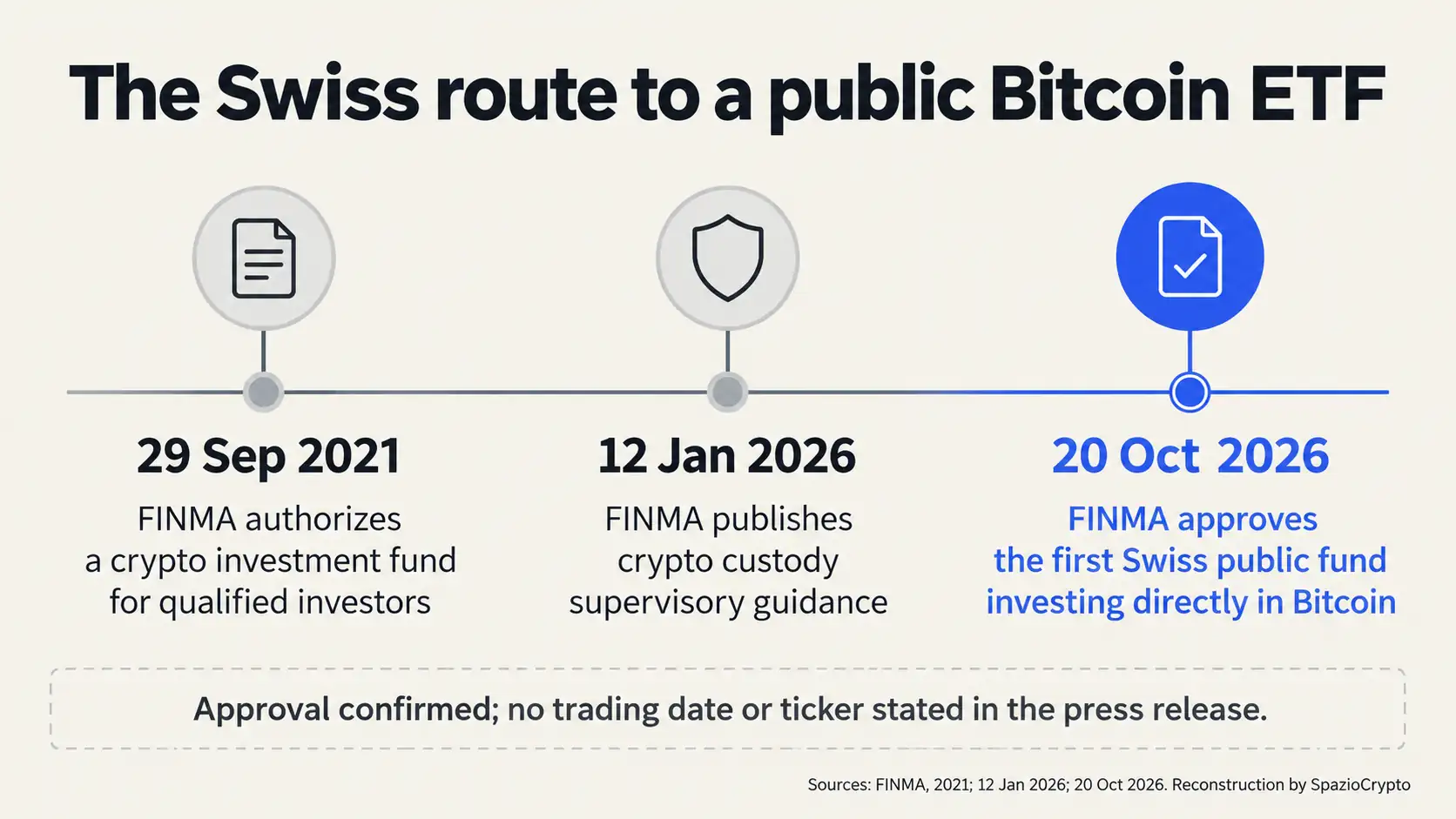
The key novelty is the investor base the fund can target. In September 2021, FINMA had already authorized a Swiss fund reserved for qualified investors invested primarily in a basket of cryptocurrencies. That precedent was not a single-asset spot ETF open to the general public. The October 20 decision therefore expands a specific regulatory possibility without erasing the distinctions between fund categories.
The word “first” should be read within this perimeter: the first Swiss public exchange-traded fund investing directly in Bitcoin approved by FINMA. It doesn't mean the first listed product in the world, nor the first Bitcoin-linked financial instrument available in Switzerland. The Swiss market has long hosted other structures, including ETPs, whose legal form and investor protections can differ materially.
Why a Diversification Waiver Was Needed
A fund concentrating entirely on Bitcoin hits an obvious structural problem: there is only one underlying asset. Standard rules on risk diversification were not designed to accommodate that kind of concentration. In its announcement, FINMA specified it granted a waiver from the applicable diversification rules, citing Bitcoin's relatively long trading history and its high trading volume compared to other cryptocurrencies.
That step is not a statement about price safety. It means the regulator permitted a particular investment structure, subject to conditions and risks that must be clearly explained to investors. A liquid market does not prevent sharp price swings, losses during stress periods, or gaps between the purchase price and the fund's net asset value.
FINMA reiterates that capital can lose a considerable portion of its value even when an investor accesses Bitcoin through an authorized ETF. The diversification waiver allows the product to exist in its approved form. It does not reduce the concentrated risk exposure to Bitcoin.
Custody: The Decisive Infrastructure Question
Direct Bitcoin investment requires infrastructure capable of securely holding the underlying asset. In its October 20 decision, FINMA referenced its supervisory communication of January 12, 2026, dedicated to the custody of crypto assets. That document distinguishes technological risks (private key compromise, cyberattacks) from legal risks tied to the depositary and potential insolvency.
For Swiss collective investment schemes, custody of assets is in principle assigned to a Swiss depositary bank. Delegation to a third party is possible within defined supervisory and asset-protection conditions. FINMA specifically calls for adequate safeguards in the event of custodian insolvency and careful assessment of any offshore custody arrangements.
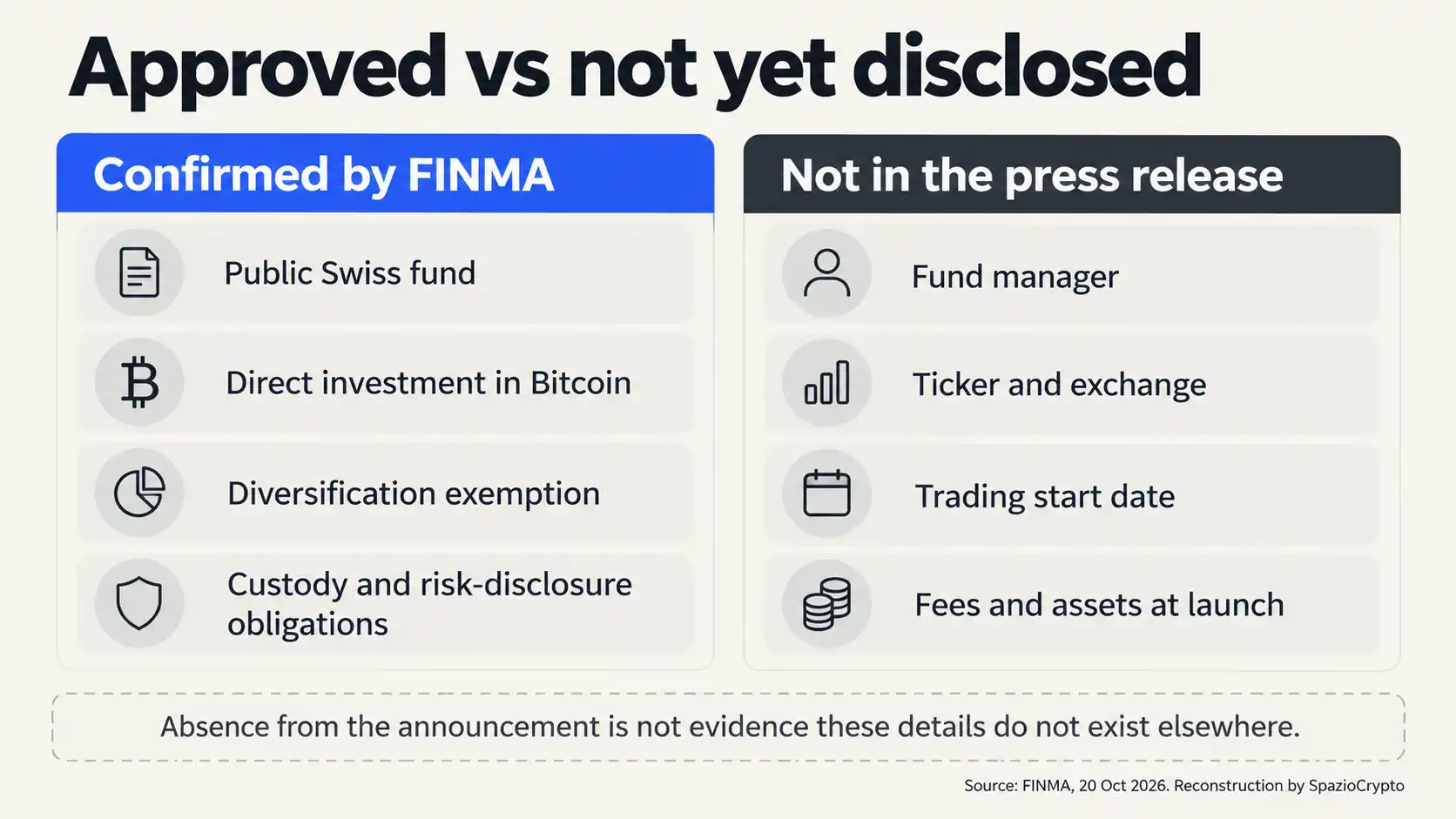
It would be incorrect to infer from the announcement that the new ETF uses a specific depositary or a particular technical custody model. Those elements require the prospectus and the fund's definitive documentation. Regulated custody reduces certain operational and legal risks, but it does not neutralize Bitcoin's price volatility.
What Retail Distribution Obligations Apply
FINMA insists on the conduct-of-business rules under the Swiss Financial Services Act (FinSA). Intermediaries distributing crypto-linked instruments must provide clear, understandable information about volatility, loss risks, and product characteristics. Where required, they must also verify the appropriateness or suitability of the product relative to the individual client.
This investor protection sits upstream of the transaction itself. The goal is to prevent the familiar “ETF” label from causing investors to underestimate the risk profile of the underlying. A fund can streamline how an investor gains Bitcoin exposure, but it doesn't make returns predictable, and it doesn't automatically shield capital from a market downturn.
The fund's product documentation will therefore be decisive. It will reveal how much holding shares costs, how net asset value is calculated, which custody risks are flagged, and which parties carry operational responsibility. The official FINMA announcement confirms the approval of the fund category and the first fund; it does not set out the full commercial terms.
ETF, ETP, ETN: Why the Distinctions Matter
In European financial debate, the acronyms ETF, ETP, and ETN are often used interchangeably. They're not the same thing. An ETF is a fund; an ETN can be a debt security whose return depends on an underlying asset, carrying risk tied to both the structure and the issuer. The FINMA announcement concerns a Swiss fund. It does not license the use of the label “ETF” for any certificate or note listed on Bitcoin.
The distinction is concrete in products already on the market. SpazioCrypto has covered the Bitcoin and Ether ETNs distributed to French retail clients by BNP Paribas and the five crypto ETPs that reached Borsa Italiana through Bitwise. Both are examples of financial access to crypto assets, but each product's structure must be analyzed separately.
Our guide on leveraged 2x and 3x crypto ETFs also shows why understanding product structure and replication method matters at least as much as knowing the underlying. The new FINMA fund is not described as a leveraged instrument and should not be conflated with products that carry leverage.
What We Know and What Remains Open
Confirmed: FINMA approved, on October 20, 2026, Switzerland's first publicly available ETF investing directly in Bitcoin, granting a waiver from applicable diversification requirements and attaching custody, conduct, and transparency safeguards.
Not disclosed: fund name, issuer or manager, ticker, listing exchange, trading start date, fees, and initial assets under management. The announcement also does not document whether the fund will be marketed in the EU, including in markets such as Germany, France, or the UK.
To watch: prospectus publication, identification of the depositary bank, actual trading mechanics, and the content of investor risk warnings.
The Broader Picture
The Swiss decision marks a clear distinction between access and protection. A regulator can authorize a public fund concentrated on Bitcoin when it deems the required safeguards adequate, but it must make explicit that the asset remains volatile and that losses can be severe. That is the central nuance of FINMA's October 20 announcement, and it contrasts with the looser disclosure environment that preceded the SEC's U.S. spot Bitcoin ETF approvals in January 2024.
The next verifiable development won't be a Bitcoin price forecast. It will be the publication of the fund documents, which will allow a proper judgment of whether the operational conditions match the scope of the authorization. Until then, this news concerns an important but narrowly defined regulatory approval, not an ETF already available for purchase anywhere in the world.
Sources
- FINMA, official press release, October 20, 2026.
- FINMA, Supervisory Communication 01/2026, Custody of Crypto Assets, January 12, 2026.
- FINMA, prior authorization of a crypto fund for qualified investors, September 29, 2021.