

Ripple Prime, Ripple's prime brokerage division, is moving into a business that Wall Street has long reserved for major banks and established brokers: financing leveraged ETFs through swap agreements. On October 6, Ripple announced an expanded partnership with Brevan Howard, an alternative asset manager with roughly $35 billion in assets under management, to which it will provide multi-asset prime brokerage, clearing, and financing services. On October 7, the Wall Street Journal reported that Ripple is becoming a meaningful player specifically in swap-based financing for leveraged ETFs. This is a story about balance sheets and financial intermediation, not blockchain: nothing in the sources reviewed demonstrates that these operations are settled in XRP, RLUSD, or on-chain.
What Ripple Announced on October 6
According to Ripple's October 6 press release, Ripple Prime will provide Brevan Howard funds with multi-asset prime brokerage, clearing, and financing services across traditional and digital markets. The announcement does not list the asset classes covered, nor does it specify volumes, fees, or a start date. Brevan Howard manages approximately $35 billion in assets for institutional investors, employs around one thousand people, and maintains offices from London and New York to Geneva, Singapore, and Tokyo.
The relationship between the two firms didn't start here. Brevan Howard-affiliated funds participated in Ripple's $500 million strategic funding round announced on November 5, 2025, which valued Ripple at $40 billion and was led by Fortress and Citadel Securities-affiliated funds, according to Fortune. Noel Kimmel, President of Ripple Prime, described the deal as a “long-term commitment to shared success”; Alan McGroarty, Group COO of Brevan Howard, said he expects the platform to deliver “greater operational simplicity” and improved capital efficiency for investment teams. These are stated expectations, not measured results.
 Team Ripple
What the Wall Street Journal Adds
In its October 7 article, “Ripple, Crypto's Payments Giant, Breaks Into Wall Street,” the Journal reports that Ripple Prime is financing leveraged ETFs through swap agreements that have historically been dominated by major banks and brokers. For readers unfamiliar with the mechanics: a leveraged ETF targets two or three times the daily return of a stock or index and, rather than buying all the underlying shares outright, typically enters a total return swap with a counterparty, which guarantees that exposure in exchange for a financing fee and then hedges on the open market. In this structure, Ripple Prime acts as the financing counterparty, not as the fund issuer or manager.
The specific fund cited in reporting is the Tradr 2X Long SNDK Daily ETF, which targets twice the daily return of Sandisk shares. According to a regulatory filing from the fund cited by Blockonomi, the fund pays Ripple the overnight bank financing rate plus 4 percentage points, roughly 8% per year of assets: a cost borne by investors, separate from the management fee. This should be read as one example, not as a market-wide benchmark rate.
The broader market framing comes from Morningstar Direct, as cited by Blockonomi: there are 593 leveraged ETFs in the United States with more than $256 billion in assets, 426 of which are single-stock products. That figure represents fund assets, not the size of the swap financing market itself, and it says nothing about Ripple's share. Among non-bank competitors, reporting names Jane Street and Clear Street. CoinGape notes that tighter capital and risk requirements on banks have opened the door for non-bank operators. Nate Geraci, host of ETF Prime, wrote on X that this is a profitable business “if you're equipped to manage it and its risks.”
Leveraged ETFs carry a specific risk profile worth understanding: they recalibrate exposure daily, so over multiple sessions the realized return can diverge materially from the stated multiple. SpazioCrypto has covered this dynamic in the context of the SEC-approved 3x ETP products on Bitcoin and Ethereum and the GraniteShares 3x XRP ETF, which rely on swaps and futures. Nothing in the sources reviewed establishes any link between those funds and Ripple Prime.
From Hidden Road to Ripple Prime: How It Got Here
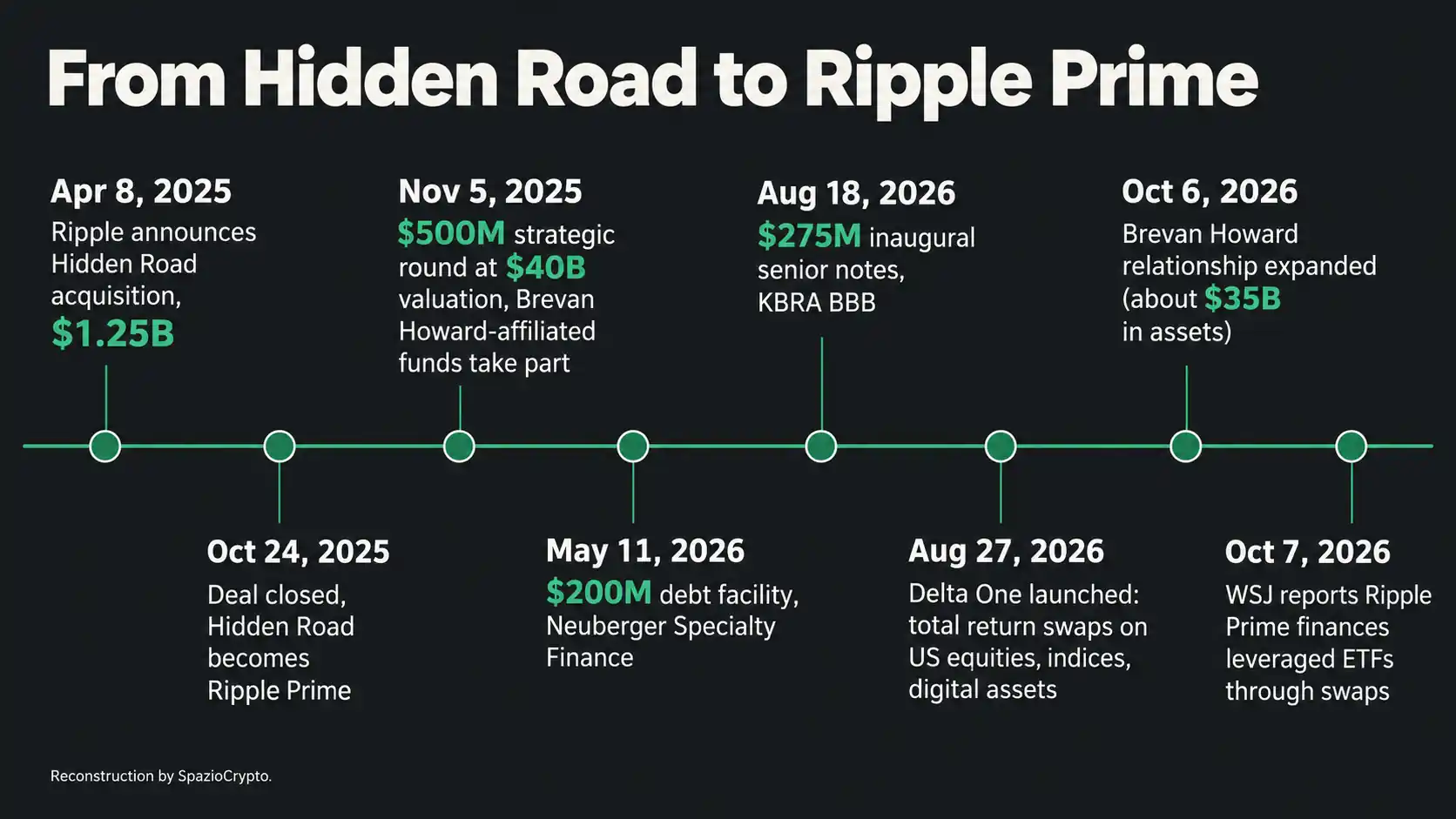
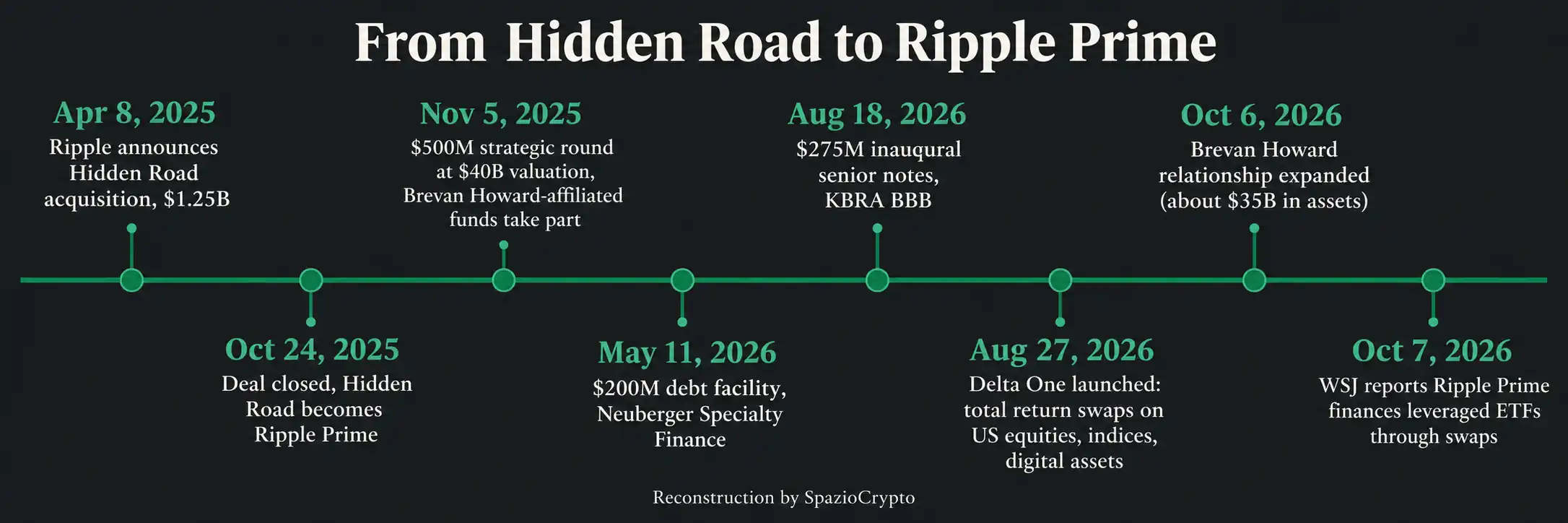
The foundation is Ripple's acquisition of Hidden Road, announced on April 8, 2025, for $1.25 billion. Hidden Road was a non-bank prime broker that, according to the deal announcement, cleared more than $3 trillion per year for over 300 institutional clients. Ripple confirmed the deal closed on October 24, 2025, rebranded the firm as Ripple Prime, and stated that the business had already tripled since the announcement. The capital build-out followed: a $200 million debt facility with Neuberger Specialty Finance (May 11, 2026), a $275 million private placement of senior notes carrying a BBB rating from KBRA (August 18), and on August 27 the launch of Delta One, the business line enabling total return swaps on U.S.-listed equities, indices, and digital assets. Ripple reports that Ripple Prime now holds more than $1 billion in net regulatory capital.
Delta One is the piece that makes the leveraged ETF swap story plausible, but neither Ripple nor any of the sources explicitly confirm that the ETF financing contracts flow through that business line specifically. That reading is editorial inference, not a stated fact. Ripple reports that Ripple Prime revenues have tripled year-over-year since the acquisition, a self-declared figure without absolute numbers, and no source quantifies the leveraged ETF contribution specifically. Kimmel reportedly described ETF financing as a “growing and significant part” of the business, according to Blockonomi, which does not clarify whether the quote originates from the Wall Street Journal.
What Remains Unproven
The most clickable narrative, the one the data simply don't support, is a direct link to XRP. The Brevan Howard press release mentions XRP and RLUSD only in the company overview and says nothing about on-chain settlement. Cryptonews noted that the agreement doesn't specify whether the funds actually use those assets, while crypto.news and Blockonomi clarified that the leveraged ETF financing operations don't appear tied to XRP or RLUSD. The connection exists in Ripple's stated strategy, not in these specific deals: in April 2025 the company said Hidden Road's post-trade activity would migrate to the XRP Ledger, and in October 2025 it confirmed that RLUSD was already being used as collateral for certain prime brokerage products, with some derivatives clients holding stablecoin balances.
Where Ripple has actually delivered on-chain settlement, we covered it in the May pilot with Ondo, JPMorgan, and Mastercard, where tokenized Treasuries were settled on the XRP Ledger using RLUSD, not XRP, as the settlement asset. In the analysis “Ripple wins everywhere, XRP stays flat” we explained that the value of these agreements flows first to the company, then to RLUSD, and only gradually to the token, which is legally distinct from Ripple's equity. The leveraged ETF financing piece reinforces that reading: if the gain is a financing fee on traditional swaps, the beneficiary is Ripple Prime's balance sheet.
The asset classes covered under the Brevan Howard agreement remain undisclosed, as does the full scale of the ETF financing activity. The October 6 press release makes no mention of leveraged ETFs, and none of the reconstructions we reviewed connect Brevan Howard to that business. These two developments should be read together as a signal of direction, not as a single integrated operation.
Ripple Prime and Leveraged ETFs: What We Know
Confirmed facts vs. open questions. Sources: Ripple press releases, WSJ report reconstruction.
- Confirmed: Ripple Prime will provide prime brokerage, clearing, and multi-asset financing to Brevan Howard funds (approximately $35 billion in assets). Per WSJ reporting, it also finances leveraged ETFs through swaps.
- Unconfirmed: settlement in XRP, RLUSD, or on-chain; Ripple Prime revenue and market share in ETF financing; any direct link between Brevan Howard and the leveraged ETF business.
- Watch for: Ripple Prime revenue figures, new client wins post-Brevan Howard, and the post-trade migration to the XRP Ledger announced for 2025.
The Bigger Picture
The structural shift is this: a company built around payments and a token is now in the business of providing balance sheet, credit, and hedging capacity. Acting as a swap counterparty means taking on risk, which is why the financial profile Ripple has assembled around Ripple Prime matters. Per the company's press release, that includes a $200 million debt facility, $275 million in notes rated BBB by KBRA, over $1 billion in declared regulatory capital. More than 85 licenses across the group. In Europe, the firm received a preliminary MiCA approval letter from Luxembourg's CSSF, though as we noted at the time, that win belonged to the company, not the token.
The boundary is shifting from the other direction too. As a crypto firm carves out a slice of traditional intermediation, exchanges are building tokenized infrastructure, as we explored in Chervinsky's forecast for CME and ICE. To assess how durable Ripple's position in leveraged ETF financing actually is, three numbers are still missing: what share of Ripple Prime's revenue it represents, how many funds use it as a counterparty, and which assets fall under the Brevan Howard agreement. Until those figures surface, this story remains a directional signal, not evidence of dominance in a market that banks have long controlled.