

Ethereum is preparing to eliminate one of its oldest and most frustrating pain points: the requirement to hold ETH before you can do anything on the network. Developers have formally included a new feature called Frame Transactions in the roadmap for a future network upgrade. If everything goes to plan, users will be able to pay gas on Ethereum without holding ETH in their wallet, using stablecoins instead.
The potential here is real. This directly targets one of the biggest barriers to mainstream Ethereum adoption. Before getting excited, though, the timeline and the current state of the proposal both deserve careful attention. This feature is not available today, and the path to delivery is still long.
TL;DR: Ethereum developers have included Frame Transactions in the Hegotá upgrade, currently scheduled for no earlier than 2027. The feature separates the person sending a transaction from the party paying the gas fee, meaning a wallet holding only stablecoins could operate without any ETH.
The Problem Frame Transactions Solve
Anyone who has used Ethereum early on has run into a specific frustration. Suppose you hold USDC in your wallet and want to send some to a friend. You try, and the transaction fails. Why? Every operation on Ethereum requires a fee, called “gas,” and that fee must be paid in ETH, the network's native currency. If your wallet doesn't have enough ETH, your tokens go nowhere, regardless of how much value you hold in stablecoins.
 Ethereum Foundation Protocol Cluster
This friction is enormous from a user-experience standpoint. Completely foreign to the logic of traditional financial apps, where you don't need a separate “fee currency.” The barrier has consistently made Ethereum hostile to newcomers and has slowed mass adoption. Frame Transactions are designed precisely to tear down that barrier, which is why their significance goes well beyond technical detail. SpazioCrypto covered the mechanics of Ethereum gas fees in a dedicated guide on the topic.
How Frame Transactions Work
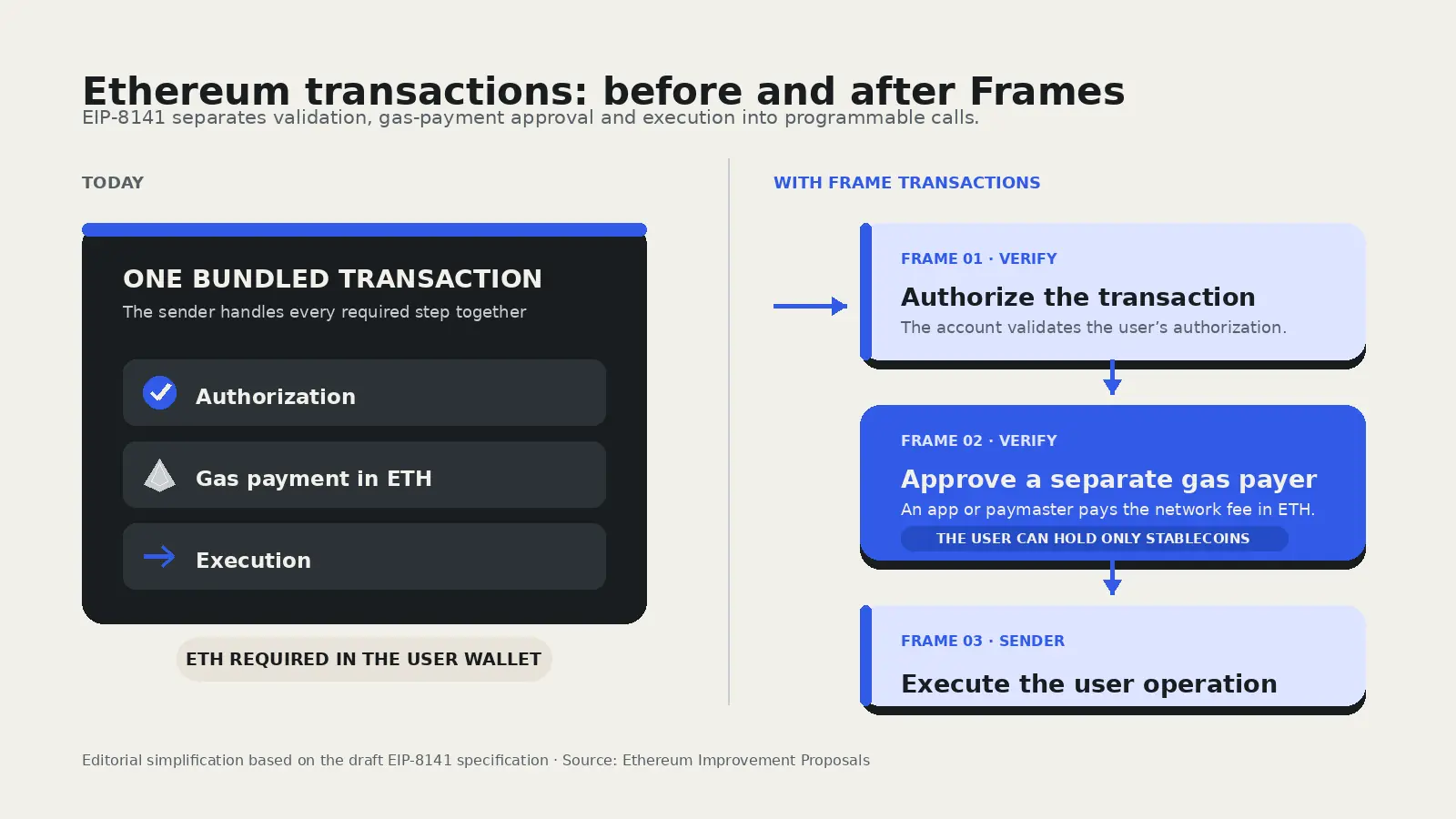
The technical solution is elegant. Today, an Ethereum transaction is a single, indivisible block that bundles three things together: the authorizing signature, the gas payment, and the operation itself. Frame Transactions “unbundle” this into separate, programmable steps called “frames.” The most important consequence: the person sending a transaction and the party paying the gas fee no longer need to be the same entity.
That opens up genuinely interesting scenarios. An application could pay the ETH gas fee on behalf of its users, accepting stablecoin reimbursement from them behind the scenes. For the end user, the need to hold ETH would effectively disappear. The benefits extend further: Frame Transactions would also allow multiple actions to be batched into a single operation (such as a token approval and swap in one step), and they open the door to wallets with more flexible security models, including the ability to rotate access keys or adopt quantum-resistant protections. Partial solutions for third-party gas payment exist today through mechanisms like ERC-4337 account abstraction, but Frame Transactions would embed this capability directly into the Ethereum protocol itself.
 Ethereum Improvement Proposals
ETH Keeps Its Role: A Necessary Clarification
A quick read of this news could lead someone to conclude that Frame Transactions make ETH redundant. That's not the case, and the distinction matters. The feature changes the user experience, not ETH's economic function. Validators, the nodes that secure and operate the network, continue to be paid in ETH, exactly as they are today.
Think of ETH as the fuel that runs Ethereum's engine. What changes is that end users won't need to keep fuel in their own tank; someone else handles that on their behalf. Individual retail demand for ETH to cover gas could theoretically soften at the margin, but ETH retains its central role in the network's security and settlement mechanism. It's a subtle but important distinction for anyone tempted to draw conclusions about ETH's long-term value from this upgrade.


Timeline Reality Check: Not Coming Soon
Here is the most important caveat, and the one most headlines on this topic tend to underplay. Frame Transactions are not available today and won't be for some time. The technical specification, formalized in EIP-8141, is still in draft form, meaning its details can change before any final implementation. A competing proposal targeting the same goal is also in the mix. Developers are still evaluating which path to take.
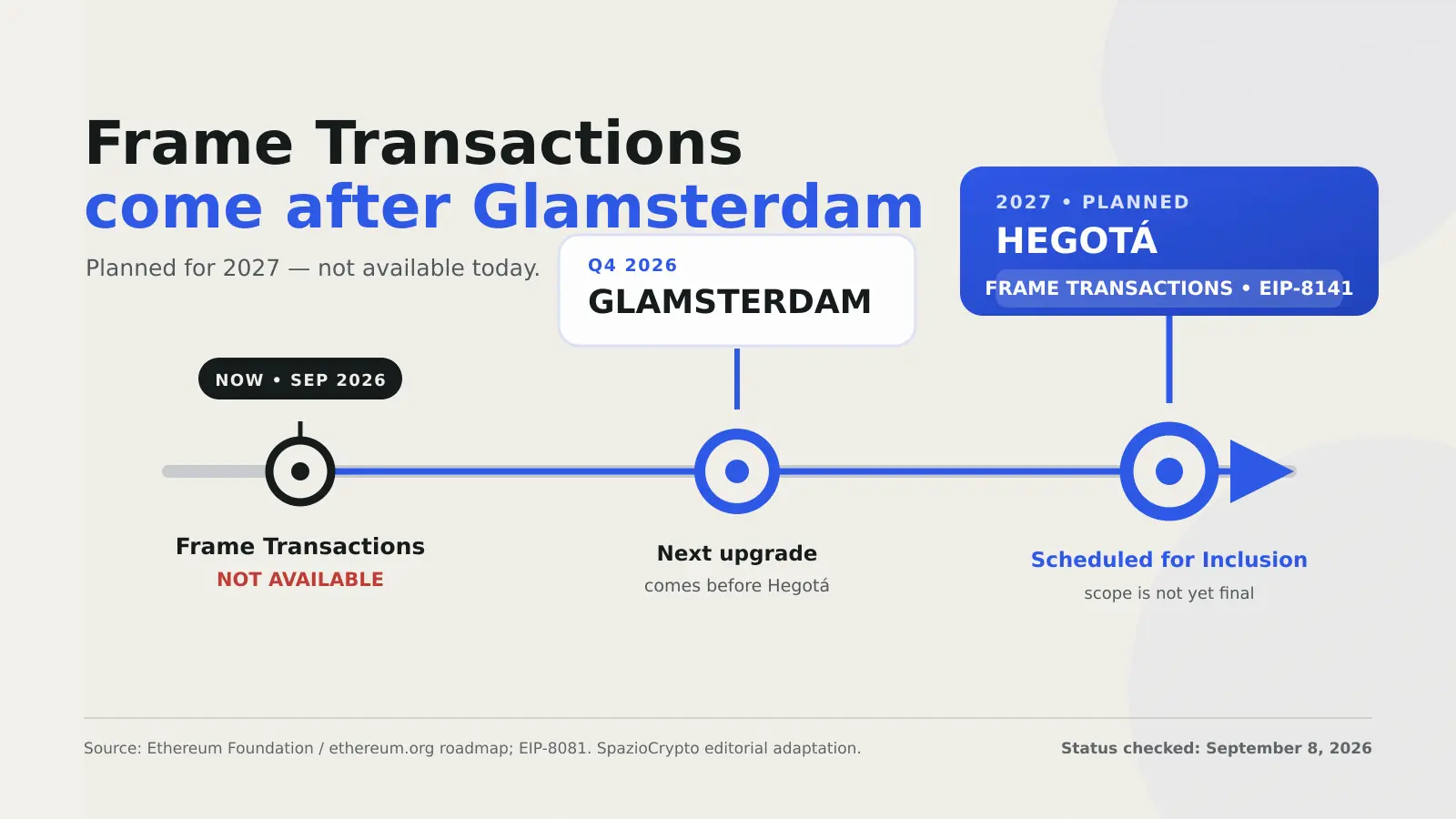
Above all, the timeline is long. Frame Transactions are slated for the Hegotá network upgrade, expected no earlier than 2027, which itself follows the Glamsterdam upgrade planned for later this year. Before any real-world deployment, the code will need to be implemented across network clients, tested extensively, supported by wallet software, and subjected to security audits. What we're looking at is a formal commitment from Ethereum developers to build this feature, not a product ready to ship. A 2027 upgrade announcement is not an immediate change to how the network works, and it shouldn't be read as a short-term market signal.
The Bigger Picture
Beyond the timeline and the technical detail, this development signals the direction Ethereum is heading: hiding technological complexity behind a simpler, more familiar user experience. The stated goal is to make blockchain feel indistinguishable from the financial apps people already use, stripping away the friction that still puts off most newcomers. It's the same principle driving projects that aim to make the underlying crypto infrastructure invisible to the end user.
Two lessons stand out for anyone watching this space. First, the next major battleground in crypto isn't raw technological power, it's usability. The platform that delivers the cleanest experience, hiding complexity from ordinary users, will have a serious competitive edge in the race for mass adoption. Second, this story is a reminder to read crypto development news with a calibrated sense of time. Between a feature announcement and its actual availability, years can pass. Telling apart what already works from what's still a proposal is essential for setting realistic expectations. Frame Transactions is a well-aimed and meaningful commitment, but it remains, for now, a commitment. Its real value will only become clear if and when it ships in 2027.