

You don't always need to break into a safe to get inside: sometimes an invitation to a job interview is enough. On November 3, Binance published its first technical report on the Binance attack via EIP-7702, the theft of roughly $6.34 billion on October 29. According to the exchange's reconstruction, the operation began in June with a tampered Homebrew installer and continued in September with a fake job interview. To reach the wallets, the attackers used an internal AI tool, the signing service and Ethereum's EIP-7702 authorizations. About $2.85 billion is reported as blocked. This is a preliminary account written by the company itself: the independent review it announced is not yet available.
We read the report Binance published on Binance Square, which uses Singapore time, and compared it with CoinDesk and The Hacker News. Reuters would not open with our tools. The times below have been converted to UTC.
How did they get in?
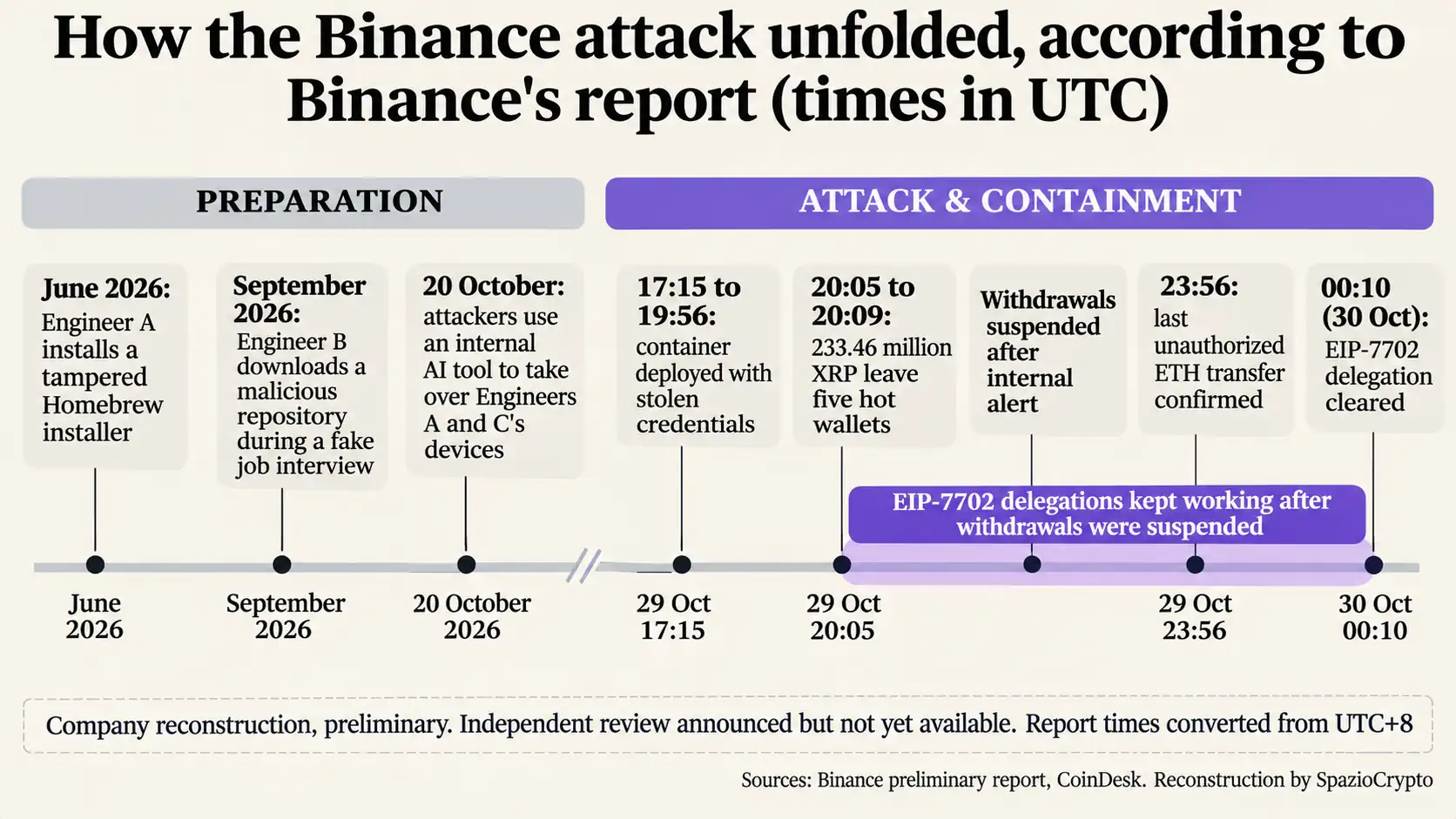
The first door opened in June. According to the report, an engineer on the team that runs the wallet infrastructure, referred to as “engineer A”, was looking for an artificial intelligence tool and downloaded a tampered Homebrew installer through a search engine. Binance replaced the device and changed the credentials, but the engineer's role and data on colleagues had already been exposed.
, Binance (@binance) November 3, 2026
In September it was the turn of “engineer B”, a developer. A fake project director contacted him on a job platform and a fake human resources manager interviewed him by video. Then a fake chief executive assigned him a technical test to download onto his work computer. The test contained a malicious repository that, according to the report, replaced a legitimate component of pyenv, a tool for managing Python; CoinDesk reports that the malware slipped past the devices' security controls. These techniques recall those used in scams that impersonate exchanges and authorities: trust is built first, and the damage comes later.
How did they reach the wallets?
On October 20, the attackers used engineer B's computer and an internal AI tool to take control of the devices of engineers A and C. On A's computer they found a token with permissions to launch containers, meaning ready-to-use software environments. Artificial intelligence is now part of how financial companies operate, as described in AI takes center stage in finance, and here it became one step in the attack.
On October 29, between 17:15 and 19:56 UTC, the attackers got into engineer C's computer, launched a container with the stolen credentials and ran a script. This gave them access to the internal service that signs hot wallet transactions, bypassing the normal withdrawal process. The first transfers went out at 20:05 UTC: 233.46 million XRP from five wallets in four minutes.
What does EIP-7702 have to do with it?
EIP-7702 is a feature introduced with Ethereum's Pectra upgrade in 2025. It lets an ordinary address temporarily delegate execution to a smart contract, for things like paying fees on someone else's behalf or bundling several operations together. It works like a power of attorney: the address stays the same, but someone else can act according to the rules written into the contract. As early as June 2025, Wintermute, cited by The Block, warned that more than 80% of delegations pointed to copies of the same code used to drain wallets with stolen keys.
On 29 October, Binance was the target of one of the most sophisticated attacks the digital asset industry has ever seen. ~$6.34B in assets were impacted. We take full responsibility and we're making it right.
, Richard Teng (@_RichardTeng) November 3, 2026
No user bears the loss. We set aside more than the full amount… https://t.co/BDmr3wLzOP
According to the report, the attackers sent 50 signed transactions to manipulate the transaction counters and set up malicious delegations on the hot wallets. Those powers of attorney kept working even after withdrawals were suspended. And because Binance's wallets use multi-party signing, with no single private key, there was no one key that could revoke them: a dedicated procedure was needed. The last transfer was confirmed at 23:56 UTC and the delegation was removed at 00:10 UTC on October 30, about four hours after the first outflows.
How much got out and how much was stopped?
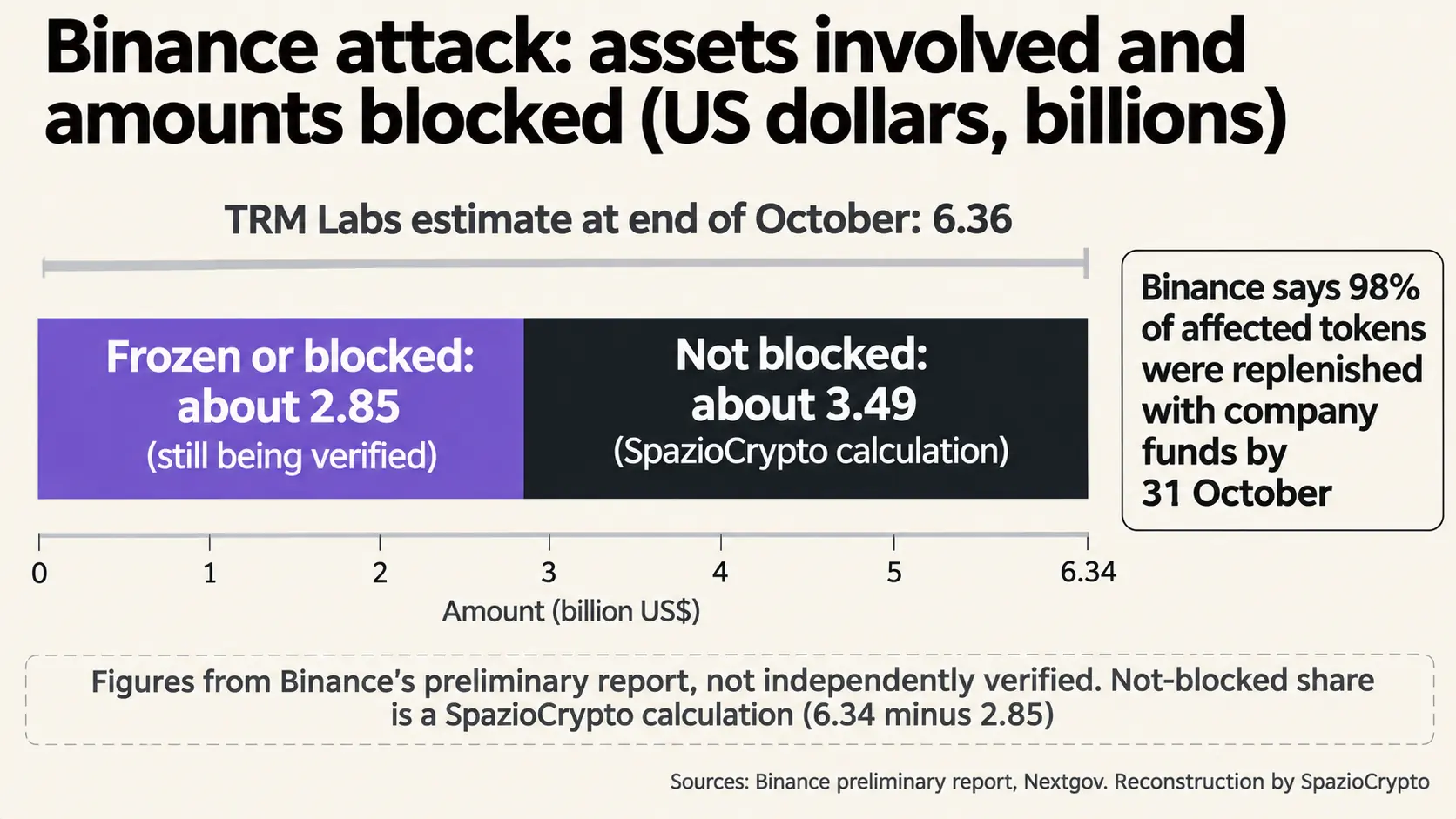
Binance puts the assets involved at roughly $6.34 billion, including about 970,500 SOL, 44.2 million OP and 18,270 BTC. At the end of October, TRM Labs had estimated $6.36 billion, according to Nextgov. About $2.85 billion has been frozen or blocked with help from law enforcement and industry partners, a figure Binance says it is still verifying. By our own rough calculation, around $3.5 billion remains outside the freeze. With funds spread across different networks, the tools available on each network also matter, as the case of Coinbase and USDC on Noble shows.
For users, Binance says it had restored 98% of the affected tokens by October 31 and is buying back the less liquid ones, and it repeats that it will cover the full loss. According to Cointelegraph, withdrawals began to resume on Sunday, November 1.
Who is behind it?
The report cites an FBI notice attributing the attack to North Korea. TRM Labs, according to Nextgov, had linked it with high confidence to the TraderTraitor group. “It was a campaign built over many months,” CEO Richard Teng told CoinDesk, adding that Binance has blocked 57 attempts suspected of coming from North Korea this year.
What remains to be verified?
A great deal, because for now only Binance is talking. The review by independent experts has been announced with no names or dates, some technical details have been left out to avoid inspiring copycats, and the figure for blocked funds is still being checked. No outside source has so far confirmed the reconstruction step by step.
What changes for people who use an exchange?
A balance on a platform is a claim against that platform, and how safe it is depends on how much the exchange can absorb. Binance says it can; not every exchange could. The difference between the forms of custody is explained in our guide on self-custody, exchanges and wallets compared. Anyone who wants to hold part of their funds themselves can start with how to open a crypto wallet.
Binance's report at a glance
What is confirmed and what is not
- Reported: according to Binance, entry through a tampered installer in June and a fake interview in September, internal movement with an AI tool on October 20, outflows through the signing service and EIP-7702 delegations on October 29; $6.34 billion affected, $2.85 billion blocked, 98% of tokens restored.
- Not disclosed: who will carry out the independent review and when, the omitted technical details, the breakdown of the blocked funds.
- What to watch: the outcome of the review, recovered funds, and other exchanges' countermeasures against fake interviews and EIP-7702 delegations.
The bigger picture
Our reading is that the weakest point was not a contract or a chip, but the engineers' everyday work: looking for a tool, answering a job offer, using an internal AI assistant. The attackers spent months working on people and productivity tools, and only at the very end on the blockchain. For Europe, which increasingly relies on AI tools developed elsewhere, the issue goes beyond crypto, as shown by EU finance's dependence on foreign AI.
The second lesson concerns EIP-7702: a feature designed to make wallets more convenient turned into a power of attorney that outlives the closing of the counter. There are three signals to watch: the outcome of the independent review, any changes to custody wallets and wallet apps to display and revoke delegations more clearly, and other exchanges' countermeasures against fake job interviews.