


The US private sector remained in expansion territory in November 2026, though growth decelerated to its slowest pace in four months. According to flash Purchasing Managers’ Index data published on November 23, 2026 by S&P Global, the American economy continues to expand, but persistent price pressures and capacity constraints are testing the durability of that growth.
The composite PMI fell from 55.9 to 54.6, reaching its lowest reading in four months while remaining comfortably above the 50-point threshold that separates expansion from contraction.
The picture is one of a still-resilient economy grappling with elevated costs and a gradual cooling of activity across both major sectors.
US PMI November 2026: Manufacturing and Services Both Lose Steam
The slowdown affected both pillars of the American economy. Services growth decelerated, while manufacturing continued to show expansion signals, though also at a softer pace than October.
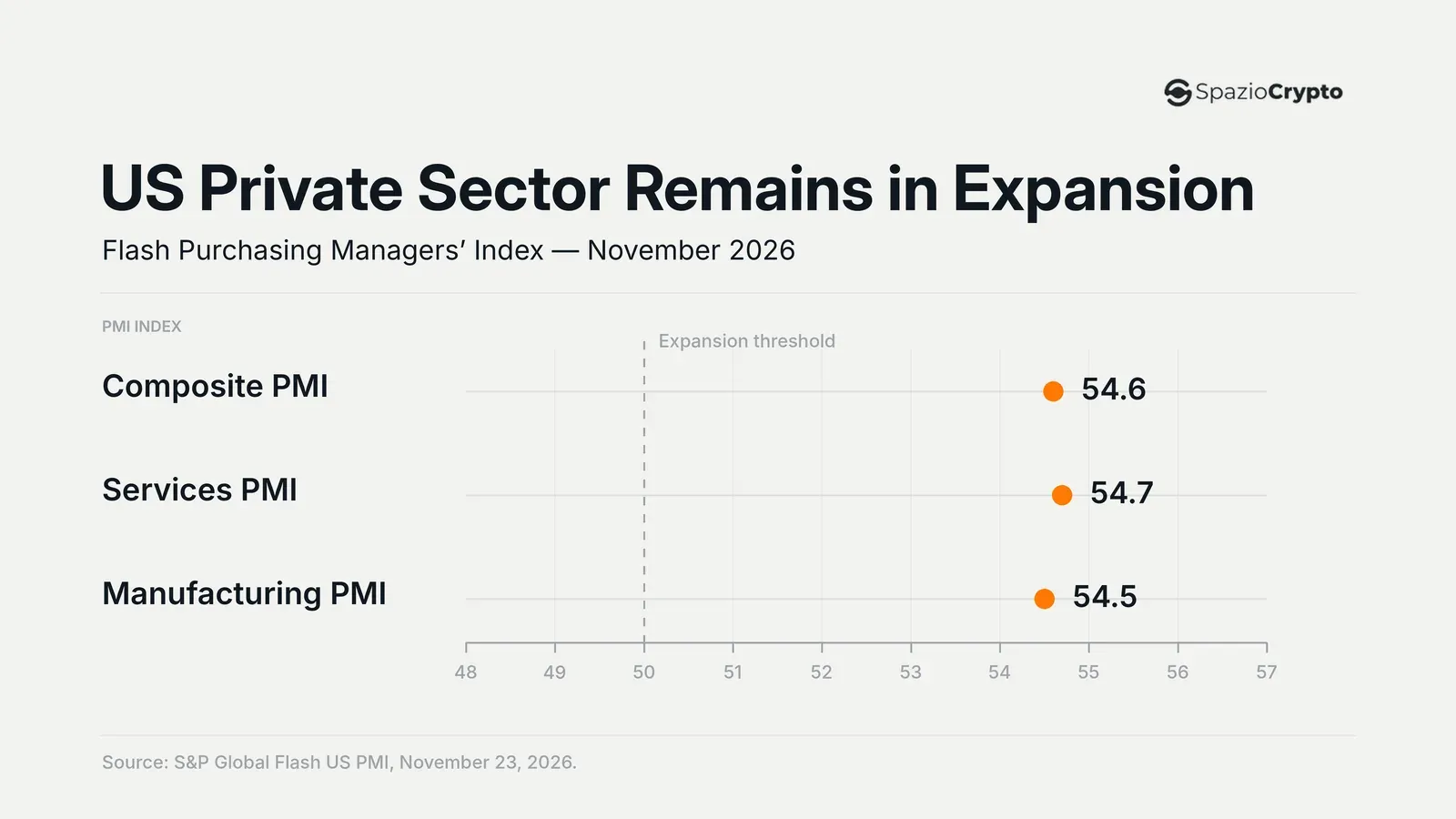
| PMI Indicator | November 2026 | Economic Status |
|---|---|---|
| Composite | 54.6 | Expansion |
| Services | 54.7 | Expansion |
| Manufacturing | 54.5 | Expansion |
Source: S&P Global. November 2026 flash estimates.
Lower index readings don’t signal contraction. All three indicators stayed above 50 points, meaning growth simply moderated rather than reversed. The distinction matters: a slowdown from 55.9 to 54.6 is very different from a reading below 50.
Whether this pace holds depends partly on whether US businesses can absorb rising operating costs without fully passing them on to consumers. Squeezing margins or raising prices each carries its own risk.
US GDP Growth Tracking Near 3% in Q4 2026
Despite November’s deceleration, the PMI data continues to point toward solid economic expansion.
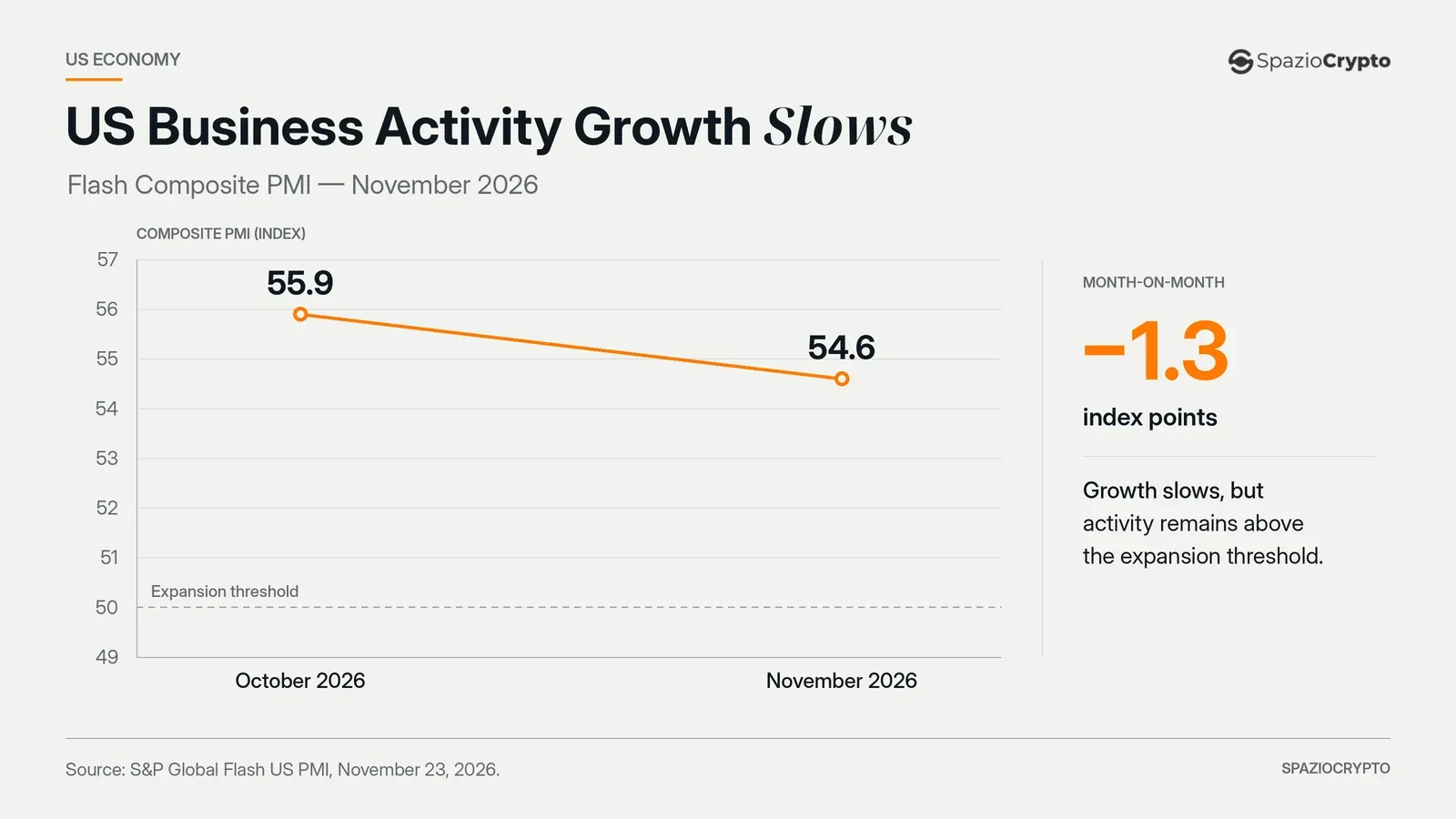
According to S&P Global Market Intelligence, survey results are consistent with annualized GDP growth of close to 3% in Q4 2026. That’s a business-survey estimate, not yet confirmed by official government statistics, but it pushes back against recession fears circulating in some corners of the market.
Sustained activity at this level reduces the probability of an imminent downturn. It doesn’t, however, rule out a further softening of demand in the months ahead, particularly if financial conditions tighten.
US Inflation: Price Pressures Stay Above Fed Target
The most uncomfortable finding in the November report concerns prices. Even as cost pressures moderated slightly, price indicators remain consistent with inflation running above the Federal Reserve’s 2% target.
Elevated input costs and capacity constraints continue to weigh on new orders and output growth for American businesses. The concern for the broader economy is a feedback loop: persistent price pressure erodes household purchasing power and compresses corporate margins, which over time curbs both consumption and investment.
This isn’t a new dynamic. What the November PMI shows is that it hasn’t resolved itself yet.
Federal Reserve: The Monetary Policy Dilemma
November’s PMI data frames a genuinely difficult situation for the Fed.
An economy still expanding at a healthy clip, combined with sticky inflation, leaves limited room for monetary easing. The Fed must balance its mandate to bring inflation back to 2% against the risk of overtightening and stalling growth.
Keeping rates elevated for longer would hold borrowing costs high for households and businesses alike, dampening investment and domestic demand. But cutting too early risks re-accelerating price pressures that haven’t fully subsided.
As reported by Reuters on November 23, 2026, US business activity growth eased further in November, adding pressure on Fed policymakers heading into the final weeks of 2026. The Fed’s next moves will ultimately depend on the full picture of incoming macro data, with inflation readings and labor market figures carrying the most weight.
What Does This Mean for Bitcoin and Crypto Markets?
US macro conditions are a direct input for crypto market sentiment. The dollar, interest rates, and risk appetite all flow through to Bitcoin and digital asset valuations in ways that weren’t true a decade ago.
A resilient US economy can support investor risk appetite broadly. But persistent inflation, and the tighter financial conditions it implies, can cut the other way. Specifically, elevated interest rates tend to:
- Reduce the liquidity available for speculative investments.
- Increase the attractiveness of US Treasuries as a safe-yield alternative.
- Strengthen the US dollar, which historically pressures dollar-denominated assets.
- Compress valuations of higher-risk assets across the board.
- Raise the cost of leverage, reducing amplified positions in crypto markets.
For Bitcoin, altcoins, and the broader tech sector, the key variable isn’t just the pace of US growth. It’s how that growth, combined with inflation data, shapes expectations for Fed policy. Markets tend to reprice rapidly when those expectations shift.
No single PMI reading determines market direction. But November’s data adds one more data point to the picture the Fed, and investors, are assembling heading into 2027.
The US Economy Slows but Holds
The November 2026 US PMI captures a private sector that’s still growing, still expanding, but doing so with more friction than a month ago. Operational challenges and persistent inflation are real constraints, not noise.
The challenge for the coming months is sustaining a growth rate that doesn’t reignite inflation. That balance will be one of the defining macro themes of early 2027, with implications for both traditional financial markets and digital assets.
One important caveat: the flash PMI is a preliminary business survey. It doesn’t replace official GDP, inflation, or employment statistics, and it should be read alongside those data points rather than in isolation.
Sources
- S&P Global: US flash PMI indicates still-elevated but cooling business activity growth and price pressures
- Reuters: US business activity growth eases further in November