


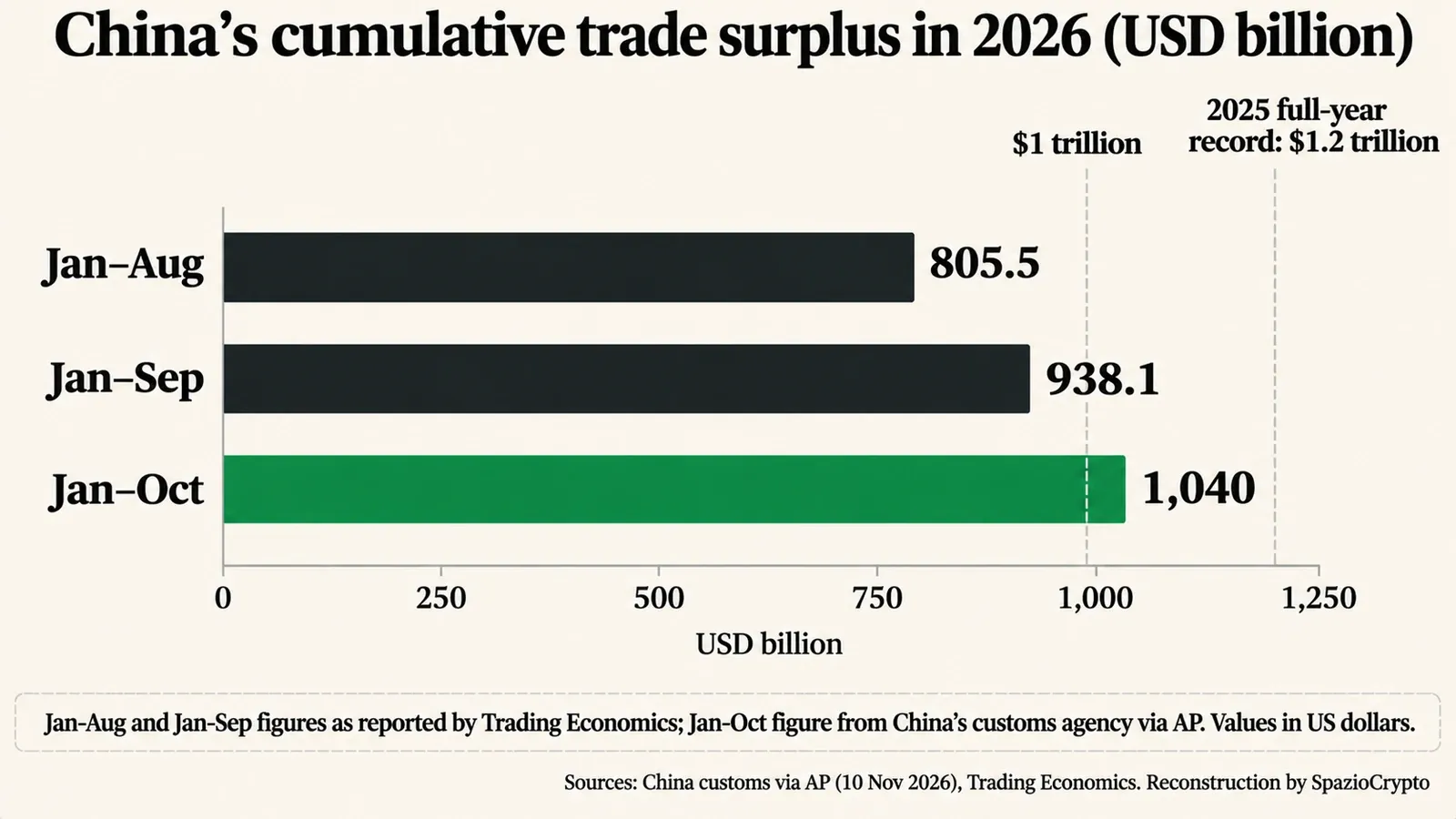
China's cumulative trade surplus has crossed $1 trillion for the second consecutive year, according to data from China's customs agency reported by the Associated Press. The 10-month surplus reached $1.04 trillion through October 2026, clearing that threshold roughly one month ahead of the same milestone in 2025. Yet the more striking figure from October points in the opposite direction: imports surged 41.6% year-on-year, outpacing exports which rose 35.2%, and the monthly trade balance narrowed sharply to $105.3 billion.
 Eamonn Sheridan

Note on sourcing: the Reuters article and the original AP page were not directly accessible to our tools. We worked from the full AP text republished by WRAL, the IndexBox analysis with economist commentary, and the forecasts reported by investingLive. English-language bulletins from China's customs authority have not yet published 2026 breakdowns at the time of writing.
The Record That Keeps Repeating
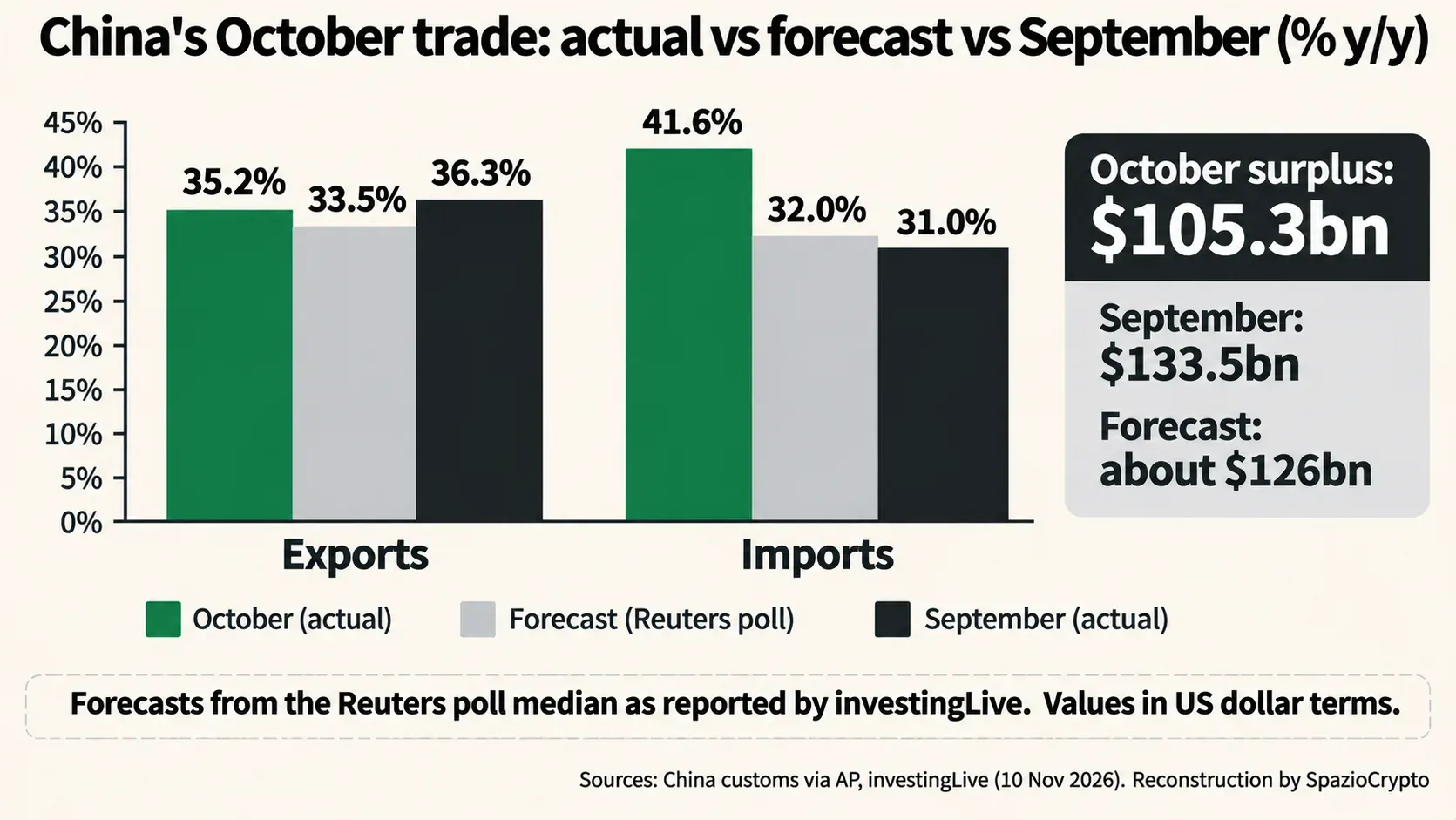
October's trade numbers were strong on both sides of the ledger. Exports climbed 35.2% year-on-year, according to investingLive, beating the Reuters consensus forecast of 33.5% and coming in just below September's 36.3%. Imports accelerated to 41.6%, well above the 32% that analysts had expected and September's 31% reading. The monthly surplus settled at $105.3 billion, down from $133.5 billion in September and below the roughly $126 billion the market had anticipated.
Stacking up the first ten months, the cumulative balance reaches $1.04 trillion. That figure is consistent with earlier data: according to Trading Economics, the nine-month total through September stood at $938.51 billion, and adding October's monthly surplus brings the running total to approximately $1.044 trillion (our own indicative calculation). The Associated Press reports that China is on track to surpass last year's full-year record of $1.2 trillion. By SpazioCrypto's reading, the $1 trillion threshold was crossed a full month earlier than it was in 2025.
The Paradox: Imports Outrun Exports
This is the detail the headline record risks obscuring. In October, China bought from the rest of the world at a faster clip than it sold, and the monthly surplus shrank by more than $28 billion compared to September. The sources we reviewed do not break down what drove the acceleration. Without a product-by-product and country-by-country decomposition, it is not possible to say whether this reflects recovering domestic demand, a build-up of industrial components, or a price effect.
Our editorial read, stated as such: one month does not make a trend, but the import figure is worth tracking. If faster import growth persists over the coming months, it would relieve external pressure on the surplus without requiring new trade barriers. If instead it mainly reflects imported components destined for re-export inside finished goods, the broader picture remains that of an economy driven by foreign demand rather than domestic consumption.
Chips and Cars: What Is Driving Chinese Exports
According to the Associated Press, this year's export surge has been led by high-technology goods including semiconductors and automobiles. Dave Chia, an economist at Moody's Analytics cited by IndexBox, expects exports to remain strong through the rest of the year on the back of electronics and vehicles. Global demand for AI hardware is part of that picture, as illustrated by industrial projects such as the NVIDIA and LG AI factory in South Korea.
That is also where one of the key risks sits. Chia warns that a slowdown or correction in the AI hardware boom could drag down chip and electronics prices and reduce shipment volumes. It is the same type of structural vulnerability that ECB President Christine Lagarde identified for the financial sector when she cautioned against potential systemic risks linked to artificial intelligence.


The Structural Problem: Growth That Depends on Foreign Demand
Alicia Garcia-Herrero, chief economist for Asia-Pacific at Natixis, cited by IndexBox, attributes the persistent surplus to excess production capacity across multiple sectors, elevated domestic savings, and weak internal demand, all of which push Chinese goods toward foreign markets. She described the situation as “unsustainable.” Chinese officials, as reported by IndexBox, maintain that Beijing does not seek to widen the surplus and wants a more balanced global trading system.
The more immediate risk comes from trading partners' reactions. Chia points to European Union trade restrictions as a significant threat, compounding U.S. tariff barriers that are already elevated. According to IndexBox, trade is expected to be on the agenda when Donald Trump and Xi Jinping meet on the sidelines of the APEC summit in Shenzhen in the coming weeks. The surplus also underpins Beijing's financial strength directly: in October, China's foreign exchange reserves climbed to $3.405 trillion, with gold rising for the 24th consecutive month.
What This Means for Europe and Global Markets
For the European Union, China's $1 trillion-plus surplus is not an abstract statistic. It translates into competitively priced goods entering European markets, from electric vehicles to consumer electronics, creating constant pressure on domestic manufacturers. The EU has already deployed trade-defense instruments, including countervailing duties on Chinese electric vehicles introduced in 2024, and Moody's Analytics flags further European restrictions as one of the main risks to Chinese export growth. The sources we reviewed do not provide October-specific data on bilateral Sino-European trade flows.
On the technology side, Europe's dependency runs in two directions. Chips, servers, and AI components are sourced heavily from Asia, while European countries are attempting to build domestic capacity, as seen for instance in the sovereign AI platform announced by TIM and NVIDIA. A Chinese slowdown triggered by new trade barriers or softening global demand would affect prices for these components, with consequences that cut both ways for European businesses and consumers.
China Trade Surplus: Confirmed Facts and Open Questions
What is confirmed, what is not
- Confirmed: according to China's customs agency, as reported by the Associated Press, October exports rose 35.2% year-on-year and imports climbed 41.6%; the monthly surplus narrowed to $105.3 billion from $133.5 billion in September; the 10-month cumulative surplus stands at $1.04 trillion, above $1 trillion for the second consecutive year.
- Not reported: the October breakdown by product category and trading partner; the specific drivers behind the import acceleration; granular bilateral data for EU-China or U.S.-China trade in October.
- To watch: November trade data and the trajectory toward (or beyond) the 2025 full-year record of $1.2 trillion; the outcome of the Trump-Xi meeting at the APEC summit in Shenzhen; any new EU trade-defense measures targeting Chinese exports in autos and electronics.
The Bigger Picture
Our editorial assessment, stated as such: a Chinese surplus above $1 trillion for the second straight year confirms a growth model that leans on external demand while domestic consumption stays subdued. That makes it structurally fragile. It depends on the global technology boom, on the patience of trading partners, and on Beijing's ability to avoid turning each new record into fresh diplomatic friction. October's import figure is the first isolated signal of a possible rebalancing, and it deserves attention precisely because it is still isolated.
For investors and market watchers, three signals are worth tracking. First, whether imports maintain or accelerate their October pace in November, converting a single data point into a recognizable trend. Second, the substance of the Trump-Xi exchange at APEC in Shenzhen and what, if anything, is agreed on trade. Third, the European policy response: new restrictions targeting the sectors currently powering Chinese exports, from electric vehicles to semiconductors, would reshape both the surplus trajectory and the supply chains that European companies rely on. Monetary and currency policy across major blocs adds another layer, as Japan's record yen intervention in July 2026 and the pressure on crypto assets when Bitcoin faced 5% Treasury yields and a hawkish Fed both illustrate how tightly these macro threads are connected.