


Iran's currency has reached a new all-time low as inflation approaches 90%. U.S. sanctions, financial isolation, and geopolitical pressure are driving the crisis. The stablecoin market is feeling the strain too.
The Iranian rial keeps losing ground. On Saturday, November 28, 2026, the national currency touched a new historic low on the free market, approaching the psychologically significant threshold of three million rials per U.S. dollar.
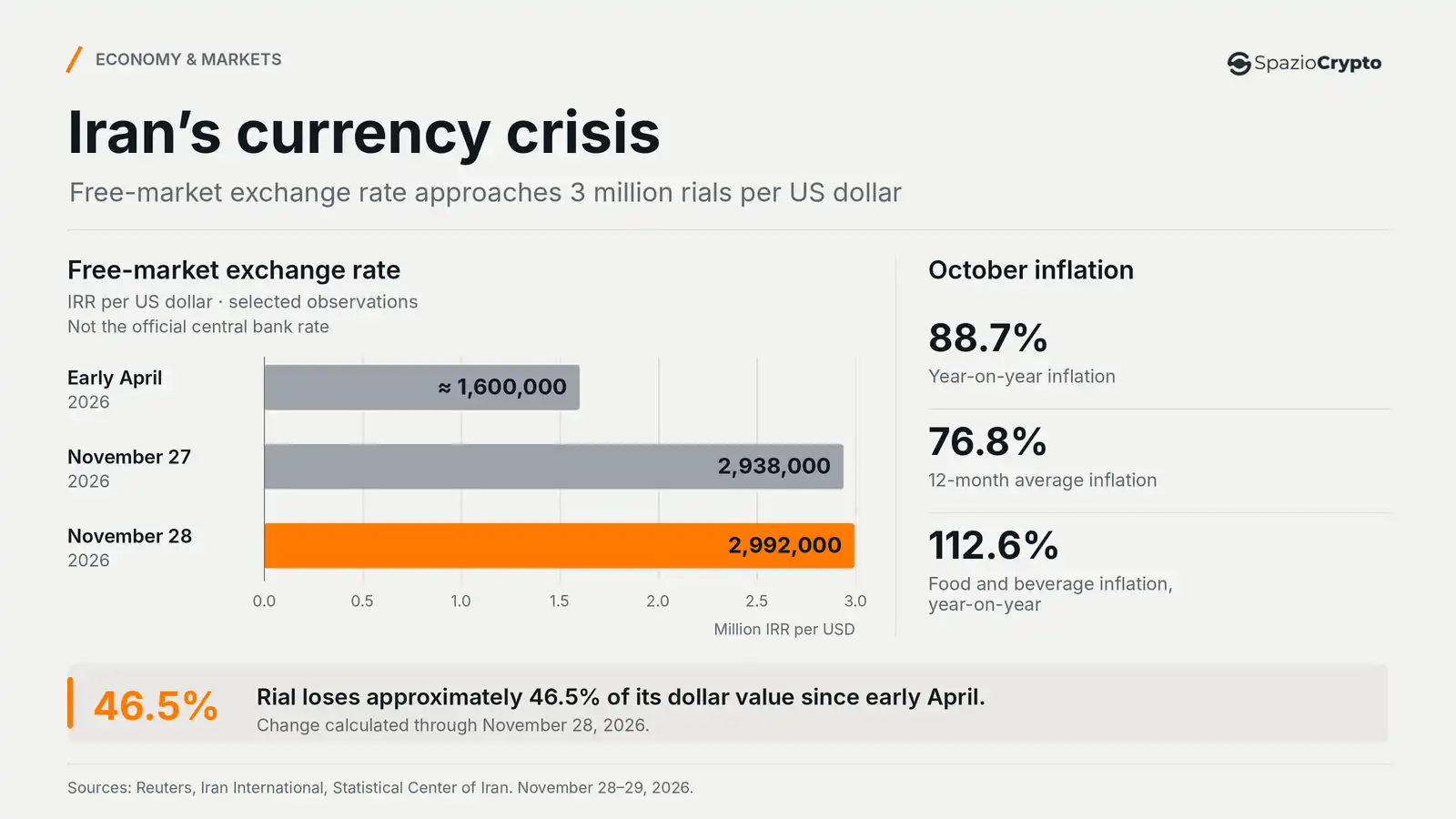
According to Reuters, the dollar reached 2,992,000 rials on the Bonbast currency tracking platform, up from 2,938,000 the previous day. Alanchand, another monitoring service, logged quotes as high as 2,999,000 rials.
The new record reflects the worsening economic conditions inside Iran, compounded by trade restrictions, international sanctions, and severely limited access to foreign currency.
Iran's Currency Crisis Deepens
The depreciation of the rial has accelerated sharply throughout 2026. According to Iran International, the dollar was trading at around 1.6 million rials in early April. By August it had already crossed the two-million mark, before closing in on three million by late November.
Compared to early April, the rial has lost approximately 46.5% of its value against the dollar in just eight months.
It's worth clarifying that these figures refer to the free-market rate, not the official exchange rate set by Iranian monetary authorities. The gap between the two rates is itself a symptom of the crisis.
Currency depreciation makes imports more expensive and erodes the purchasing power of households, particularly when wages and pensions fail to keep pace with rising prices.
Inflation Hits 88.7%, Food Prices Up 112%
Data from Iran's Statistical Centre lays bare the depth of the economic crisis. For the Iranian month ending October 22, 2026, the key inflation indicators were:
- Annual inflation rate: 88.7%.
- 12-month average inflation: 76.8%.
- Monthly inflation: 4.4%.
- Annual increase in food and beverage prices: 112.6%.
The surge in food prices is particularly severe. It strikes directly at the ability of ordinary families to meet daily needs, with no cushion from stagnant incomes.
A basket of goods and services that cost one million rials in October 2025 required, on average, 1,887,000 rials by October 2026, according to Iranian Statistical Centre data.
The combination of currency devaluation and elevated inflation also eats into the real value of savings held in the national currency, pushing households toward alternative stores of value.
New U.S. Sanctions Under “Operation Economic Outcast”
On November 23, the U.S. Department of the Treasury announced new measures under Operation Economic Outcast.
The sanctions target financial intermediaries, companies, and networks through which Washington says Iran has been able to move international capital and access foreign currency despite existing restrictions.
The stated U.S. objective is to cut off Tehran's access to the financial resources used by the Iranian government to fund its operations.
From a macroeconomic perspective, reduced access to foreign currency adds pressure on the exchange market, making it harder to satisfy domestic demand for dollars. Each new round of sanctions compresses Iran's options further.
Iran's Central Bank Tries to Reassure Markets
The governor of the Central Bank of Iran, Abdolnaser Hemmati, stated publicly that the country holds sufficient foreign currency reserves to fund the purchase of medicines and essential goods for several months.
Hemmati acknowledged, though, that exchange rate movements don't depend solely on economic fundamentals. Expectations among market participants and political developments play a significant role.
The reassurances haven't stopped the currency from falling to new lows. In a climate of rising uncertainty, confidence in the national currency is a core pillar of monetary stability. When that confidence erodes, demand for dollar-denominated and foreign-currency assets tends to accelerate.
Tether Under Pressure Inside Iran
Iran's currency crisis has reached the crypto sector. According to Iran International, Hemmati identified the rising price of Tether (USDT) on unauthorized platforms as one of the factors associated with recent tensions in the foreign exchange market.
Inside Iran, the USDT price expressed in rials is widely used as a proxy for the free-market dollar rate. This makes stablecoin activity a live gauge of monetary stress.
Iranian exchange Nobitex reportedly suspended Tether trading temporarily due to extreme volatility. The Central Bank also announced restrictions on the banking operations of six additional crypto platforms.
These developments illustrate the role stablecoins can play in economies marked by monetary instability and restricted access to international currencies. For many Iranians, USDT has become a practical stand-in for the dollar.
That said, rising crypto demand doesn't appear to be the primary driver of rial depreciation. The roots of the crisis lie in sanctions, fiscal policy, and structural economic weakness.
Stablecoins themselves carry real risks: regulatory crackdowns, liquidity constraints, counterparty exposure, and the possibility that issuers like Tether could restrict access to specific jurisdictions.
What Comes Next for the Iranian Rial
The three-million-rial-per-dollar threshold is, above all, a symbolic marker of Iran's deepening monetary fragility. Breaking it psychologically matters, even if the underlying dynamics are what drive real economic damage.
The authorities' ability to stabilize the exchange rate will depend on access to foreign reserves, the trajectory of sanctions, domestic economic policy, and any realistic prospect of containing inflation.
Without structural improvements, pressure on the rial is likely to continue, pushing more Iranians toward dollars, gold, and foreign-currency-denominated digital instruments.
Iran's crisis shows how rapidly a loss of confidence in the national currency can cascade into a savings crisis, a consumption collapse, and broader economic instability. For analysts watching currency stress in sanctioned economies, Iran remains the starkest case study in circulation.