


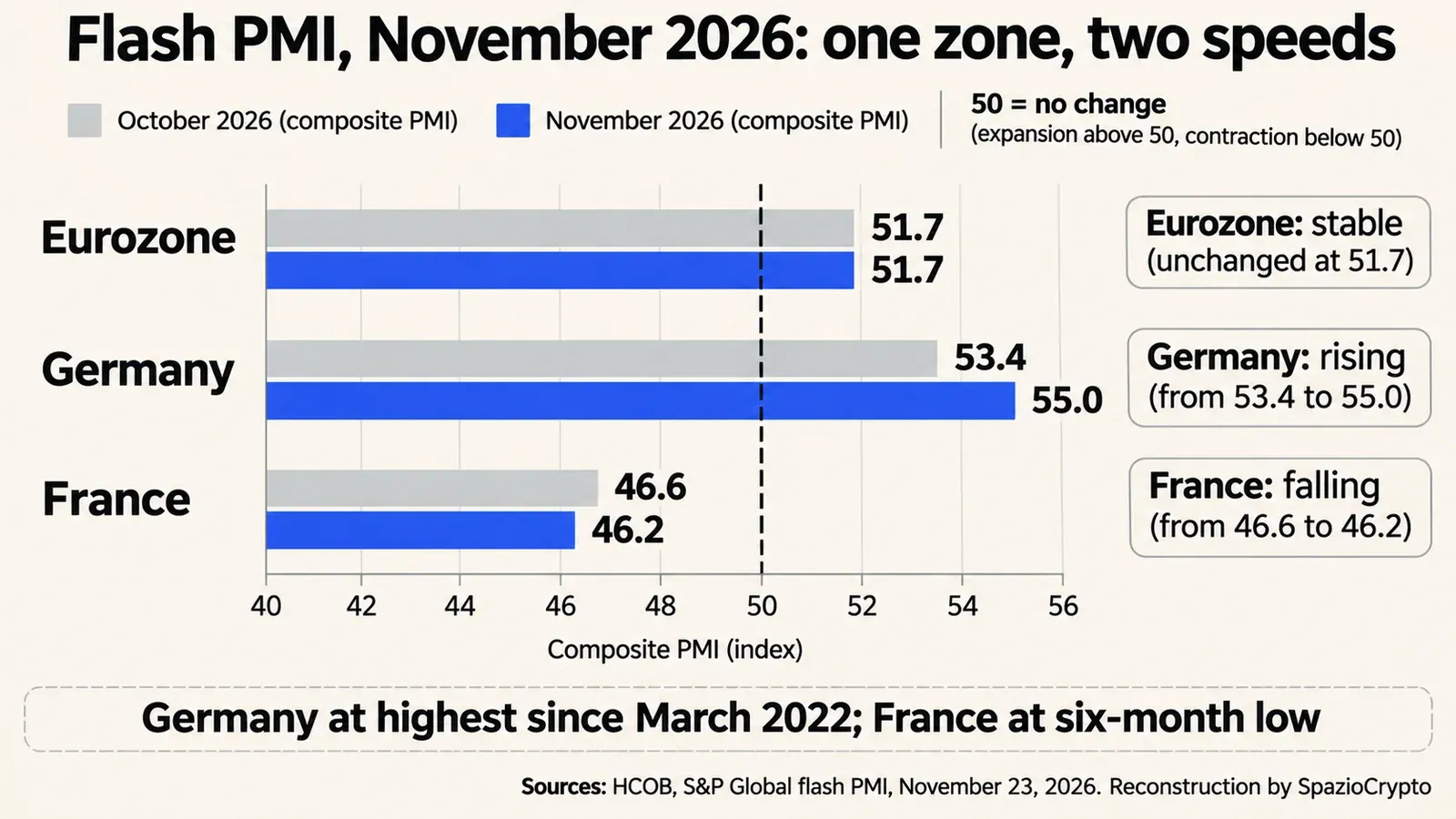
The Eurozone PMI held steady at 51.7 in November, remaining above the 50-point threshold separating expansion from contraction for the fifth consecutive month. Behind that stable headline number, a sharper fault line is opening: Germany accelerated to its highest reading since March 2022, while France slid further into contraction. The flash estimate, published on November 23 by S&P Global, measures private-sector activity through a survey of business managers.
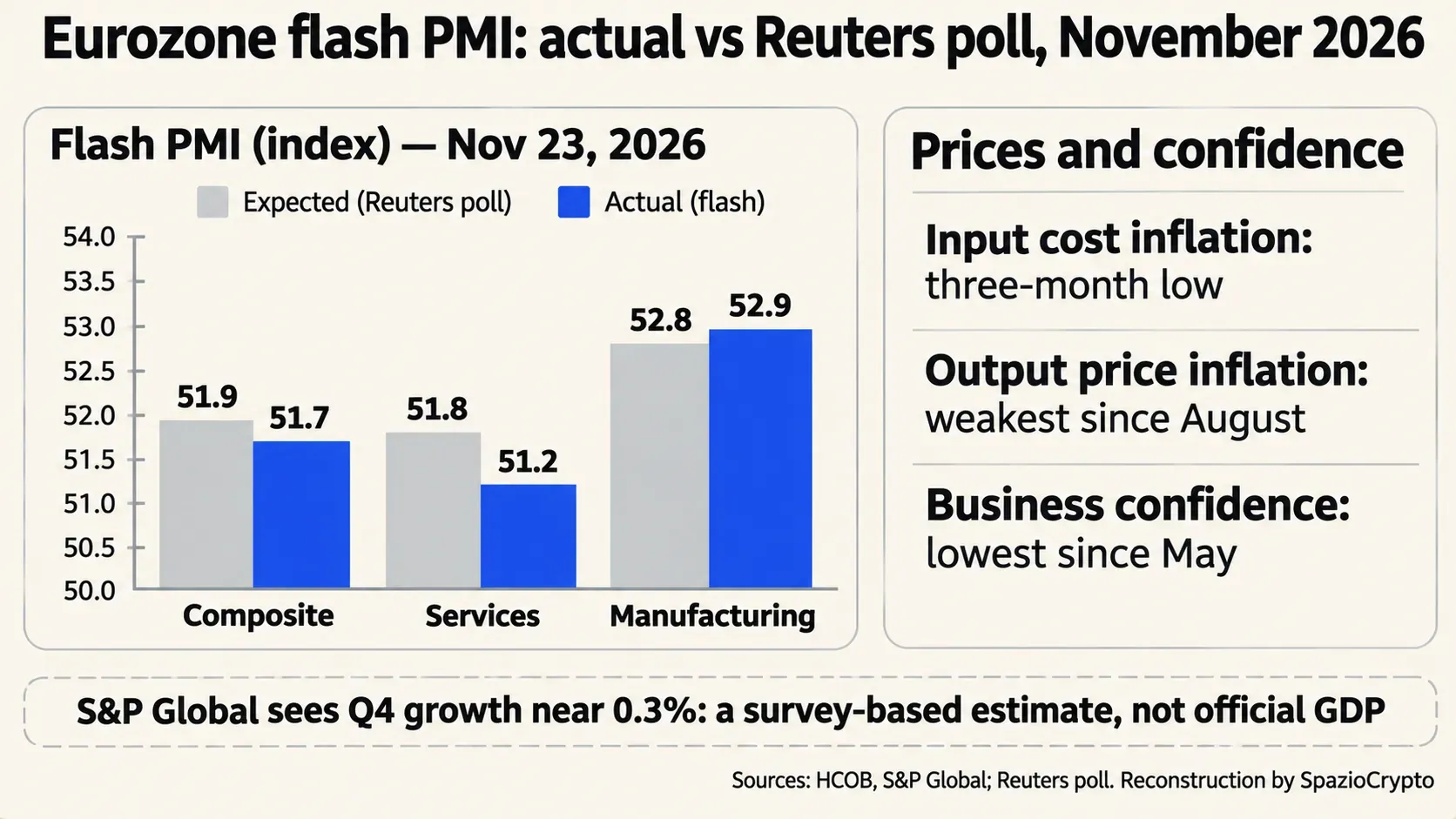
- The Eurozone composite PMI stayed at 51.7 in November, below the 51.9 consensus forecast cited in a Reuters poll.
- Services slipped to 51.2, a five-month low; manufacturing climbed to 52.9, a two-month high.
- Germany reached 55.0, its highest reading since March 2022; France fell to 46.2, a six-month low.
- According to S&P Global, the survey is consistent with Eurozone GDP growth of around 0.3% in the fourth quarter, an unofficial estimate based on survey data, not official output figures.
What the November Data Actually Tells Us
The flash reading is a preliminary estimate, subject to revision when the final print arrives in early December. According to Reuters, the services PMI fell from 51.4 to 51.2, missing the 51.8 forecast, while manufacturing edged up from 52.7 to 52.9, narrowly beating the 52.8 estimate. New orders grew for the fifth straight month, but business confidence about the year ahead dropped to its lowest level since May.
The employment picture is split. Manufacturing added jobs at the fastest pace in roughly three and a half years, while services shed workers for the second month running. Chris Williamson, chief economist at S&P Global Market Intelligence, described the outcome as “steady growth” that nonetheless “masks worrying divergences” within the bloc.
Germany and France: Who Is Driving and Who Is Braking
| PMI Index (November, flash) | Eurozone | Germany | France |
|---|---|---|---|
| Composite | 51.7 (51.7) | 55.0 (53.4) | 46.2 (46.6) |
| Services | 51.2 (51.4) | 54.0 (52.5) | 46.6 (46.2) |
| Manufacturing | 52.9 (52.7) | 55.0 (54.2) | 47.9 (49.5) |
| Manufacturing Output | 53.3 (52.8) | 57.4 (55.4) | 44.5 (48.5) |
October values in brackets. Sources: S&P Global, HCOB, ActionForex.
Germany reached 55.0, its highest composite reading in 56 months, with manufacturing expanding at its strongest pace in over five years. According to Williamson, orders are being driven by investment in machinery and capital goods, including spending linked to defence and artificial intelligence. France dropped to 46.2, with manufacturing output contracting at its fastest rate since February 2025 and business confidence near historic lows outside the Covid period.
France: Why Demand Has Stalled
Joe Hayes of S&P Global, cited by IndexBox, attributes French weakness to sluggish domestic demand. Businesses and clients are deferring projects ahead of a politically uncertain stretch, with presidential elections scheduled for 2027. France contracted in the third quarter and, as IndexBox noted, the risk of a technical recession in the current quarter has risen. The rest of the Eurozone, excluding Germany and France, grew at its slowest pace in six months.
ECB Rates: What This Data Changes
On prices, the signal is less alarming than the headline suggests. Input costs rose again sharply, but at their slowest pace in three months, and selling prices increased at their weakest rate since August, in both manufacturing and services. That matters for the European Central Bank, which on October 29 held its deposit rate at 2.50% while leaving the door open to further increases.
The backdrop remains tense. According to Eurostat data confirmed on November 18, euro area inflation climbed to 4.0% in October, the highest level since 2023, driven primarily by energy prices. The ECB's next meeting is in December, and Frankfurt is tracking additional risk fronts, including those ECB President Christine Lagarde flagged in connection with potential systemic risks tied to artificial intelligence.
Other major central banks are also tightening, as the internal debate at the Bank of Japan illustrates. In the United States, yields have reached levels that placed Bitcoin under pressure alongside 5% Treasury yields.
What This Means for Crypto and Risk Assets
Italy's November PMI will arrive with the final data in early December. In October, according to Trading Economics, the Italian composite fell to 50.8, a low since May, with services growing and manufacturing contracting; business costs rose at their fastest rate in four years. Italy sits closer to the middle of the bloc's spectrum than to Germany's pace of expansion. For households, a more restrictive ECB translates directly into pressure on mortgages and consumer loans.
For crypto investors watching from Europe, two channels matter most. First, interest rates: tighter monetary policy in both the eurozone and the US tends to compress appetite for higher-risk assets, including Bitcoin and altcoins. Second, national regulation: from the crypto tax proposals under discussion for 2027 to the Bank of Italy's work on a digital euro, the ECB sits at the centre of both conversations.
November PMI: What Is Confirmed and What Is Not
What the data confirms and what it doesn't
- Confirmed: composite at 51.7 for the fifth consecutive month above 50; Germany at 55.0, highest since March 2022; France at 46.2, six-month low; services at 51.2 and manufacturing at 52.9.
- Not stated: actual fourth-quarter GDP growth. The 0.3% figure is an S&P Global survey-based estimate, not an official output statistic.
- To watch: final PMI readings in early December, including Italy's figure; the ECB December meeting; and political developments in France ahead of 2027 elections.
The Bigger Picture
Our editorial read, stated as such: the Eurozone is growing on a single engine. Germany is providing the thrust, driven by investment in defence, capital equipment, and AI infrastructure, a cycle also visible in the AI infrastructure debt build-up flagged by the Fed. France, the bloc's second-largest economy, is slowing for reasons that are mostly political rather than structural.
For the ECB, this is the most uncomfortable scenario: a single monetary policy applied to economies moving in opposite directions, with inflation running at 4.0%. Three signals are worth tracking: whether the final PMI readings confirm the Germany-France gap, whether December's rate decision reflects French weakness or only the price data, and whether the softening in selling price growth recorded in November marks the start of a genuine disinflationary trend.
Sources
Data and analysis: S&P Global, Chris Williamson, 23 November 2026; RTÉ (Reuters), 23 November 2026; ActionForex; IndexBox; Finimize. Italy and ECB: Trading Economics, Italy PMI October; Mutuisupermarket, ECB decision October 29; Plataforma Media, October inflation.