


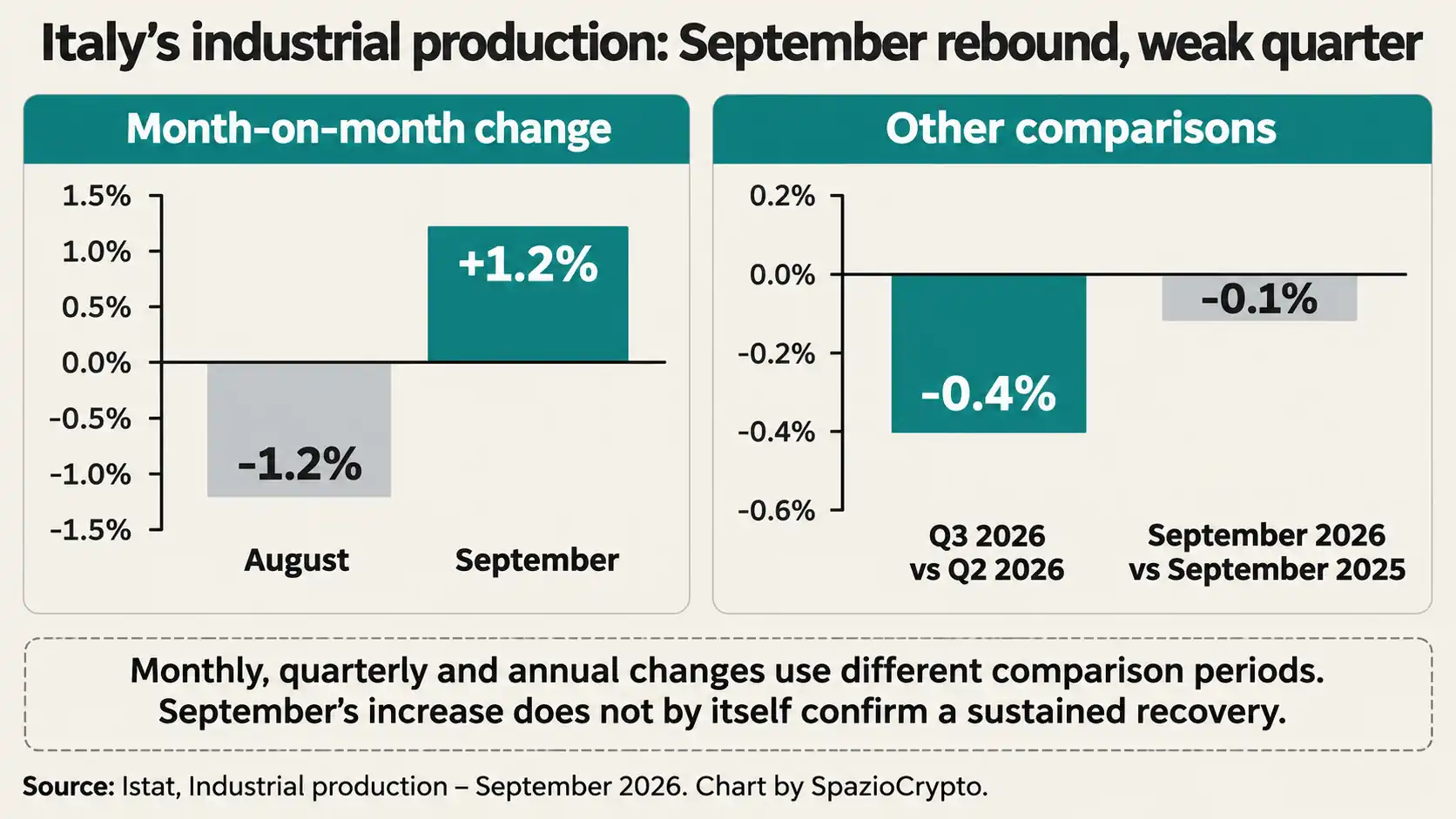
Italy's industrial production rose 1.2% in September compared to August, according to ISTAT data, recovering the previous month's drop. The monthly bounce does not, however, change the broader quarterly picture: between July and September, the index fell 0.4% compared to the second quarter.
The monthly rebound beat the Reuters consensus forecast, which had pointed to a 0.8% gain. The August figure, revised by ISTAT, showed a contraction of 1.2%, meaning September's recovery essentially offset the prior decline without putting production on a stable expansionary path.
On a year-over-year basis, the calendar-adjusted index fell 0.1% compared to September 2025. The unadjusted index also posted a negative change of 0.1%. September 2026 had the same number of working days as September 2025.
One Month Is Not Enough to Reverse the Trend
The Q3 average fell 0.4% compared to the previous three months. That quarterly figure is what puts September's positive reading in perspective: a gain concentrated in a single month can signal a partial recovery, but it doesn't confirm that Italian industry has started a durable upturn.
Monthly and quarterly comparisons measure different things. The monthly figure captures the swing from August to September; the quarterly figure compares average output in July-September against April-June. Assessing the actual direction of industrial activity will require data from the coming months.
What the Numbers Say About Italian Industry
September's reading delivers a rebound after August's contraction, but the quarterly decline signals that production lost ground across the period as a whole. The year-over-year comparison also remains slightly negative.
The most measured reading of this data is a monthly bounce inside a still-weak broader context. A genuine recovery would require a sequence of gains and improvement across multiple time periods, not a single positive print.
Prometeia, in its commentary published on November 12, noted that the rebound does not alter a context defined by underlying weakness, citing business confidence and energy costs as additional headwinds. Those are contextual factors; the ISTAT figures document the actual trajectory of production directly.