


The ESMA MiCA register now lists 329 records, and that figure has been circulating as evidence of rapid licensing progress across Europe. It isn't. Those 329 entries do not represent 329 newly authorized crypto-asset service providers. Misreading this number could lead investors straight toward unprotected platforms, so the distinction is worth understanding properly.
The starting point is ESMA itself, the European Securities and Markets Authority, which manages the register and explicitly warns users about how its data should be interpreted. Reading those raw totals at face value is, according to ESMA's own guidance, one of the most common mistakes.
TL;DR: ESMA's MiCA register shows 329 records as of mid-2026, but that total includes withdrawn authorizations and multiple entries for the same entity. Investors should check active status, specific services, and country scope before trusting any provider.
What the ESMA MiCA Register Actually Contains
Under MiCA, any platform offering crypto-asset services to EU clients must hold a formal authorization, commonly called a CASP license (Crypto-Asset Service Provider). ESMA aggregates all such authorizations into a single public register, fed by national competent authorities across EU member states. In the UK context this would be the FCA; in the EU, bodies like Germany's BaFin, France's AMF, or Spain's CNMV all feed data into the same centralized ESMA list.
But here is the first thing ESMA makes clear: the register is not a promotional directory of currently active operators. It is a comprehensive archive. Revoked authorizations remain in the register, marked with their withdrawal date rather than being deleted. Counting every row as an “active licensed operator today” is therefore already an error at step one.


Three Reasons 329 Records Are Not 329 Licenses
There are at least three structural reasons why the raw record count diverges from the number of active authorizations. Each one matters for any investor trying to verify a platform.
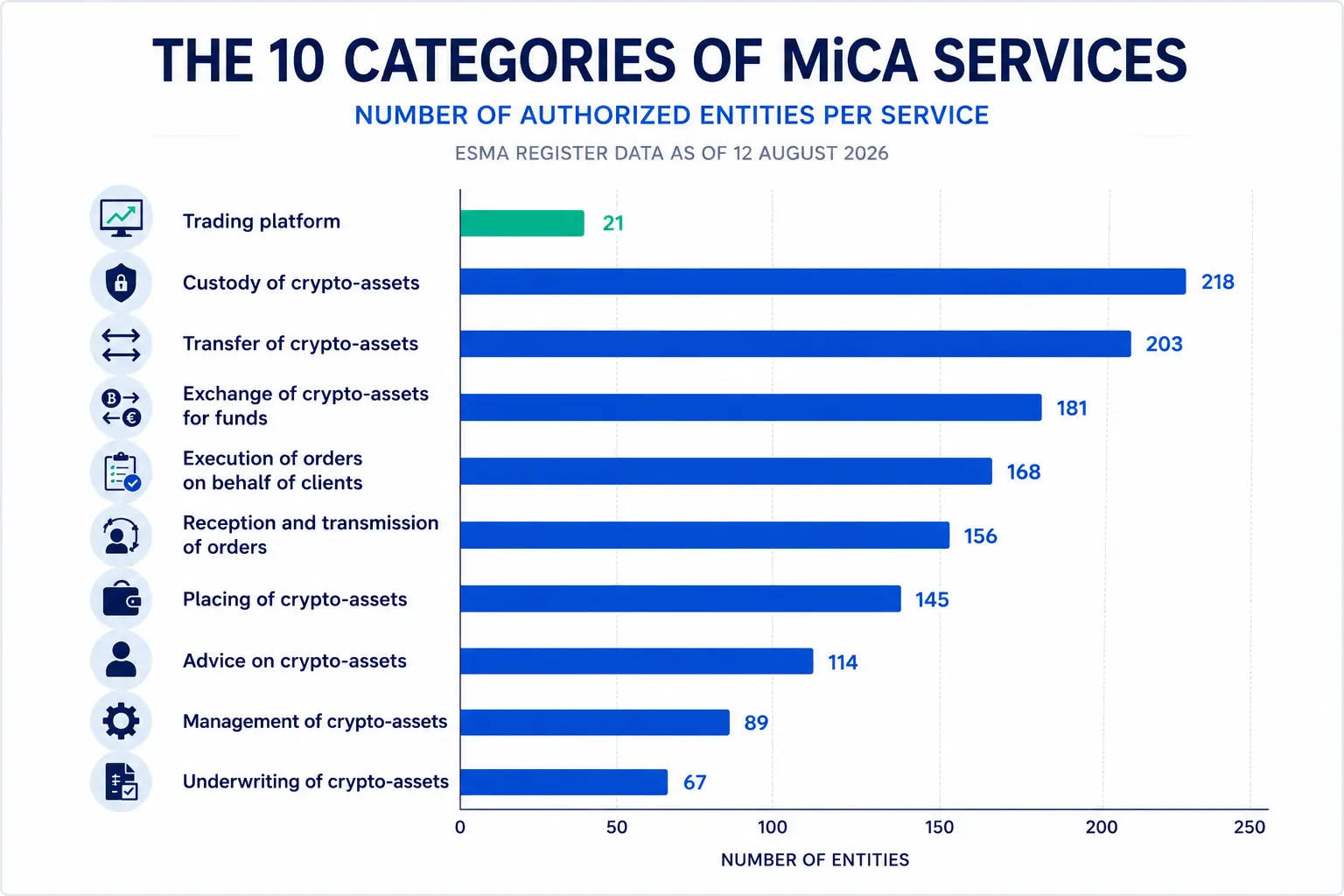
First, withdrawn authorizations inflate the total. When a license is revoked, the entry stays in the register with a withdrawal date attached. The headline figure therefore bundles active and inactive statuses together. Second, one record does not equal one company. ESMA organizes data by legal entity. A single corporate group can appear across multiple rows under different legal names or jurisdiction-specific registrations. Third, and most practically significant: being in the register does not mean being authorized for every service. MiCA defines ten distinct crypto-asset service categories, ranging from custody and exchange to portfolio management and advice. A provider might hold authorization for custody only, making it ineligible to offer trading services to its clients.
🛡️ From 1 July 2026, #crypto‑asset services for EU clients require #MiCA authorisation.
— ESMA - EU Securities Markets Regulator 🇪🇺 (@ESMAComms) April 20, 2026
⏱️ Providers without a licence will need to stop offering services.
⚠️ Investors: check your provider in the #ESMA's MiCA register.
📑 https://t.co/JaviqixaEY pic.twitter.com/o97RiFFfw9
Why a Single Number Is Never Enough
How to actually read the ESMA register. Source: ESMA, Elliptic, 2026
- Withdrawals included: revoked authorizations remain in the register with their date. They are not active operators.
- Record does not equal company: data is organized by legal entity; one corporate group can appear across multiple rows.
- Partial scope: MiCA defines 10 distinct service categories. Authorization for one does not cover the rest.
The Register Changes Every Week
There's a further complication that makes any snapshot figure provisional by definition, one that ESMA flags explicitly in its own documentation. The register is updated weekly, and authorizations communicated by national competent authorities do not appear instantly. There is a processing lag between a license being granted at the national level and its appearance in the centralized ESMA list.
The practical consequence is significant. Any count cited in an article or a social post is a photograph taken at a specific moment in time. Saying “there are 329 operators” without specifying the date is like quoting a crypto price without saying which day: incomplete and potentially misleading. Earlier in 2026, the same register showed substantially lower totals, simply because it was captured on an earlier date. The number is a moving target, not a settled fact.
How to Actually Use the Register
Past the confusion over headline numbers, here's what actually matters: how to use this tool to protect yourself as an investor. The ESMA register is genuinely valuable when read with method. Four practical rules apply.
First, search by legal entity name, not by brand name. Many well-known platforms operate under a corporate name that differs from their public-facing brand. You need to know the registered legal name to find the right entry. Second, check not just whether the provider appears, but which specific services it's authorized for and in which country. Third, always access the register directly via the official ESMA website or through your national authority (in the UK, the FCA register; in Germany, BaFin; in France, the AMF). Type the address yourself rather than following a link sent to you. Fourth, and critically: if a platform does not appear in the register at all after the transitional period ended on July 1, 2026, it cannot legally offer services to EU clients, and that absence is a serious warning sign.
The Bigger Picture
The “329” episode is a small but instructive example of how crypto information needs to be read: with precision, beyond the headline. A raw figure, however exact it appears, can tell a distorted story when stripped of context. The gap between “329 entries in the dataset” and “329 exchanges ready to serve you safely” is substantial. It lies entirely in the ability to interpret the source correctly.
For investors, the lesson cuts two ways. The existence of a public, comprehensive register is a genuine transparency achievement. A tool like this simply didn't exist a few years ago; today anyone can verify who they're dealing with before committing funds. But that tool needs to be used intelligently, with a clear understanding of what it contains and what it doesn't. In a sector where bad actors exploit every ambiguity, reading official data for what it actually says, without false simplifications, is the best form of self-protection. The register exists: it's on us to learn to read it well. Investors wanting to go deeper on the regulatory framework can start with our full guide on MiCA regulation in Europe.