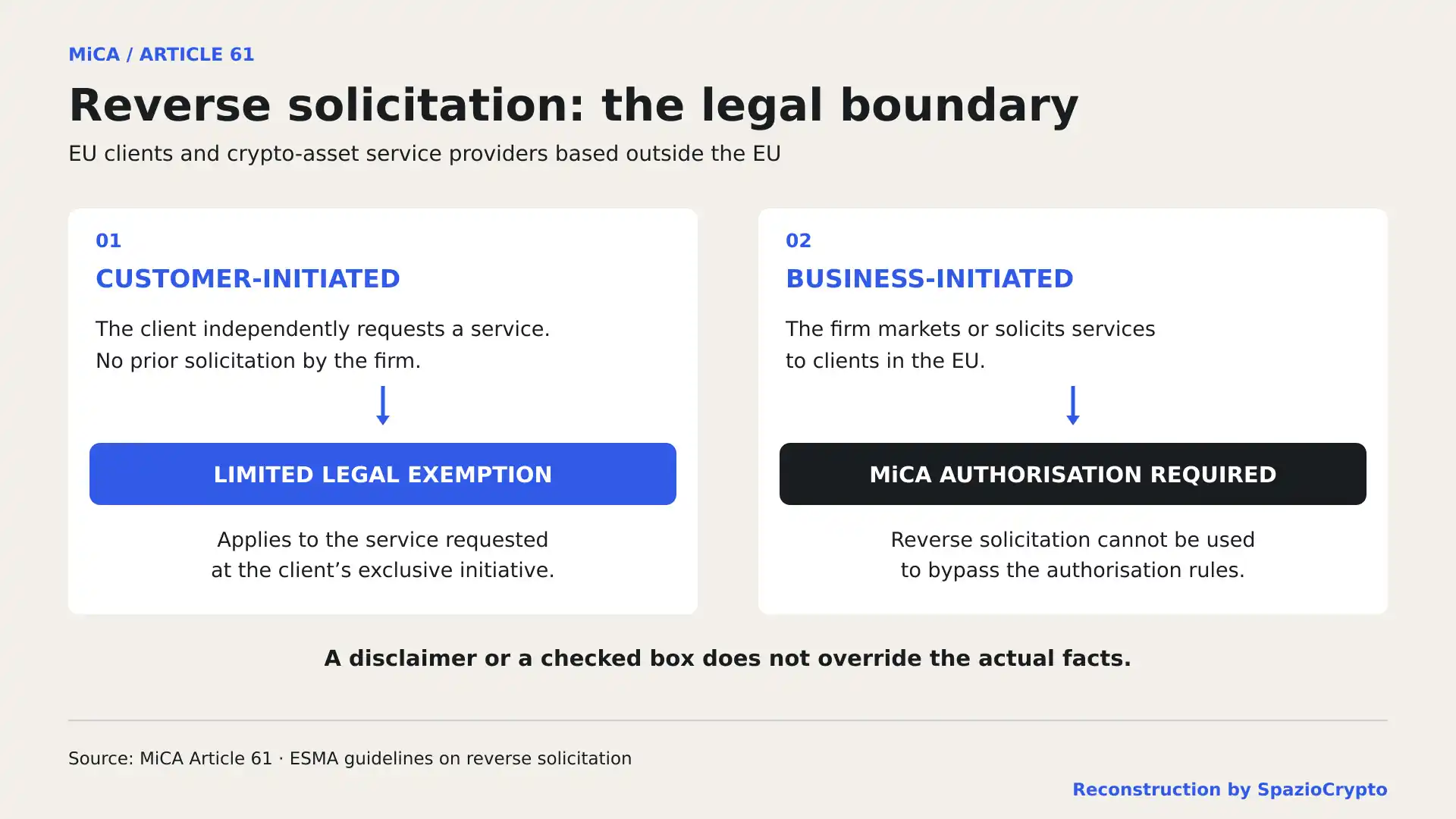
Binance is facing questions from European regulators about how it continues to serve EU clients without a valid MiCA license. According to reporting by the Financial Times, confirmed by Reuters, ESMA and national regulators in France, Germany, and Greece are examining Binance’s use of the so-called reverse solicitation exemption: a provision under MiCA Article 61 that allows a non-EU firm to serve a European client without a local license, but only when the client initiates the relationship entirely on their own initiative. At this stage, these are information requests and reviews, not a formal investigation.
The underlying legal question is not new to financial services. The same exemption has long been invoked by CFD brokers operating across multiple jurisdictions. What makes it significant now is that the maximum MiCA transitional period expired on July 1, 2026, meaning firms without authorization should have begun winding down EU operations and helping clients exit their positions in an orderly way.


How Binance Continues to Serve EU Clients
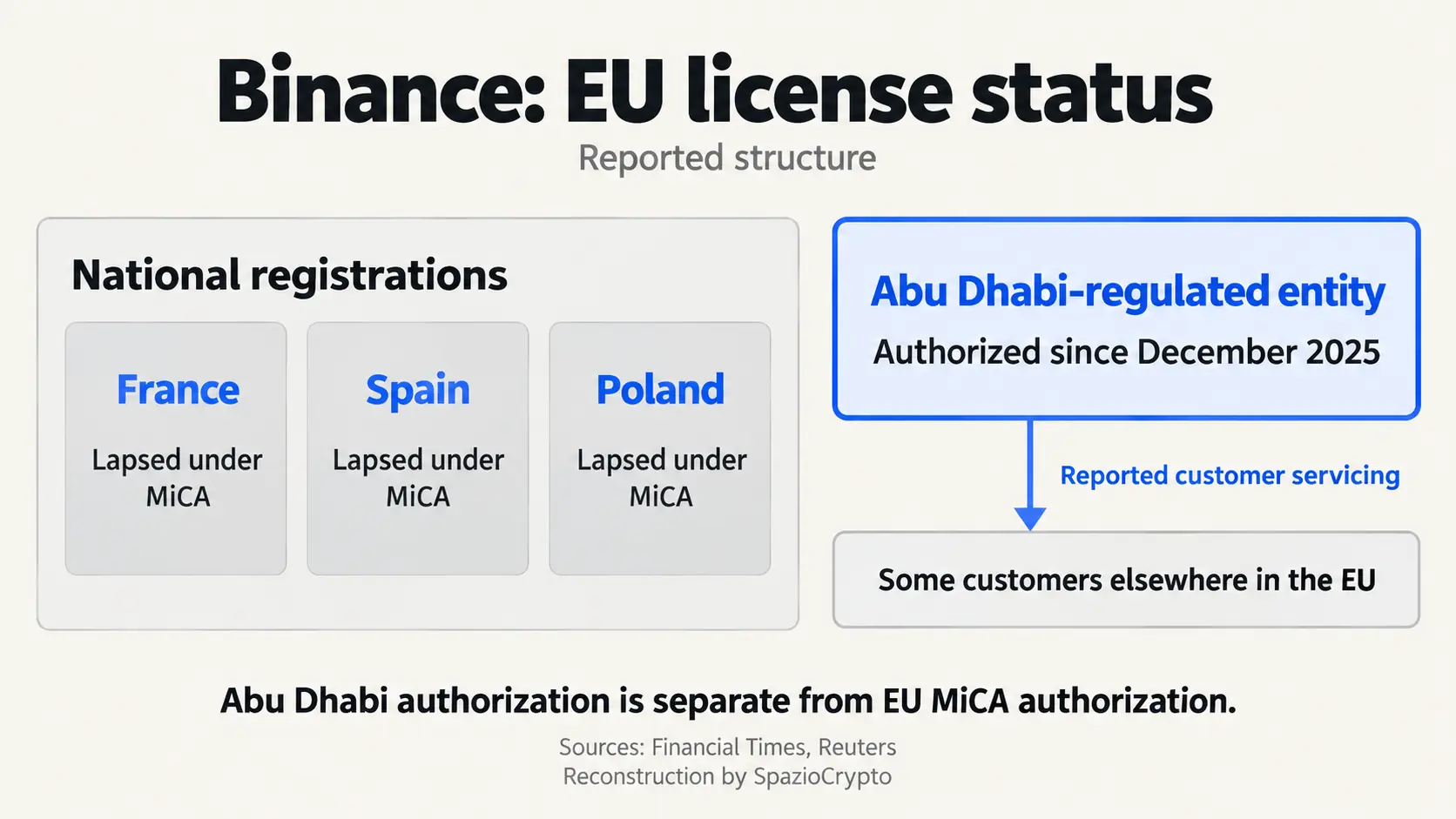
According to sources cited by the Financial Times, the local licenses Binance held in France, Spain, and Poland have lapsed under MiCA rules. In several European countries where Binance never obtained a local license, some clients are being served through a Binance entity regulated in Abu Dhabi, which received authorization in that jurisdiction in December 2025. It is this mechanism, routing EU client activity through a non-EU regulated entity, that regulators are now scrutinizing.
Several authorities have already sent formal information requests to the company, asking for specifics on how individual clients were classified as having initiated contact “exclusively on their own initiative”, the technical standard that distinguishes genuine reverse solicitation from ordinary commercial outreach. Worth noting: Binance is not the only firm under scrutiny. The Financial Times reports that smaller firms are also subject to similar reviews, placing this story within a broader supervisory sweep rather than a targeted action against the world’s largest crypto exchange.
An Exemption That Must Stay Exceptional
The Dutch regulator AFM has taken a clear public stance on the issue, stating that platforms “cannot simply claim reverse solicitation” as an automatic justification for continued operations, though it declined to comment specifically on Binance. Regulators in Germany, France, and Greece similarly declined to address the Binance case directly. ESMA has repeatedly made its position clear: this exemption is meant to cover genuinely exceptional situations, not serve as a parallel commercial channel for firms that want to keep operating in the EU single market without going through standard authorization.


Enforcement action, including potential financial penalties, remains a concrete possibility if the answers provided by firms under review do not satisfy regulators, according to the same sources. As of now, no public enforcement decision has been issued against Binance on this specific matter. A Binance spokesperson for Europe and the UK told Reuters that the company is “not leaving Europe” and that Binance maintains it operates in compliance with applicable regulations while continuing to pursue a path toward full MiCA authorization.
What We Know, Precisely
The situation as of today. Source: Financial Times, Reuters, October 1, 2026
- Confirmed: licenses lapsed in France, Spain, and Poland; EU clients served via Abu Dhabi entity.
- Ongoing: formal information requests from multiple regulators on a case-by-case basis.
- NOT confirmed: no formal investigation or public sanction has been launched.
Why This Matters Beyond Binance
The stakes extend well past Binance itself. This episode will determine, in practice, how far a major non-EU exchange can go in serving European users without a genuine MiCA passport, simply by routing activity through an entity licensed elsewhere and invoking a narrow legal exemption. A clear precedent here, in either direction, will have direct consequences for every operator in a comparable situation, including the smaller firms already identified by sources as being subject to parallel reviews.
 European Securities and Markets Authority (ESMA)
This fits into a broader moment in which the practical details of EU crypto authorization are becoming sharply defined. As our earlier analysis of KYC and AML compliance providers for European CASPs showed, there is a meaningful difference between obtaining a license and maintaining continuous operational compliance over time. The same principle applies here, on a different plane: holding a license in some EU countries in the past does not grant the right to operate across the entire single market today through regulatory shortcuts.
The Bigger Picture
This episode is, in all likelihood, the first real stress test of what MiCA’s reverse solicitation boundary actually means in practice for a large non-EU operator. For months, the debate was largely theoretical. Now, with ESMA and multiple national competent authorities actively requesting information, the question has become operational: how strictly will the EU enforce the principle that this exemption must remain genuinely exceptional?
Two things stand out. First, this situation shows that the end of the MiCA transitional period didn’t close the question of who can operate in the EU single market. It simply moved the contest to the interpretation of the regulation’s exceptions. Second, the fact that smaller operators are also under review signals a systematic supervisory approach, not a one-off action targeted at the largest exchange. Over the coming months, the outcomes of these reviews could produce the clearest guidance the sector has yet seen on where exactly the line falls between a legitimate exemption and a structured workaround. Investors and compliance officers at any non-EU platform still serving European users should treat the progress of these reviews as a direct indicator of their own regulatory exposure. For broader context on how crypto regulation is evolving in Europe, our guide on what cryptocurrencies are offers a useful starting point.