
The European Central Bank and all 27 EU national central banks formally proposed on September 22, 2026, to eliminate one of MiCA's core stablecoin reserve requirements: the obligation for issuers to hold at least 30% of reserves in bank deposits, rising to 60% for systemically significant tokens. The European System of Central Banks (ESCB), which includes the Bank of Italy among its members, submitted the proposal through the European Commission's targeted consultation on the MiCA review. The reasoning, at first glance, is counterintuitive: a rule designed to protect stablecoin reserves is now being flagged by the very central bankers who oversee the system as a potential source of new systemic risk.


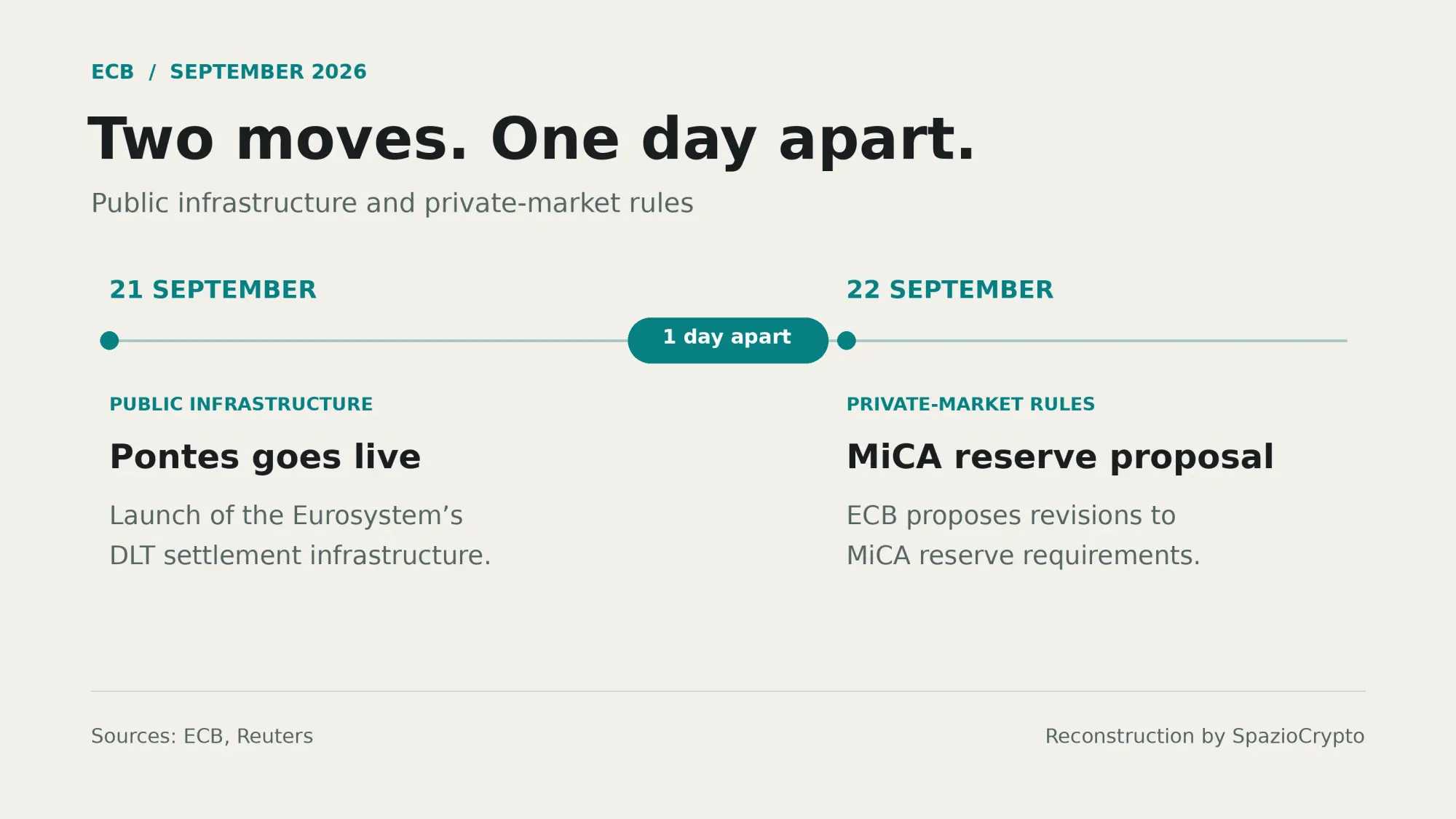
The proposal arrives just one day after the ECB activated Pontes, its infrastructure for bringing central bank money into tokenized finance. The timing is no coincidence: Europe's central banking architecture is moving on multiple fronts simultaneously, both building new rails for digital money and rewriting the rules that will govern private stablecoins operating alongside them.
What the ESCB Is Proposing
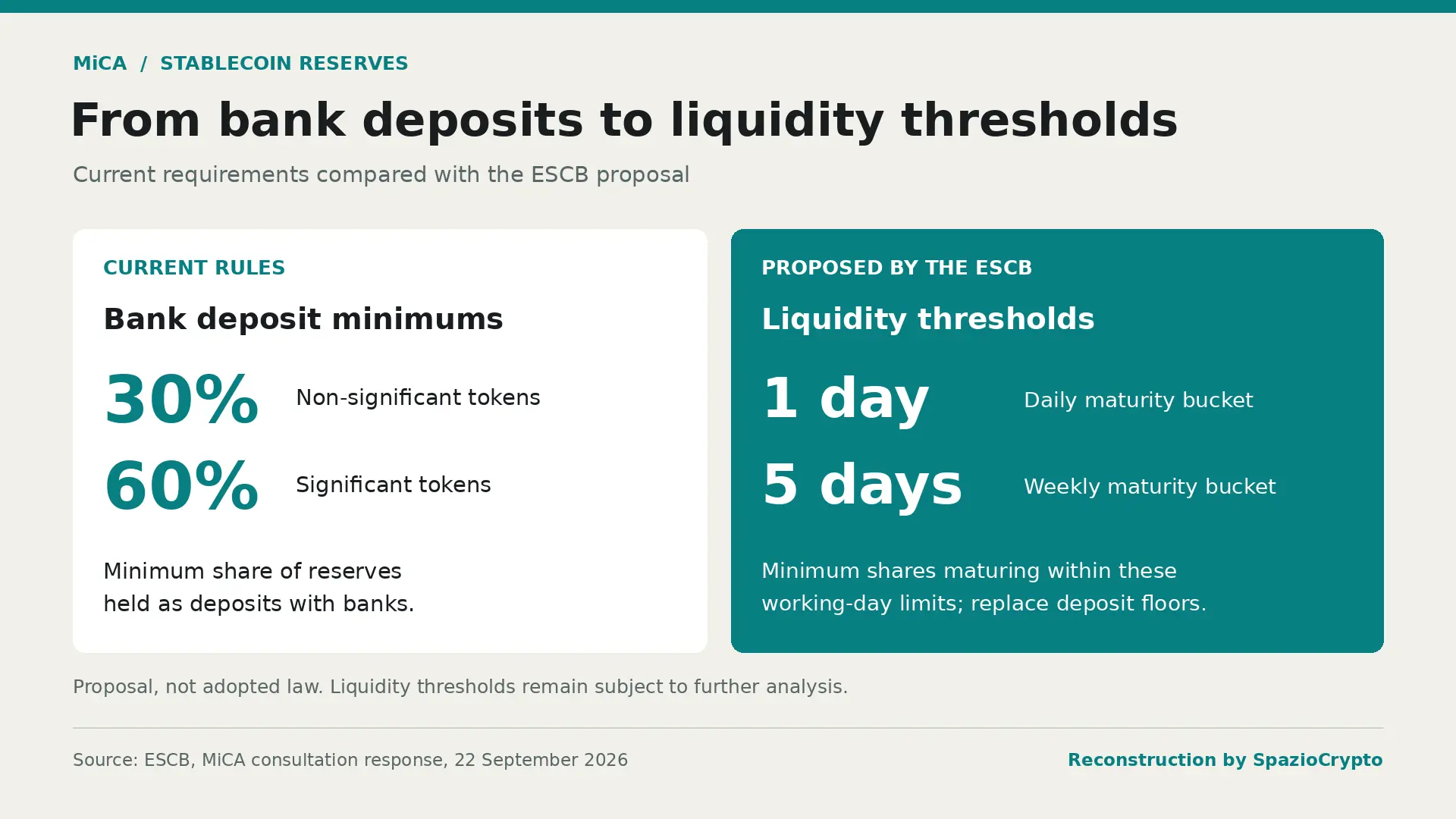
The formal request is contained in the ESCB's official response to the European Commission's targeted consultation on the MiCA review, the EU digital asset regulation that entered into application last year. Under current rules, specifically Article 54 of the regulation, stablecoin issuers must hold at least 30% of their reserves as deposits at credit institutions. That threshold rises to 60% for tokens classified as “significant”, a designation triggered when a token exceeds certain thresholds related to number of holders, market capitalization, and international usage.
The central banks are proposing to replace this rigid threshold with a liquidity-based requirement. A minimum share of reserves would need to be invested in assets with a maturity of between one and five business days, such as overnight repurchase agreements or very short-term government securities. One distinction deserves precision here: the ESCB has not proposed specific percentages for this new requirement. The submission references 2024 draft technical standards from the European Banking Authority, which indicated thresholds of 40% within one day and 60% within five days for significant tokens. Those remain EBA figures, not the central banks' own final proposal.
A Safety Rule That Creates New Risks
The ESCB's reasoning is worth unpacking carefully, because it inverts the most intuitive reading of the situation. The bank deposit requirement was introduced specifically to protect users, keeping issuer funds inside the regulated and insured banking system. But according to the ESCB submission, those deposits don't behave like ordinary stable bank liquidity. They fluctuate in line with token creation and redemption, creating a direct link between the stablecoin issuer and the bank holding its reserves.
When a stablecoin grows rapidly, large concentrations of money flow into a small number of banks. When a redemption run begins, the issuer may need to withdraw those deposits quickly, transmitting the shock from the stablecoin directly to the bank that held them. The document explicitly cites the USDC and Silicon Valley Bank episode of March 2023, when the collapse of the California-based institution temporarily put part of USDC's reserves at risk, causing the stablecoin to lose its dollar peg for several hours, according to contemporaneous reporting by Reuters and Bloomberg.
The ESCB also flags concerns about “multi-issuance” models, where the same stablecoin is issued simultaneously inside and outside the European Union, with tokens treated as interchangeable. Such a structure, the submission warns, could create liquidity problems if redemptions were to concentrate suddenly on the EU-based component.
The Proposal at a Glance
What would change. Source: ESCB, Reuters, September 22, 2026
- Today: 30% (60% for significant tokens) of reserves held in bank deposits.
- The proposal: liquidity thresholds, assets maturing within 1 to 5 business days.
- The reason: stablecoin-linked deposits can transmit financial shocks directly to banks.
What This Means for European Bank-Issued Stablecoins
This is where the story becomes directly relevant for investors and institutions watching the European stablecoin market. A change to the reserve regime isn't an isolated technical detail: it would affect the economic architecture of bank-issued euro stablecoins currently under development. The most prominent example is the consortium of nine major European banks, including UniCredit and Banca Sella, that is building a MiCA-compliant euro stablecoin known as Qivalis.
One point deserves clarity to avoid misreading: the ESCB's proposal is a systemic implication, not a decision targeting any specific project. Qivalis and all other licensed issuers remain subject to whatever rules emerge from the overall MiCA review. The direction of travel matters, though. If liquidity thresholds replace the bank deposit floor, the operational and counterparty-risk calculations for every euro stablecoin issuer shift substantially.
 European Central Bank
The euro-denominated stablecoin market remains small by any measure, with total market capitalization estimated at around $800 million according to CoinGecko data, a fraction of the dollar-denominated segment. For context, Tether, the world's largest stablecoin issuer, does not appear in the ESMA authorization register, having seen its MiCA transitional period expire on July 1. The company's CEO stated publicly that this reflects the same policy rationale that led Tether to forgo a European license application in the past, though that characterization comes from the company itself and has not been independently verified.
Two Moves, One Day Apart: Public Infrastructure and Private Rules
The timing is striking, and it reveals quite a lot about Europe's overall digital finance strategy. On September 21, as we covered in our detailed report on Pontes, the ECB activated its infrastructure for settling tokenized transactions in central bank money. Just one day later, the same institution, alongside the broader European System of Central Banks, proposed revisiting the rules governing private money circulating on-chain as stablecoins. These are two complementary pillars of one coherent strategy: build the public settlement layer first, then refine the rules for private digital money to make it safer for the financial system as a whole, not only for direct holders.
The Bigger Picture
This proposal signals a genuine evolution in how European authorities approach stablecoin regulation. The original MiCA rules were drafted primarily to protect end users, requiring that most reserve funds remain within the traditional banking system, insured and supervised. In hindsight, and in light of episodes such as the USDC-SVB crisis, central banks themselves now acknowledge that this approach, well-intentioned as it was, can shift risk rather than eliminate it, concentrating exposure on a small number of banking institutions.
Two lessons emerge for any close observer. First, this episode shows European rulemaking in a phase of genuine institutional maturity: the ECB and ESMA are willing to revisit their own frameworks when real-world experience points to unintended consequences, a sign of seriousness rather than drift. Second, it remains to be seen how the European Commission will respond to this request and what specific liquidity thresholds will ultimately be set, a decision that will directly shape the economic model of every future European bank-issued stablecoin, including Italian projects already in development. The consultation closes at the end of September, and its outcome is worth watching closely. For a broader grounding in these instruments, our guide on what stablecoins are remains a useful starting point.