
The dispute over more than 61,000 bitcoin seized in the Zhimin Qian case will be decided under Chinese law. The High Court of England and Wales ruled on October 12, 2026, that Chinese law governs the substantive rights claimed by fraud victims. The October 12 ruling does not permanently assign the bitcoin to the British state: it resolves a preliminary question that will determine how individual claims are assessed next.
The judgment is Director of Public Prosecutions v Zhimin Qian & Anor, [2026] EWHC 2509 (KB), handed down by Justice Turner and picked up by the press on October 13. According to The Block, citing the Financial Times, the seized assets are valued at approximately 3.8 billion pounds (around 5 billion dollars). That figure reflects the valuation reported in that coverage, not a price fixed by the Court.
What the High Court Decided
The Crown argued for Chinese law; the investor-claimants pushed for English law or a combination of the two. Justice Turner sided with the prosecution's position on the substantive rights underlying those claims. To determine whether the bitcoin belong to the victims, the court will now need to establish what rights arose and survived under Chinese law.
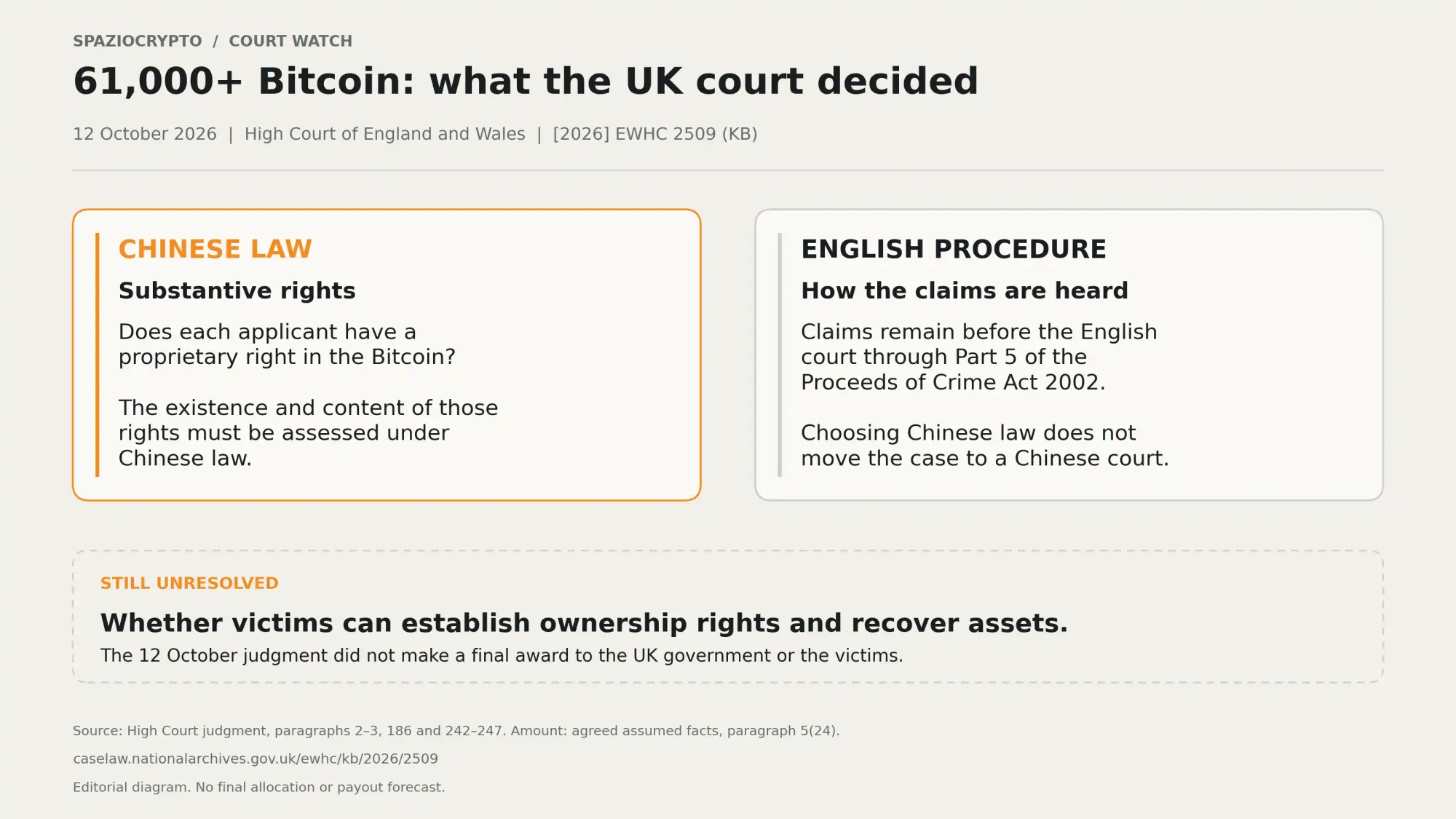
The proceedings remain before the English courts, governed by Part 5 of the Proceeds of Crime Act 2002 (PoCA). Applying a foreign law does not mean transferring the case to a Chinese tribunal. Two distinct layers apply here: the legal system that defines the rights, and the procedural rules under which those rights are enforced in a British court.
Repayment vs. Ownership: Two Different Rights
The decisive point is the difference between a debt claim against the fraudster and a proprietary right over the recovered assets. As explained by Duan & Duan UK, a firm representing several claimants, Section 281 of PoCA requires demonstrating a proprietary interest. Being a creditor for the amount lost is not, by itself, sufficient to obtain a declaration that those bitcoin belong to the victim.
A hypothetical example sharpens the distinction. If an investor deposits money and the recipient converts it into bitcoin, the question becomes whether the investor retains recognizable rights over the acquired asset or merely holds a claim for repayment. Bitcoin's price appreciation makes the difference economically significant: recovering a loss and claiming assets that have grown in value can lead to very different outcomes, and this ruling has not yet determined which.
The Contested Bitcoin: Quantity, Ruling, and Limits
Source: High Court, [2026] EWHC 2509 (KB). Quantities drawn from agreed facts; conclusions at paragraphs 242-247.
- Over 61,000 BTC. The assets subject to these proceedings include this quantity of bitcoin. This is not a new acquisition for a national reserve.
- October 12, 2026. The Court indicated Chinese law to assess the substantive rights claimed by victims; British procedure remains governed by PoCA.
- Individual outcomes remain undecided. The ruling does not quantify any repayments, does not allocate a share of gains to victims, and does not order the final distribution of assets.
Why the China Connection Is Decisive
In the agreed facts used to resolve this question, the fraudulent schemes were organized in China between 2014 and July 2017. Investor payments and the conversion of funds into bitcoin all preceded Qian's flight. The case was previously covered in SpazioCrypto's reconstruction from September 2025; the new development concerns the legal foundation for claims over recovered crypto.
Where assets are held does not, on its own, resolve who owns them. The UK's recognition of digital assets as property objects addresses a separate question from ownership in this specific case. Tracing transfers may link the original money to the bitcoin, but that process does not automatically create a right that survived under the applicable law.
The State May Keep Them, but the Outcome Is Open
According to the Financial Times, as cited by The Block, the ruling strengthens the British state's chances of retaining a significant share of the bitcoin. That is a reading of the litigation's prospects, not a provision in the October 12 judgment itself. The next step must clarify the content of Chinese law and the position of each individual claimant: the Court has not determined that all victims are without rights.
The Block also reports that Fieldfisher, the lead firm for the individual claimants, told the Financial Times it intends to appeal the decision. Duan & Duan UK stated in its published analysis that it will review the ruling with clients and continue pursuing their claims. These statements document the lawyers' positions. They do not confirm that an appeal has already been filed or accepted by any court.
The Bigger Picture
An asset can circulate across a global network while the rights to that asset depend on relationships formed under a specific national legal system. The Qian case makes this gap visible: recovering the crypto is an investigative achievement; establishing who can claim it is a separate legal question entirely. In SpazioCrypto's earlier analysis of the Capstone and EQIBank proceedings in the United States, the content of court documents remains the benchmark for separating what was actually decided from journalistic interpretation, even across different legal systems.
What's at stake goes beyond custody of the bitcoin: it concerns who can benefit from value that accumulated after a fraud and what evidence is required to claim it. Reading future developments in this case will require keeping three threads separate: the applicable law, the existence of rights, and the actual recovery of assets. The October 12 decision clarifies the first thread. The other two remain to be resolved.