

Tokenized asset custody faces four concrete barriers, according to a study published on November 17 by Banca d'Italia: a fragmented ecosystem, insufficient liquidity, risk manager caution, and unresolved legal questions. The paper, authored by Michele Corio and Ferdinando Mastropietro as part of the bank's “Markets, Infrastructures, Payment Systems” series (No. 97), examined 11 major operators active in tokenization during the second half of 2025. Its core finding is striking: the only custody service that has genuinely reached stable production in native digital form is private key custody. Everything else remains under construction.
TL;DR: A Banca d'Italia research paper (No. 97, November 2026) identifies four obstacles slowing tokenized asset custody: ecosystem fragmentation, low liquidity, risk manager caution, and legal uncertainty. The paper, based on interviews with 11 major operators, concludes that intermediaries are not disappearing but evolving into “trust nodes” between distributed ledgers.
Methodology: 11 Interviews, a Tight Scope
The study combines a literature review with semi-structured interviews conducted with 11 large operators in the second half of 2025. The sample includes European and international central securities depositories, two of the world's top five custodian banks, a trading platform active in both traditional finance and distributed ledger markets, euro-area central banks, technology providers, and financial messaging infrastructure firms. Names were not disclosed.
The scope is precise. The analysis covers assets originally issued in traditional form and then re-issued on a distributed ledger. Native crypto-assets and stablecoins are explicitly excluded. This is a qualitative sample, not a statistically representative survey: it captures the sentiment of infrastructure builders, not market size.
The Market in Three Numbers
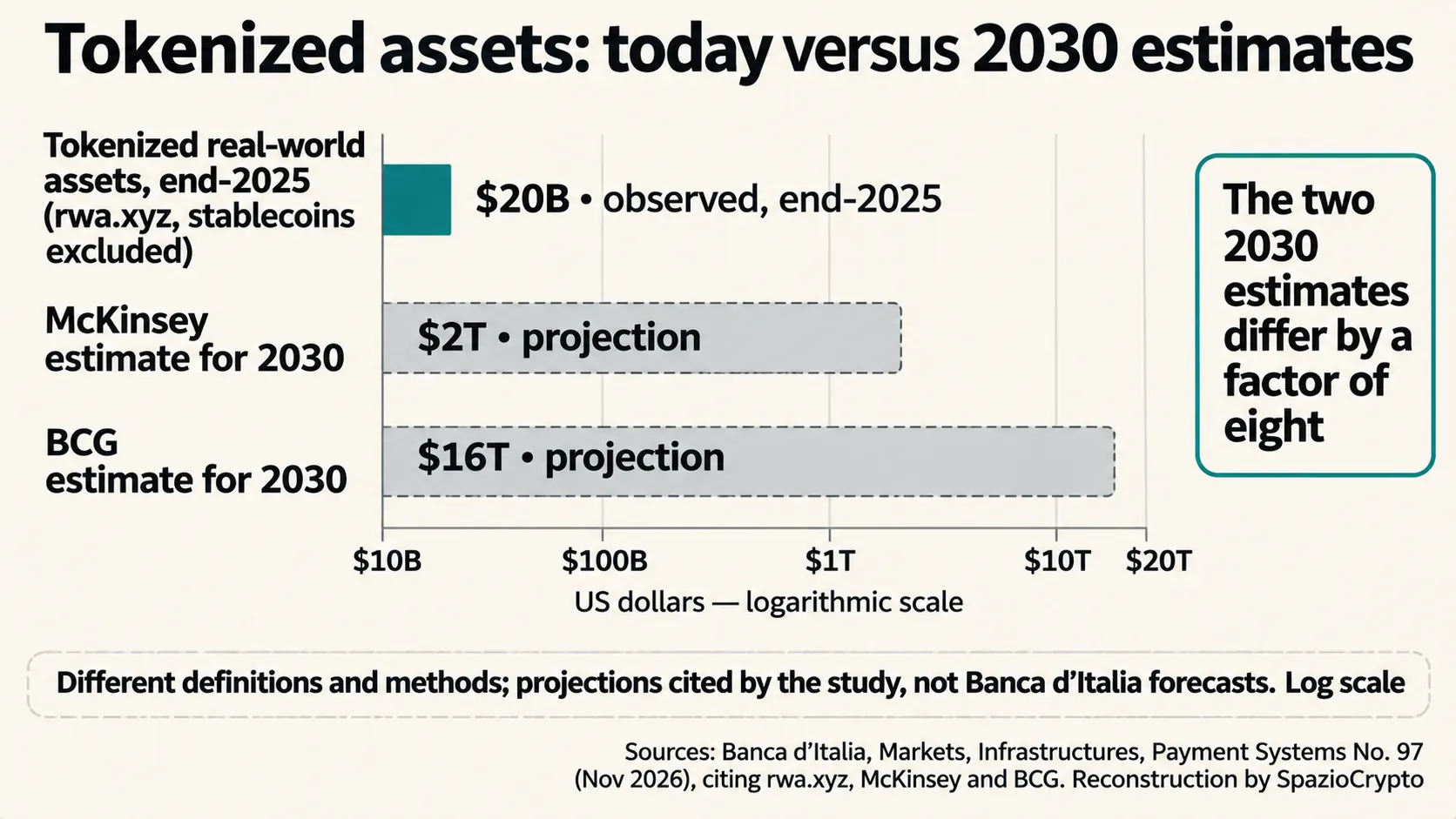
The first number is current scale. According to rwa.xyz data cited in the paper, the real-world asset tokenization market was worth approximately $20 billion at end-2025, excluding stablecoins. The second is the gap between forecasts: McKinsey estimates roughly $2 trillion by 2030, while Boston Consulting Group puts the figure at around $16 trillion. That eightfold divergence, the authors note, reflects how deep the uncertainty still runs.
The third number is the efficiency gains expected from tokenization, estimated at between $31 billion and $130 billion per year. Real-world experiments are already underway. The paper cites the Eurosystem's settlement trials in central bank money, which involved 64 participants across 9 jurisdictions and settled 1.6 billion euros. It also references the European Investment Bank's 100 million euro digital bond issued on Ethereum. Among private-sector examples, BlackRock's BUIDL money market fund appears, with BNY as custodian, the same model BlackRock is extending to tokenized funds in Japan.
Four Obstacles in Detail
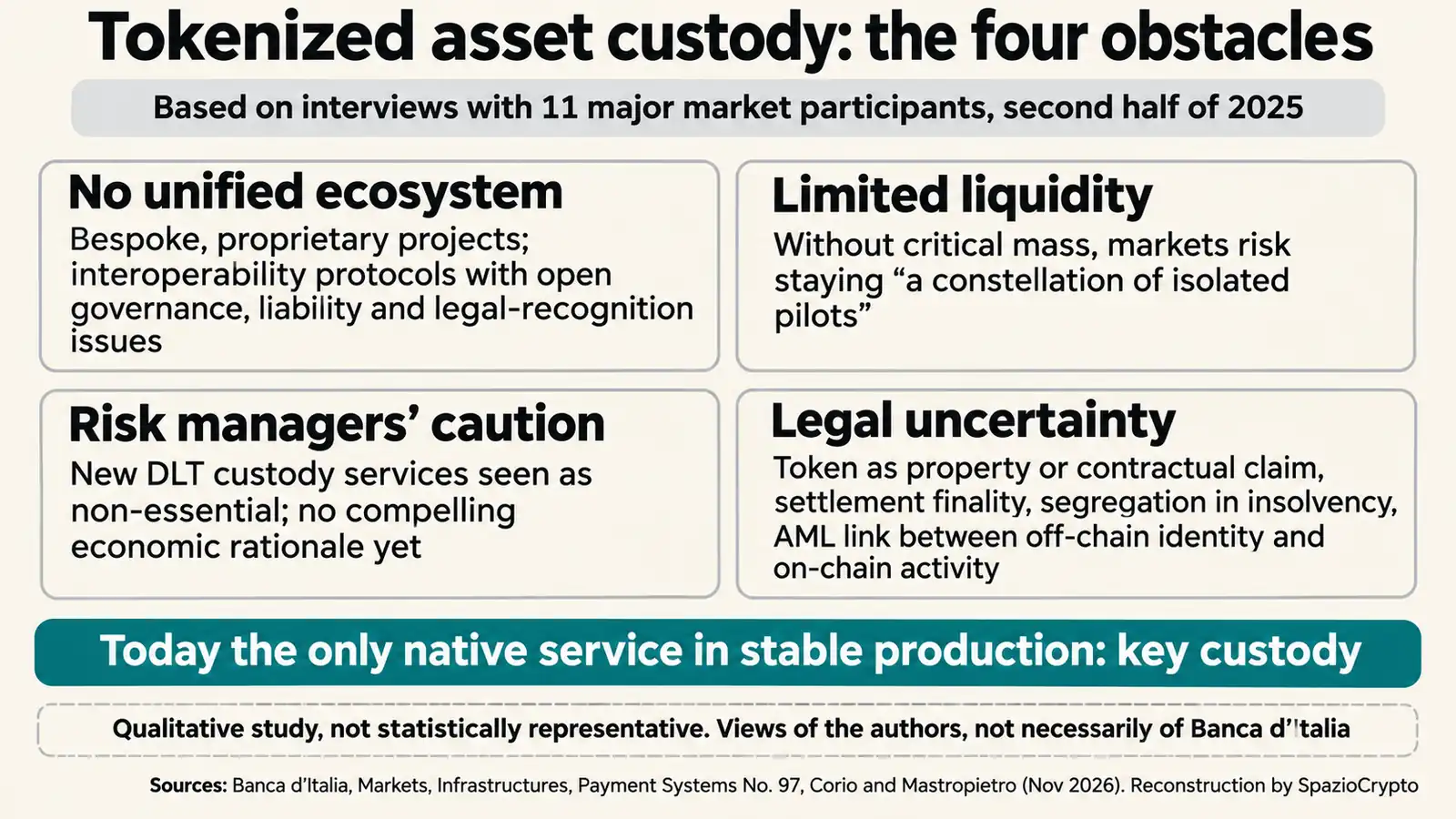
The first barrier is the absence of a unified ecosystem. Projects are built to custom specifications on proprietary platforms that cannot communicate with each other. Interoperability protocols exist on paper, but governance, liability, and legal recognition remain open questions without settled answers.
The second is liquidity. Without a critical mass of issuances and trades, the authors write, tokenized markets risk remaining “a constellation of isolated pilot projects” rather than functioning markets. The dynamic is self-reinforcing: low interoperability produces low liquidity, and low liquidity removes incentives to invest in interoperability.
The third obstacle is risk manager caution. Inside large institutions, new digital custody services are frequently classified as non-essential, because traditional solutions still work. The paper identifies a missing economic case: there is no compelling reason, today, for major custodians to absorb the operational and reputational risk of change.
The fourth is law. Several decisive questions remain unanswered. Does a token represent a property right or a contractual claim? When does settlement on a distributed ledger become final and irrevocable? How are client assets segregated within a digital wallet in an insolvency? How does off-chain identity link to on-chain activity for anti-money-laundering purposes? The paper references the EU's DLT pilot regime and the capital markets integration package presented in 2025, but stops short of proposing a regulatory solution.
From Vaults to Validations
The paper's title, “From Vaults to Validations,” captures its central argument. Distributed ledger technology does not eliminate custody; it transforms it. The shift runs from custody of the asset itself to custody of access to the asset. Whoever controls the private key controls the asset, and losing that key means losing the asset permanently. That is why private key custody, using technologies such as hardware security modules and multi-party computation, is identified as the only natively digital service to have reached stable production today.
Everything else is still being built. The functions a custodian performs today, from register reconciliation to corporate action management, become real-time controls embedded in smart contracts, validator nodes, and oracles. A custodian in a tokenized environment must ensure each token maps to a valid off-chain position, prevent double issuance, and segregate client assets. Individual on-chain segregation, the paper notes, is offered by very few operators, while account-based segregation remains easier to demonstrate in insolvency proceedings.
Intermediaries Are Not Disappearing
The conclusion cuts against one of the sector's most persistent narratives. “Tokenization does not reduce the need for trusted intermediaries,” the authors write, and the disintermediation thesis deserves more scrutiny than it typically receives. Custodians and central securities depositories could instead evolve into a “trust node” and an interoperability agent bridging different ledgers.
The path described by the interviewed operators is gradual, hybrid, and regulation-led. The prerequisite they identify is standardization: common token formats, smart contract templates, interoperability protocols, and uniform AML rules. That agenda intersects directly with the work European central banks are conducting on MiCA and stablecoins and with the Financial Stability Board's work on cross-border risks.
The Banca d’Italia Study at a Glance
What is confirmed, and what is not
- Confirmed: four obstacles to tokenized asset custody; interviews with 11 operators in the second half of 2025; private key custody as the only natively digital service at stable production stage.
- Not stated: names of the operators interviewed; an official Banca d'Italia policy position; regulatory proposals or adoption timelines.
- To watch: progress of the European capital markets integration package; interoperability standards; and the first custody offerings beyond key management from major European custodians.
What This Means for European Investors
Reading the paper through a European market lens, the debate has quietly shifted from “whether” to “who.” The code to tokenize a bond already exists. What is missing is the accountable counterparty, the judge who knows how to treat a tokenized security in bankruptcy, and the secondary market where it can be sold. For European custodians and financial institutions entering digital asset services under MiCA, the custody layer is precisely where today's competitive advantage can compound fastest. The paper's finding that intermediaries survive, but in a transformed role, is more commercially significant than it might appear.
This is not the first time Banca d'Italia has approached digital finance with analytical precision: the same realism appeared in its earlier study on stablecoins and bank deposits. The message is consistent: technology is not the bottleneck. Rules, standards, and institutional trust are. Three signals are worth watching: the first on-chain segregated custody offering from a major European bank, approval of the EU capital markets integration package, and tokenized asset values breaking clear of the pilot-project range.
Sources
Study: Banca d’Italia, Markets, Infrastructures, Payment Systems No. 97, Michele Corio and Ferdinando Mastropietro, “From vaults to validations: what is the future of asset servicing in the era of tokenization?”, November 2026. Press release: Banca d’Italia, “Dalla custodia alla validazione: qual è il futuro dei servizi finanziari nell’era della tokenizzazione?”, 17 November 2026. Publication page: Banca d’Italia, No. 97.