

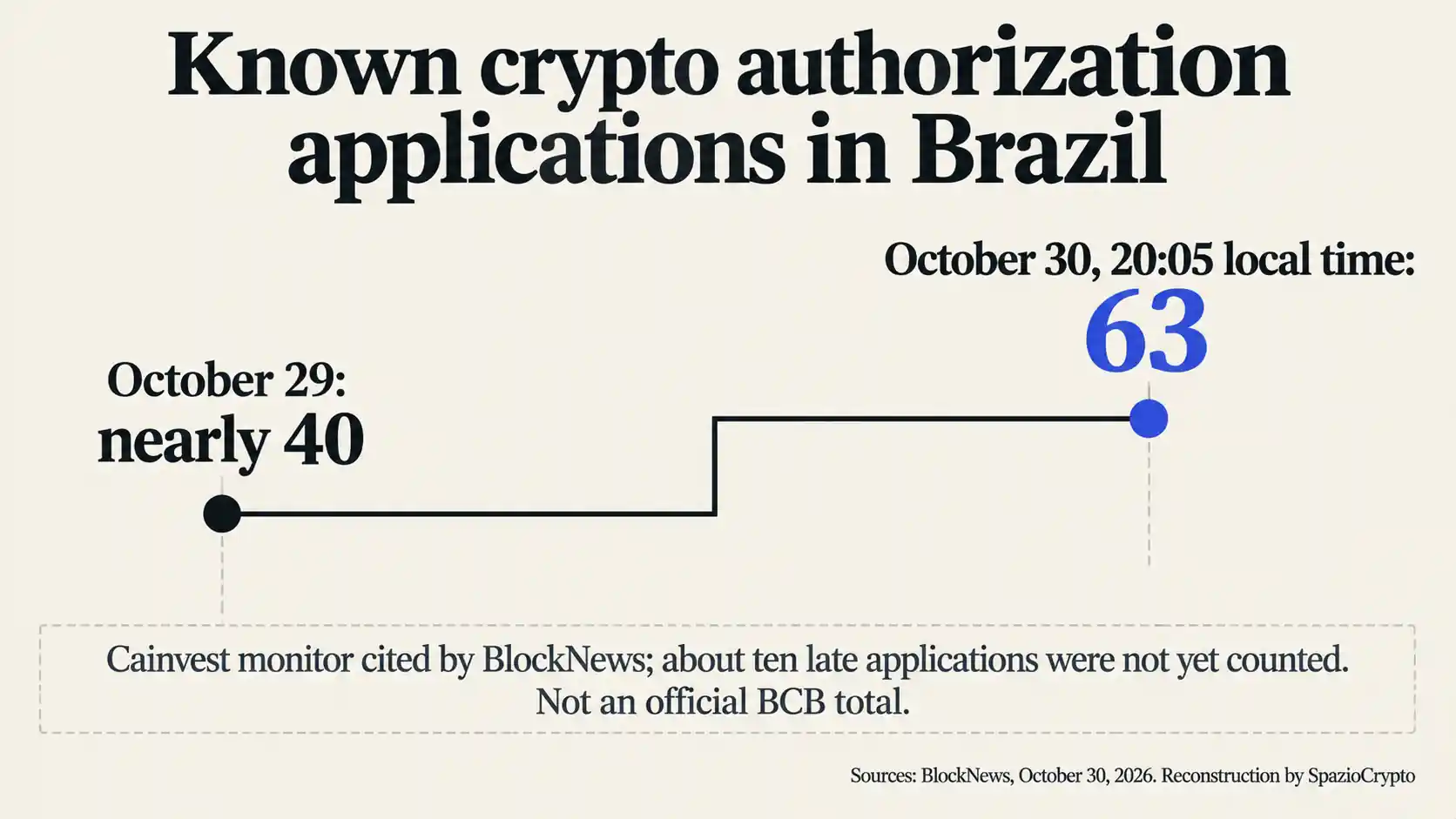
At least 63 cryptocurrency operators had filed applications with Brazil's Banco Central do Brasil by the October 30 deadline, seeking authorization to continue operating as virtual asset service providers in Latin America's largest economy. The count, updated to 8:05 p.m. local time and reported by BlockNews based on monitoring by Cainvest, is not an official figure from the Banco Central. Around ten additional applications received in the final hours were not yet included, meaning the actual total could be higher.
Among the companies named by BlockNews are Bitget, Kraken, BTG Pactual, and Banco Rendimento. OSL Brasil separately confirmed it had filed its own application with the Banco Central for its Brazilian subsidiary.
What the October 30 Deadline Required
Brazil's Resolução BCB 520 introduced a mandatory authorization requirement for companies that were already providing certain virtual asset services when the rule entered into force on February 2, 2026. Firms had 270 days to comply. Instrução Normativa BCB 704 set October 30 as the cutoff for submitting the first-phase documentation.
Filing an application starts the review process, but it does not grant a license. The Banco Central must still examine each submission and can request additional documents or clarifications at any stage. OSL's own press release made this point explicit: submitting the application does not guarantee approval.
For operators that filed within the deadline, Resolução 520 allows them to continue providing the relevant services until the review process is complete. During that interim period, they cannot change their operating model. Companies that missed the October 30 deadline must cease those services within 30 days of the cutoff.
The Count Is Provisional
The 63 applications known as of 8:05 p.m. come from Cainvest's monitoring, as cited by BlockNews, not from any official Banco Central registry. According to BlockNews, Cainvest's list showed applications spread across several Brazilian states, with some under active review, others scheduled for a decision, and others awaiting documents or responses from the firms. The list also included one application that appeared subject to challenge and one that had already been rejected.
The figure does not mean 63 authorizations have been granted, nor that all submissions are complete or destined for approval. About ten recent filings were not yet captured in the count at the time of reporting. BlockNews's headline referenced roughly 70 companies. The article body logged 63 applications as of 8:05 p.m. and flagged subsequent filings as uncounted. The most accurate read is that at least 63 applications were on record at that hour, with the total still being updated.
November 6: A Separate Banking Restriction Kicks In
The authorization application and the rules governing relationships with banks and payment institutions are two distinct regulatory tracks. Resolução BCB 589 amended Article 91 of Resolução 520: from November 6, 2026, onward, banks, payment institutions, and other entities supervised by the Banco Central will not be able to execute or facilitate operations in the virtual asset market with providers that are not authorized to operate in Brazil, except in circumstances expressly permitted by the regulation.
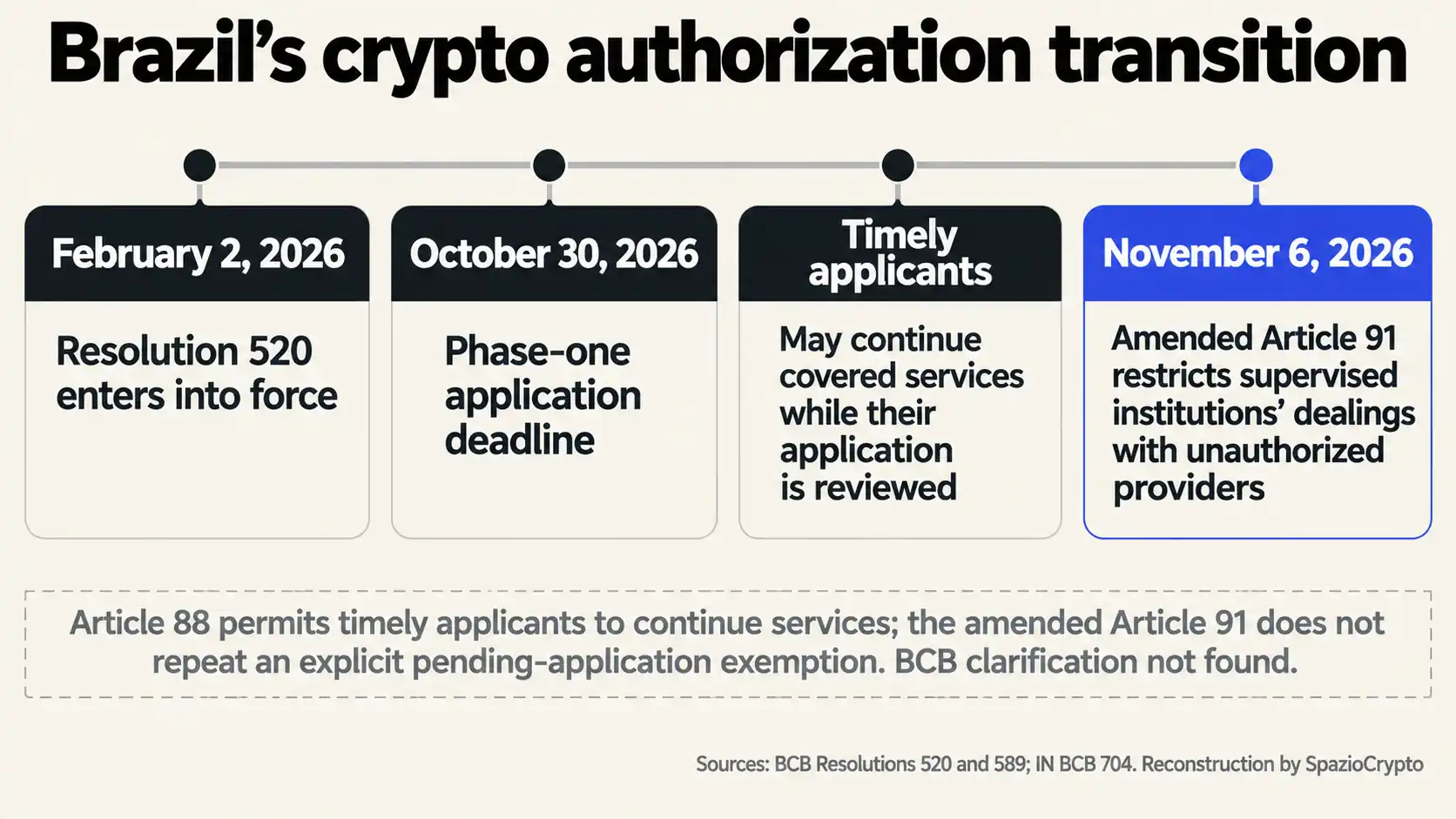
There is a tension worth understanding here. Article 88 of Resolução 520 allows operators that filed on time to keep providing services while their application is under review. The updated text of Article 91, by contrast, refers to “unauthorized counterparties” and does not explicitly repeat the carve-out for entities “in the process of authorization” that appeared in the earlier version. The two provisions together create a transitional continuity for applicant operators and a restriction on transactions intermediated by supervised entities. The sources reviewed for this article do not clarify how the Banco Central will coordinate these two rules in practice from November 6 onward.
The Banco Central has framed the regulatory changes as a way to improve market monitoring and give operators greater predictability. For crypto companies, the immediate task has shifted from meeting the application deadline to satisfying documentation requirements and managing relationships with licensed intermediaries.
OSL Brasil Confirms Its Filing
OSL announced on October 30 that its subsidiary OSL Brasil had submitted an application as a virtual asset service provider, the category identified in Brazil by the acronym PSAV. The company described the filing as part of its commitment to operating in the country, while clarifying that the outcome depends entirely on the Banco Central's assessment.
For now, OSL's direct confirmation stands alongside journalistic monitoring for the other companies named in reports. Without a comprehensive official list from the Banco Central, company names and application counts should be attributed to the sources that reported them. The October 30 deadline marks the start of the review phase, not the end of the authorization process. Operators and market participants should expect this process to extend through much of 2026, with the November 6 banking restriction adding a separate layer of compliance pressure in the weeks immediately ahead.