


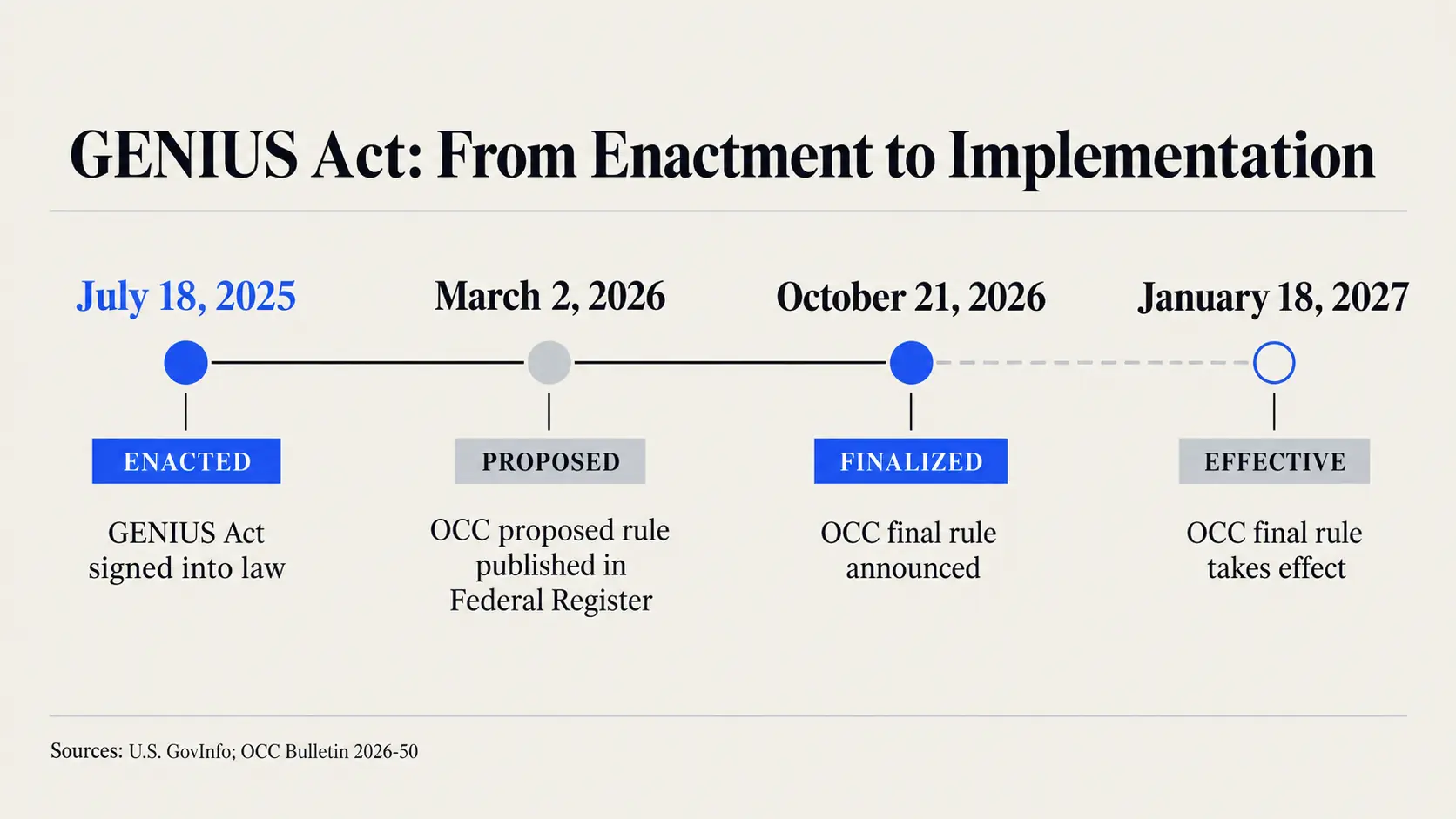
On October 21, 2026, the Office of the Comptroller of the Currency published the final rule implementing the GENIUS Act for stablecoin issuers under its supervision. The most debated provision covers stablecoin yields: an issuer cannot pay interest or yield to a holder simply because that holder holds, uses, or stores a payment stablecoin. At the same time, the OCC dropped the rebuttable presumption that would have automatically flagged certain third-party and affiliate arrangements as violations. That's not a blanket green light for reward programs. Every structure will be evaluated on its own facts and economic substance.
The Key Distinction: Ban vs. Presumption
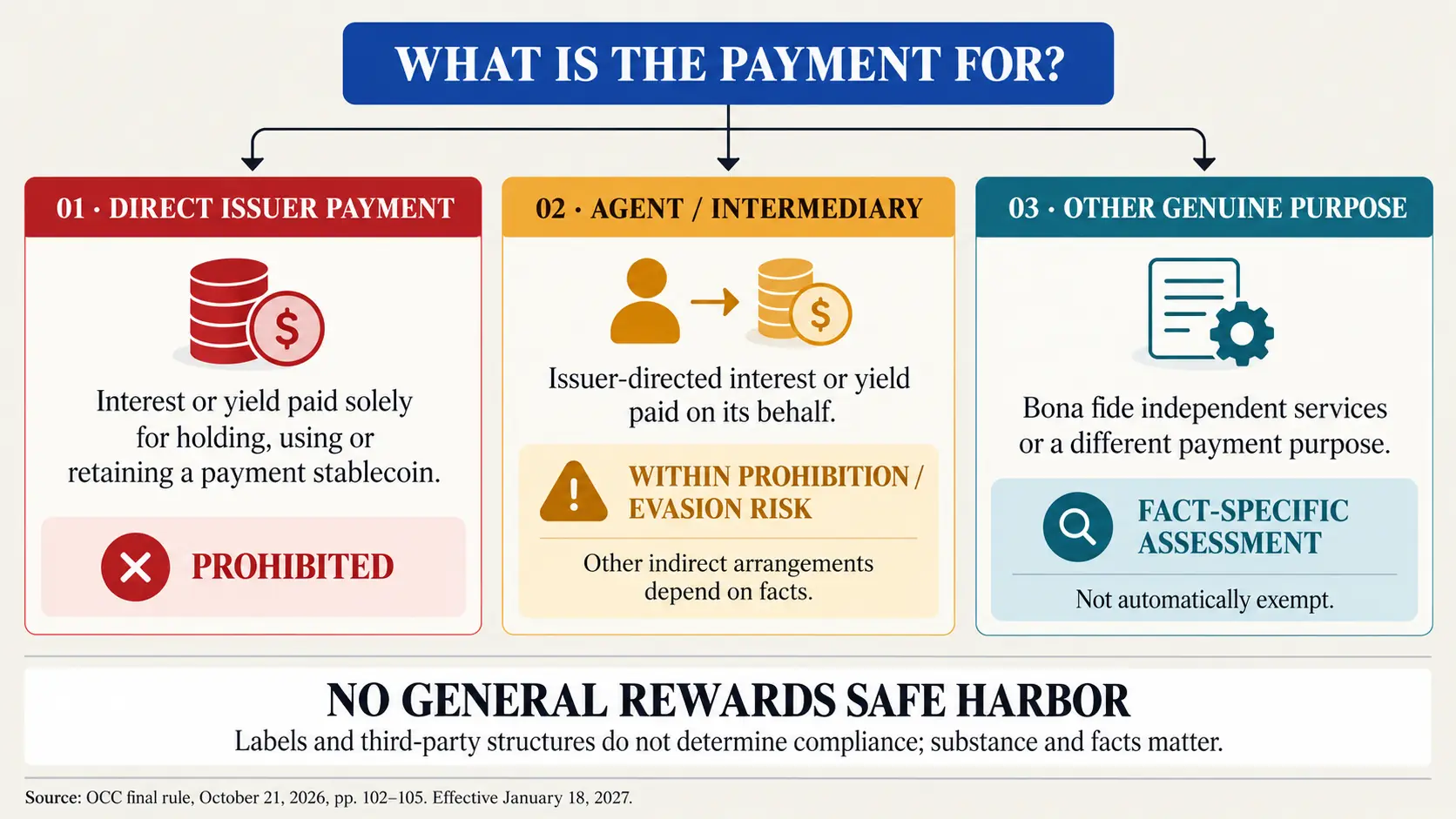
The rule's core is not the disappearance of the prohibition. The GENIUS Act still bars any licensed issuer, whether a U.S. institution or a foreign entity subject to OCC jurisdiction, from paying a holder any form of interest, yield, cash, tokens, or other benefit when that payment depends solely on the holder's decision to hold, use, or store the payment stablecoin.
What changed from the OCC's earlier proposal is the evidentiary mechanism. The draft rule included a rebuttable presumption for certain issuer-affiliate and third-party relationships. Under specified contractual conditions, a third-party payment would have been treated as an issuer payment from the outset, placing the burden of proof on the parties to show otherwise.
In the final rule, the OCC removed that presumption. According to the regulator, it risked being both too broad and too narrow simultaneously. It could have swept in legitimate arrangements and imposed disproportionate compliance costs, while also signaling to the market that structures failing to trigger the presumption were automatically permissible.
The OCC opted instead for fact-based supervision. The agency will examine arrangements during authorization procedures and ongoing oversight. If it identifies a violation or an attempt to circumvent the ban, it retains full authority to intervene. The practical difference is significant: what disappeared is an automatic legal trigger, not the oversight itself.
Why This Is Not a Blanket Approval for Rewards
The final rule does not include a list of permitted reward programs, nor does it create a safe harbor for arrangements already in place before the GENIUS Act. The OCC specifies that pre-existing programs will be assessed using the same criteria applied to programs launched after the law takes effect. Labeling a payment a “reward,” “incentive,” or “cashback” does not place it outside the prohibition.
The operative question is whether the economic benefit is, in substance, interest or yield paid by the issuer solely because of the holder's relationship with the stablecoin. A payment made by an agent on behalf of an issuer can fall within the ban. Routing funds through a third party so that party compensates the holder may also constitute evasion.
Conversely, the OCC notes that consideration for genuine services, absent contrary indicators, is not typically prohibited because it has a cause other than mere token holding. The same logic applies to transaction-linked payments: they are neither automatically lawful nor automatically unlawful. Regulators will verify whether they represent yield and whether they derive exclusively from the customer's stablecoin relationship.
This explains why the ongoing industry dispute between crypto firms and banking lobbies over intermediary-offered rewards was not resolved with a simple yes or no. The outcome will depend on the source of funds, the contractual relationships involved, the degree of control exercised by the issuer, and the economic purpose behind the payment.
What the OCC Final Rule Actually Covers
The document goes well beyond the yield question. It establishes the regulatory framework for subsidiaries of insured national banks and federal savings associations, for qualified nonbank federal issuers, for certain state issuers, and for foreign issuers seeking to operate in the United States.
The rule governs permitted activities, reserve composition and management, liquidity, diversification, redemptions, risk management, audits, reporting, custody, authorization applications, and registration. It also introduces more detailed capital and operational support requirements than the earlier proposal, while preserving a risk-proportionate approach calibrated to each institution's activity profile.
The operative date for the market is January 18, 2027. That is the same deadline around which GENIUS Act compliance timelines are being structured industry-wide. From that date, entities supervised by the OCC must comply with the final rule, while other federal regulators continue completing their own rulemaking for institutions under their respective jurisdictions.
Reserves and Redemptions Remain the Prudential Core
The OCC states it modified the proposal to allow greater flexibility in reserve management while preserving liquidity, diversification, and concentration requirements. The stated objective is to ensure issuers remain adequately covered and capable of meeting redemption requests in a timely manner.
This design distinguishes a payment stablecoin from an investment product. The token must be convertible or redeemable for a fixed monetary amount, and the issuer must back that promise with eligible assets and operational controls. The prohibition on paying yield directly to holders fits the same framework: a payment stablecoin is treated as a payment and settlement instrument, not as a yield-bearing deposit.
The OCC rule is one of the parallel regulatory tracks the GENIUS Act established. The Federal Reserve has initiated its own framework for issuers under its supervision. The distinctions between regulators matter because the GENIUS Act allocates jurisdiction based on institution type, not on the stablecoin itself.
Banking Industry Objections and Consumer Protection
The American Bankers Association, in comments published October 21, 2026 via the ABA Banking Journal, considers the yield prohibition framework too restrictive. The banking sector's concern is that elevated stablecoin rewards could draw funds currently held in bank deposits, reducing the resources available for lending. The actual scale of that effect is not quantified in the final rule: the OCC itself acknowledges the outcome will depend on market growth, where issuers hold their reserves, and the stability of those funds.
On the consumer side, comparisons with bank accounts require care. A program offering yield on stablecoins does not thereby acquire FDIC deposit insurance protection. The final rule does not expand the scope of existing consumer protection laws and does not create any federal guarantee equivalent to FDIC coverage for token holders.
For intermediaries, the room created by case-by-case evaluation also carries a transparency obligation. Presenting a reward program as if it were indistinguishable from bank deposit interest could mislead customers about product nature, risk, and protections. That is one reason the broader U.S. legislative debate over stablecoin yield will remain open even after this rule takes effect.
What Remains Outside the Final Rule
The rule does not close every chapter of the GENIUS Act. Bank Secrecy Act requirements, anti-money laundering obligations, counter-terrorist financing rules, and sanctions evasion measures will be addressed separately. Also outside the rule's scope are tax treatment, antitrust questions, the general regulation of decentralized finance, and asset types other than payment stablecoins.
The OCC also declined to publish a binding catalog of examples distinguishing permissible rewards from prohibited ones. The agency chose deliberately to apply the statutory text to the specific circumstances of each arrangement. This reduces the risk of easily gamed bright-line rules, but it leaves operators with an area of interpretive uncertainty that future supervision and guidance may gradually fill.
The Broader Reading
The most accurate interpretation is that the OCC chose supervisory flexibility, not deregulation. By removing the presumption, the agency avoids pre-classifying entire categories of arrangements. By preserving the prohibition and anti-evasion powers, it retains the ability to trace who actually funds a yield and why.
For issuers and platforms, the commercial name of a reward program will matter far less than the underlying contracts, cash flows, control structures, and economic substance. It is on those elements, not the word “reward,” that compliance will be measured from January 18, 2027 onward. Teams advising on stablecoin product design should build fact-pattern documentation now, before the OCC's first wave of authorization reviews begins.
Sources
- OCC, Bulletin 2026-50 and final rule, October 21, 2026
- OCC, full text of the final rule, October 21, 2026
- Associated Press, analysis of the yield prohibition, October 21, 2026
- American Bankers Association, comment on the final rule, October 21, 2026