


The European Banking Authority (EBA) is urging the European Commission to assess new requirements for crypto-asset service providers (CASPs) that guide clients into decentralised finance protocols, particularly lending. In a report published on November 25, the EBA describes how stablecoins and e-money tokens (EMTs) function as liquidity, collateral, and settlement instruments inside DeFi, and flags consumer risks alongside potential regulatory arbitrage. This is a recommendation aimed at the MiCA review process, not an approved rule, and it does not make DeFi lending automatically illegal.
The EBA press release confirms the core findings and links to the technical report. SpazioCrypto also reviewed CoinDesk’s coverage, which details several possible interventions discussed in the document. The full EBA PDF was not accessible via standard consultation tools; details not present in the press release are therefore attributed to press reporting.
Why Stablecoins Sit at the Heart of DeFi
Stablecoins do far more than help traders exit volatility. Inside lending protocols, they supply liquidity to pools, serve as collateral for acquiring other assets, and settle transactions. The EBA notes that certain EMTs issued under MiCA are already being used in these roles. A token designed to hold a stable value can, in practice, become a central component of loans, trading, and guarantee structures.
That centrality creates a live connection between decentralised protocols and regulated entities. The EBA warns that stress in one protocol could transmit to EMT issuers or to CASPs offering a gateway into DeFi. The issue intersects with the broader debate on stablecoins and banking deposits: economic functions evolve, and so does the type of protection a client can reasonably expect.
What Consumer Risks Does the EBA Identify?
The report lists inadequate disclosure, high-leverage positions, failure to recover lent stablecoins, and operational vulnerabilities. Under these conditions, a user can lose their entire invested capital. A stable token price does not make the loan value stable, does not guarantee repayment by the borrower, and does not protect against protocol errors or exploits.
That distinction matters even when a client enters DeFi through an exchange app. A simpler interface does not eliminate underlying risks, and a CASP’s MiCA authorisation should not be read as a guarantee that every product linked to a decentralised protocol carries the same protections. The boundary between compliant and non-compliant stablecoins, and the services CASPs offer around them, is precisely where the exposure lies.
The EBA also flags the effect of new AI-powered interfaces and applications, which can lower the technical barrier to entry. Making access easier may expand usage, but it does not automatically reduce credit, market, or operational risk. The risk profile inside a lending protocol is distinct from simply holding a stablecoin: liquidation rules, collateral requirements, and smart contract conditions all enter the picture.
How Could DeFi Sidestep Some MiCA Rules?
MiCA governs the issuance and offering of e-money tokens, as well as the services provided by intermediaries. The regulation explicitly excludes services provided without intermediaries in a fully decentralised manner. That boundary, between protocol and intermediated access, is exactly what the EBA considers significant: a CASP can remain the client’s entry point even when the actual loan is executed by a smart contract.
According to the EBA, certain DeFi structures could be used to circumvent public offering requirements, trading admission rules for EMTs, or the prohibition on paying interest on these tokens. The report identifies a risk of regulatory arbitrage, not proof that every protocol or yield-generating product violates MiCA. For clients, the legal and operational difference between a yield paid by an issuer and one generated by lending activity is real and consequential.
The debate over yields is not confined to Europe. In the United States, final rules under the GENIUS Act draw a distinction between issuer payments and certain third-party programmes regarding stablecoin interest. That framework differs from MiCA and cannot be mapped onto it directly, but it illustrates why regulators globally focus on the economic substance of a cash flow, not its commercial label.
What Should the European Commission Do?
The EBA is renewing a recommendation it had already submitted in response to the EU consultation on the MiCA review: the Commission should consider whether to introduce additional requirements for CASPs that facilitate DeFi access, particularly for lending. As reported by CoinDesk, options discussed in the document reportedly include suitability checks, enhanced disclosure, leverage limits, and a possible certification framework for lending protocols. These options do not constitute a legislative text that has been tabled or adopted.
The regulatory question is therefore narrower than a sweeping “DeFi crackdown.” The recommendation targets entities that act as bridges between users and protocols. It does not establish that the EBA has the authority to directly authorise or prohibit decentralised software. For firms operating across the EU, the scope of CASPs and the controls required of intermediaries will determine how any eventual rule applies in practice.
How Widespread Is DeFi Use in Europe?
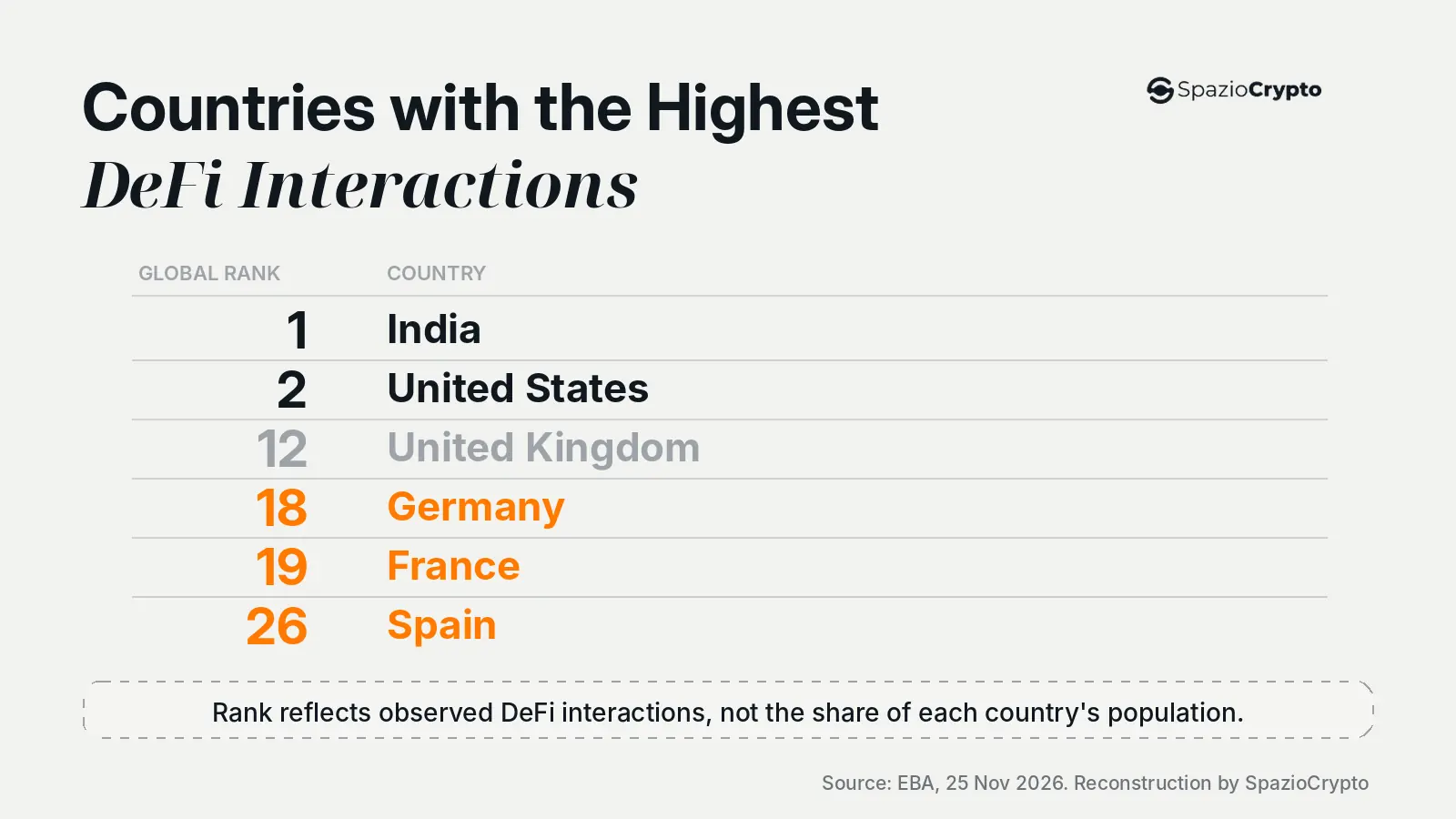
The EBA states that European consumer participation in DeFi remains limited compared with other financial centres, even as access grows easier through CASPs and AI-powered apps. For DeFi interactions, Germany, France, and Spain rank among the top countries in the EU, yet they sit 18th, 19th, and 26th globally, respectively, according to the EBA report. India holds first place, the United States second, and the United Kingdom twelfth. These rankings measure observed interactions, not the share of citizens actively using DeFi.
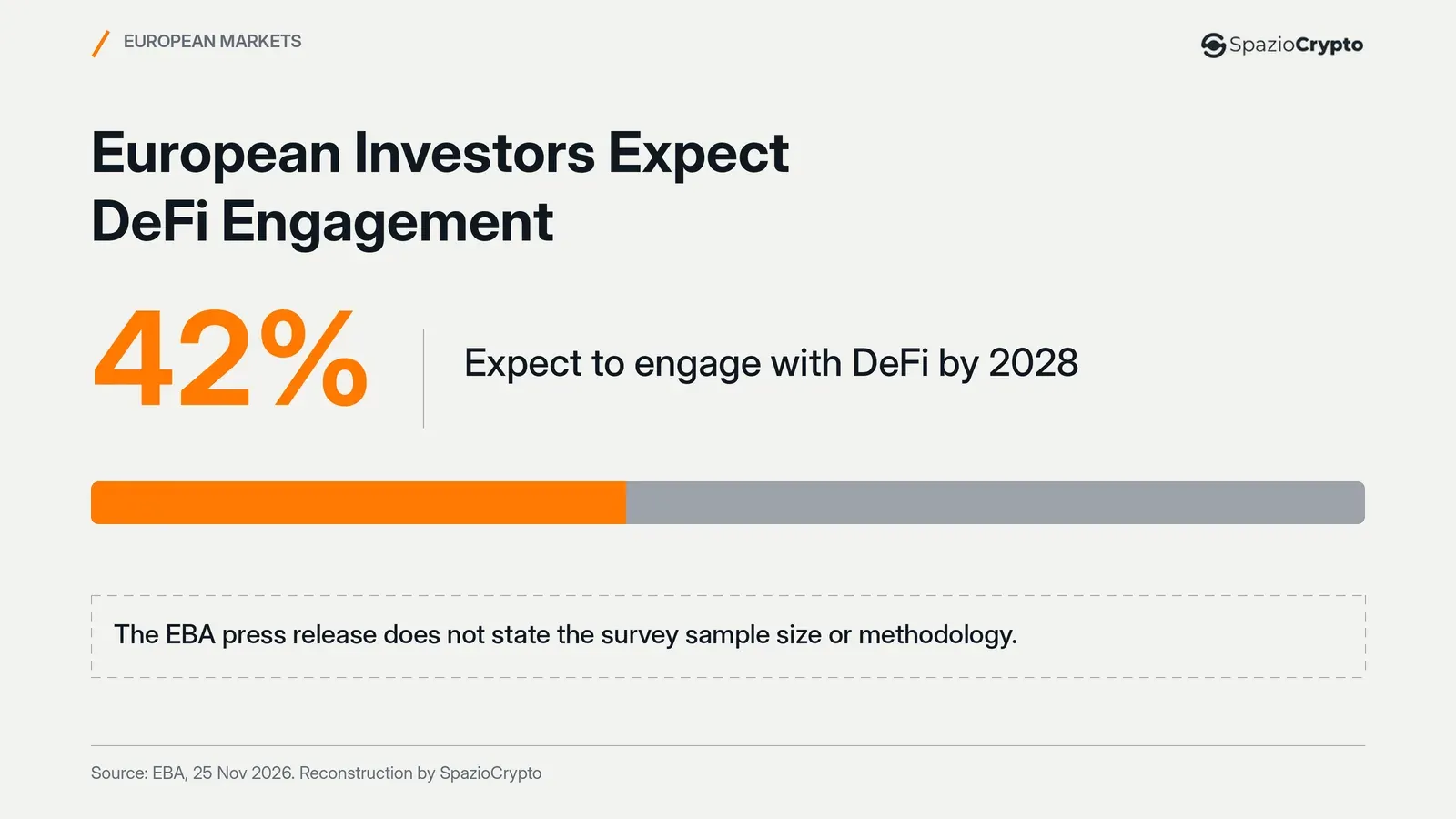
The EBA press release also cites a survey finding that 42% of European-based investors expect to participate in DeFi by 2028. The public release does not disclose the sample size or methodology; CoinDesk describes the figure as referring to European institutional investors. Treat it as a signal of expectations, not a forecast of actual adoption. Stablecoins deployed in these strategies can include yield farming, which carries a different risk profile from simply holding the token.
What Changes Now for Stablecoin Users?
In the short term, the publication does not change the rules applicable to clients. The Commission will need to assess the recommendation as part of the MiCA review; the EBA has indicated it will continue monitoring stablecoin use in DeFi and providing technical input. No deadline for a Commission proposal, no draft legislation, and no immediate measures for CASPs are specified.
For anyone evaluating lending products, the practical point is this: risk is not measured by a stablecoin’s peg alone, nor by the advertised rate. What matters is who receives the funds, how collateral is managed, which entity controls the interface, and what protections apply in the event of a default or protocol failure. On-chain lending linked to payment services illustrates how stablecoin lending can connect to traditional finance without becoming a bank deposit.
EBA, Stablecoins, and DeFi: the Scorecard
What is confirmed, and what is not.
- Confirmed: stablecoins and EMTs are used for DeFi liquidity, collateral, and settlement; the EBA flags consumer risks and potential regulatory arbitrage.
- Not confirmed: new approved rules, a Commission legislative draft, or an implementation date.
- To watch: whether the Commission includes CASP requirements for DeFi lending access in the MiCA review.
The Bigger Picture
SpazioCrypto’s read, stated as such, is that the EBA is zeroing in on the regulated entry point to DeFi. A protocol may operate without intermediaries, but client access can run through a platform that holds a contractual relationship and controls the interface. The proposal is to assess whether that gateway role should carry specific obligations, especially when the product routes users into lending backed by EMTs.
The next concrete step is not an automatic new rule. It is the Commission’s response during the MiCA review. Watch for any legislative consultation that follows, the definition of which entities fall into the “facilitating CASP” category, and how disclosure, suitability, and leverage requirements would be calibrated to avoid conflating intermediated services with fully decentralised protocols.
Sources
Report and recommendation: EBA, press release of November 25, 2026.