


The Swiss National Bank has raised a pointed warning about large-scale stablecoin adoption, arguing it could erode both bank credit capacity and the effectiveness of monetary policy transmission. On September 30, 2026, in Zurich, SNB Governing Board member Petra Tschudin stated that widespread stablecoin use may make it harder for central banks to steer the economy. The alert carries particular weight coming from an institution that simultaneously runs some of the world’s most advanced wholesale CBDC experiments.
One clarification before diving into the mechanics: Tschudin did not oppose payment innovation. She called it “sensible.” The concern is narrower and more technical: what happens if that innovation scales to the point where it strips central banks of core policy tools? Tschudin identified two specific transmission channels worth examining closely.
First Mechanism: Fewer Deposits, Less Credit
The first risk is what economists call disintermediation. If households and businesses were to shift significant sums from commercial bank deposits into stablecoins, banks would end up with a smaller funding base and, as a direct consequence, reduced capacity to extend loans to the real economy. Tschudin made the point plainly: the central bank’s ability to influence how much credit is available in the economy, and at what cost, feeds directly into overall monetary policy effectiveness.
This isn’t a concern invented for the occasion. As early as July 2026, the SNB’s own financial stability report flagged disintermediation as one of the primary risks associated with stablecoin proliferation. The institution has been building a coherent analytical framework around this issue for months, not issuing a sudden alarm.
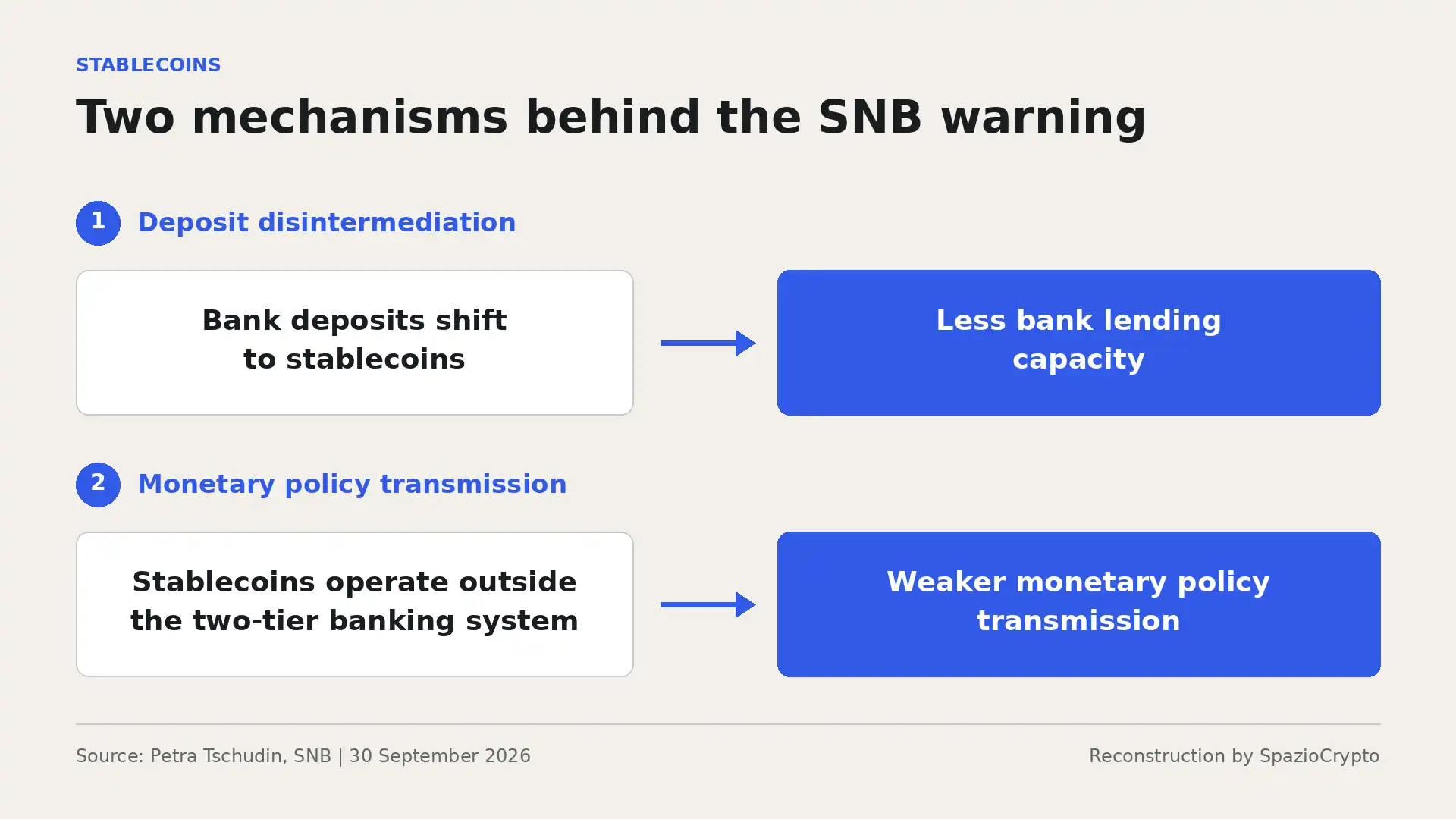
Second Mechanism: The Singleness of Money
The second risk is conceptually subtler. It concerns what economists call the “singleness of money”: the principle that one franc must equal exactly one franc, at any moment and under any circumstance, regardless of where it is physically held. Tschudin pointed out that because stablecoins operate outside the central banking system, a “franc held in a stablecoin” is not automatically guaranteed to hold the same value as a real franc at every point in time. That gap directly undermines the uniformity principle.
If large stablecoins were to develop while remaining too distant from the existing two-tier financial system, Tschudin warned, central banks would face a growing burden in fulfilling their institutional mandate. The solution she called for isn’t prohibition: it’s a regulatory framework capable of preserving monetary authority influence even as these instruments spread.
The Two Mechanisms in Summary
What the SNB fears. Source: Petra Tschudin, Zurich, September 30, 2026
- Disintermediation: fewer bank deposits means less credit available to the real economy.
- Singleness of money: a “stablecoin franc” is not always guaranteed to equal a real franc.
- Not a rejection: Tschudin is calling for regulation, not a block on innovation.
A Concern Shared Across Central Banks
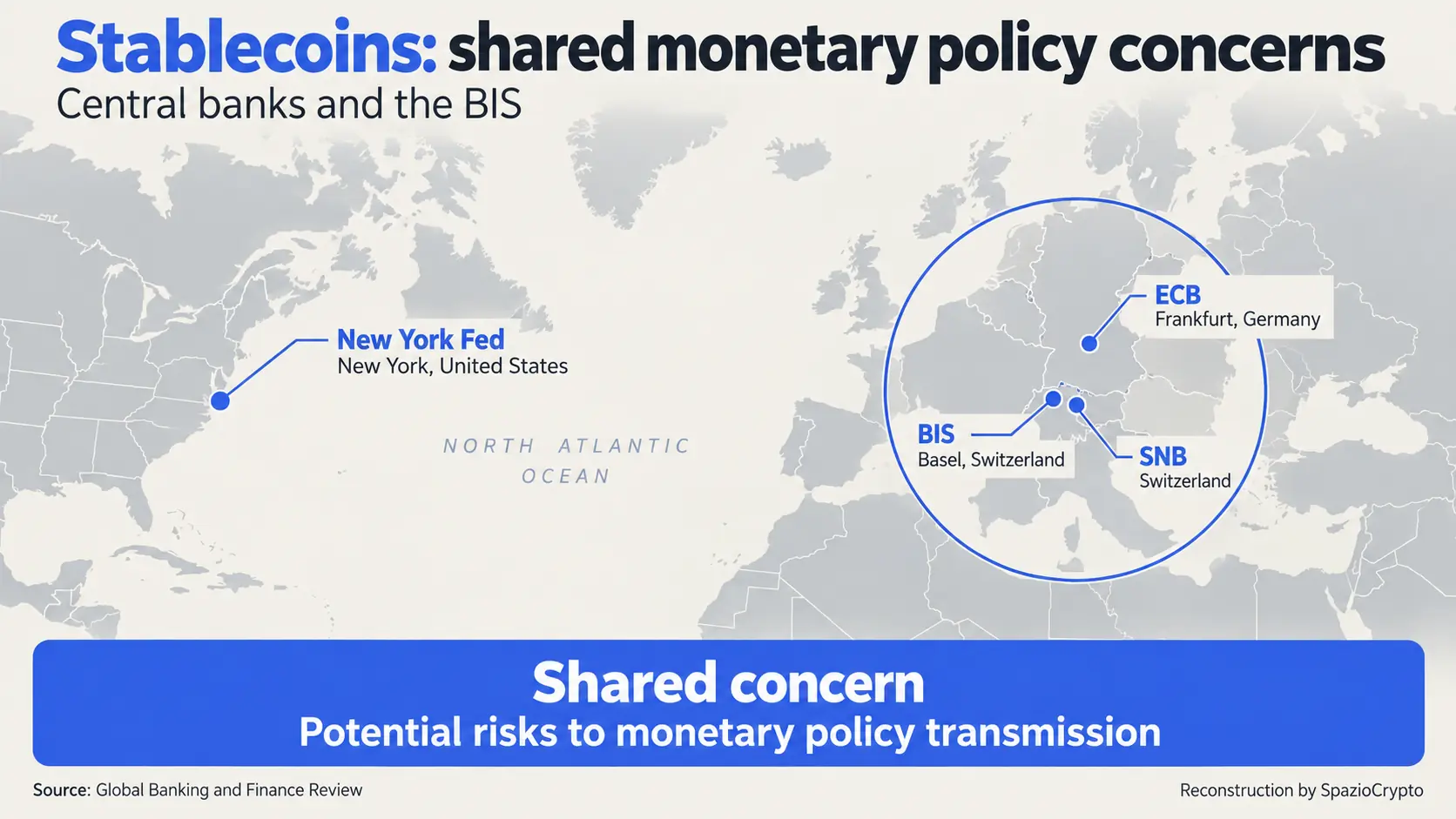
This warning doesn’t arrive in isolation. Similar concerns have been voiced in recent months by the European Central Bank, the Federal Reserve Bank of New York, and the Bank for International Settlements, all of which have noted that stablecoins could substitute for traditional bank deposits, alter how credit institutions fund themselves, and complicate monetary policy transmission. That’s the same underlying tension that surfaced when the ECB proposed revising MiCA’s stablecoin reserve rules, where the core fear was a direct channel between stablecoin issuers and commercial banks capable of transmitting shocks between sectors.
For context: the SNB is far from a digital money skeptic. The Swiss institution ranks among the world’s most active central banks in wholesale CBDC testing, a track conceptually close to what we covered with Pontes in the Eurosystem. Tschudin’s message is not “blockchain yes or no.” It’s a stated preference for forms of innovation that remain anchored to central bank money, over private stablecoins that drift too far from that system.
The Bigger Picture
Tschudin’s warning completes, from the opposite direction, the picture we’ve been building over recent weeks tracking institutional stablecoin adoption at banks like SoFi and large institutions like Citi. After tracking how stablecoins are embedding deeper into financial infrastructure, we now see why the central banks that must coexist with this shift are watching it with a mix of curiosity and institutional caution.
Two readings emerge from this moment. First, the fact that near-identical concerns are arriving simultaneously from central banks in Switzerland, the euro area, and the United States suggests this is not an eccentric minority view: it’s a genuinely shared position at the highest levels of the global monetary establishment. Second, the distinction Tschudin draws with precision, between payment innovation in itself (which she calls sensible) and stablecoins that drift too far from the central bank money system, offers a useful lens for anticipating what kind of regulation monetary authorities will likely pursue in the coming years. The goal won’t be an indiscriminate barrier to innovation. It will be an attempt to keep innovation anchored in a system where central banks retain their capacity to govern. For a grounding primer on these instruments, our guide on what stablecoins are remains a useful starting point.