Citi and Coinbase have expanded their stablecoin payments partnership, embedding crypto settlement directly into Citi's commercial infrastructure for large corporate clients. Businesses using Citi to process payments can now accept stablecoins from their customers and receive traditional currency in return, without ever holding or managing the tokens themselves. This isn't a back-office experiment: the infrastructure is already live.


This expansion builds on a relationship that's already been running for nearly a year. Citi and Coinbase announced their initial collaboration, focused on fiat-to-crypto payment infrastructure, in October 2025. What's new here is the scope and the direction: the partnership now works both ways, and it's aimed squarely at commercial adoption by large enterprises.
How the Partnership Works in Both Directions
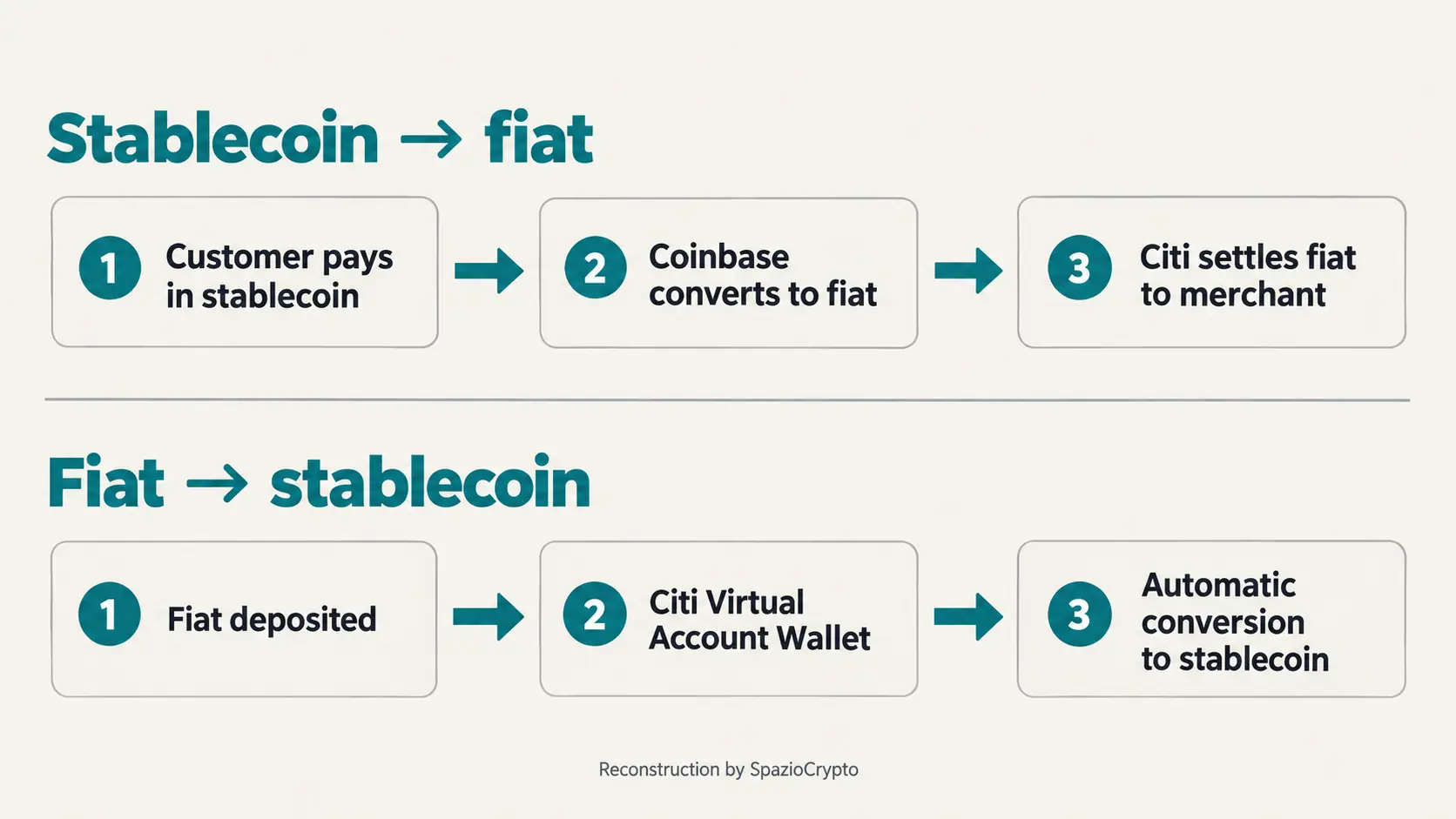
The first piece of the deal covers stablecoin acceptance by Citi's institutional clients. Through Spring by Citi, the bank's commercial payment acquisition platform, corporate clients can accept stablecoin payments at the point of sale. Coinbase Payments handles the conversion. When a buyer pays in stablecoins, Coinbase converts the tokens into traditional currency, and Citi, acting as the settlement bank, credits the equivalent amount in fiat to the merchant. The merchant never touches the stablecoin directly.
The second piece runs in the opposite direction. Coinbase has adopted Citi's Virtual Account Wallet solution, part of the bank's banking-as-a-service offering, to power its own Coinbase Virtual Accounts. A business using these accounts gets something that feels like a standard bank account: incoming traditional currency is automatically converted into stablecoins. Shahmir Khaliq, Citi's head of services, described the partnership in a joint press release as “a critical step in our strategy to offer clients optionality,” while Coinbase framed it as giving businesses “bank-account-like functionality, with stablecoin speed under the hood.”

Infrastructure Live, Adoption Still Unproven
One detail that deserves attention, and was absent from several initial reports: Coinbase describes this capability as already available, but the official announcement from both companies does not name a single client that has actually processed a payment through Spring, nor does it disclose any transaction volumes to date. The infrastructure is live and ready. Whether corporate clients will use it at scale is a question the next several months will answer.
The potential scale, though, is worth keeping in mind. Citi operates in more than 180 countries and jurisdictions. Coinbase, for its part, references a global stablecoin holder base of more than 150 million users. The initial launch covers the United States, with additional features and markets planned for later phases. And the commercial stakes are real: according to Coinbase's own financial disclosures, stablecoin-related revenue generated nearly $600 million in the first half of 2026 alone, making this one of the exchange's most important business lines.
The Deal at a Glance
What the agreement covers. Source: Citi, Coinbase, September 28, 2026.
- Direction 1: Customer pays in stablecoins, Coinbase converts, Citi settles in fiat to the merchant.
- Direction 2: Incoming fiat to a Virtual Account is automatically converted into stablecoins.
- Current status: Infrastructure live, no real client volumes disclosed yet.
A Fourth Model for Money on Chain
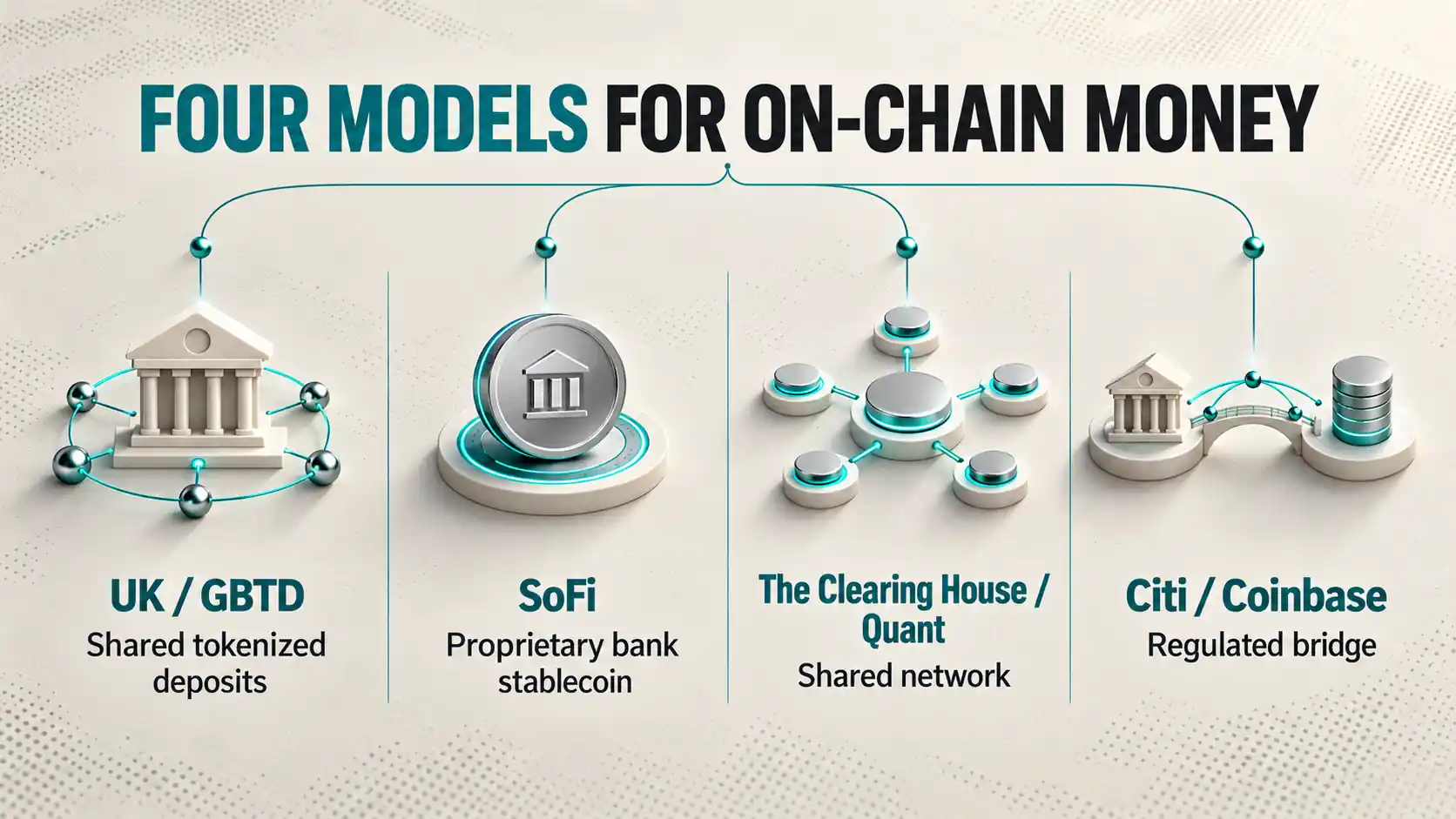
This announcement fits into a broader pattern that has emerged in recent weeks, as major financial institutions experiment with different approaches to putting money on blockchain rails. In the UK, large banks including Lloyds, Barclays, NatWest and HSBC have opted for shared tokenized bank deposits. In the US, SoFi chose a proprietary bank stablecoin for card settlement, while The Clearing House selected Quant to build a shared tokenized deposit network across twenty-five major banks.
Citi and Coinbase represent a fourth, distinctly different model. A large global bank doesn't issue its own stablecoin and doesn't build a peer network with other institutions. Instead, Citi acts as a regulated bridge between the fiat world and existing stablecoins, allowing its corporate clients to operate in both without ever becoming crypto operators themselves. It's the same principle of silent adoption observed in the launch of World Money, applied here not to the end consumer but to the relationship between a major bank and its enterprise clients.
The Bigger Picture
The real significance of this announcement may lie less in the technical details and more in the language used to describe it. Nobody involved is talking about pilots, experiments, or theoretical use cases. This is commercial infrastructure, available now, offered by one of the world's largest banks to corporate clients across more than 180 countries. Whether it gets used at scale, and what volumes it generates, remains an open question.
Two things stand out for anyone watching this space. First, the fact that a bank of Citi's size chose to rely on an external exchange, Coinbase, to manage the stablecoin layer, rather than building its own proprietary solution, says something about where crypto-native expertise actually sits, even as traditional financial institutions move in. The gap between institutional intent and in-house capability remains wide. Second, the growing variety of models now visible across the industry, from tokenized deposits to bank-issued stablecoins to this regulated-bridge approach, suggests the sector is still far from settling on a single dominant architecture for putting corporate money on blockchain rails. For readers who want to understand the building blocks better, our guide on what stablecoins are remains a useful starting point.