Binance invested $100 million in Circle, the issuer of the USDC stablecoin, acquiring a direct equity stake confirmed on September 22. The deal comes alongside a new five-year commercial agreement aimed at expanding USDC's presence on Binance, with a clear focus on emerging markets. Reading this as a straightforward stock purchase misses the point: when the world's largest crypto exchange takes a direct financial stake in one of the leading dollar stablecoin issuers, it signals an economic alignment that goes well beyond a routine technical integration.
The structure is simple to map out. Binance brings distribution, with an estimated user base of around 300 million globally. Circle brings the USDC infrastructure. The $100 million investment is the economic glue binding both sides of the deal. Below is a precise look at how the deal works and why it matters more than a standard platform partnership.
Deal Structure and Terms
According to Circle's official announcement on September 22, the investment was executed through a private placement of Class A ordinary shares: just over 1.2 million shares at approximately $80.84 each, representing a 5% discount to Circle's NYSE market price in the days before closing. Binance agreed to a lock-up period of up to two years on those shares, a constraint that signals a long-term commitment rather than a short-term speculative position.
Under the five-year commercial agreement, Circle will pay Binance a monthly fee calculated as a percentage of USDC balances held through Circle's infrastructure services. In return, Binance commits to actively promoting USDC adoption across its platform, with particular emphasis on emerging markets. Circle's CEO Jeremy Allaire stated that Binance is now the largest stablecoin wallet in the world for dollar-denominated stablecoins, while Binance co-CEO Richard Teng described the partnership as a long-term commitment, framing the goal as making access to a stable, reliable digital dollar available to anyone with a smartphone.
Third Time Around: The Partnership History
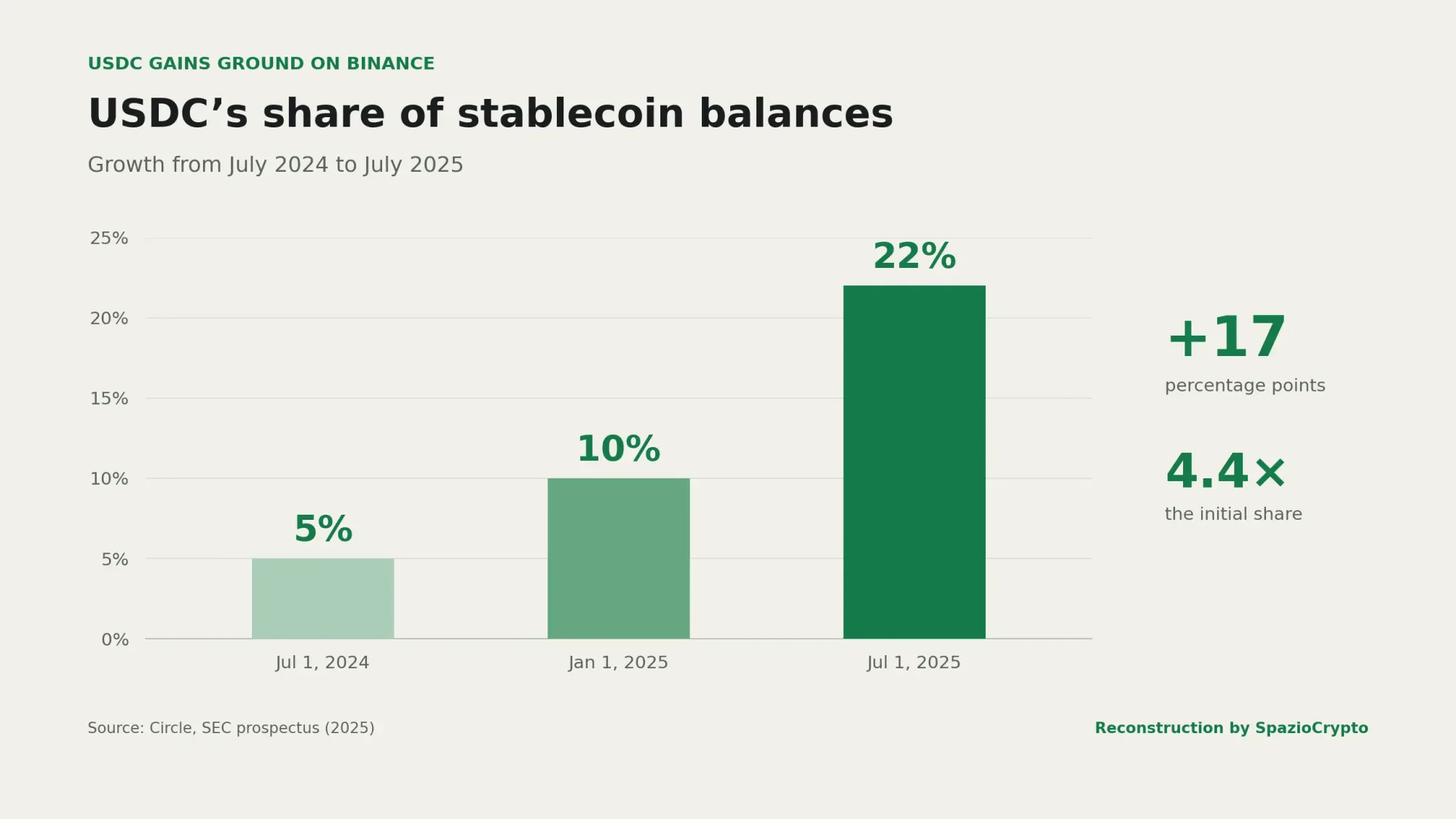
There's a context element that makes this news considerably more significant and guards against rushed conclusions. This agreement doesn't emerge from nowhere: it replaces two earlier deals between the same companies, dating to November 2024 and August 2025. According to data disclosed by Circle itself, USDC's share of total stablecoin balances held on Binance had already grown from 5% in July 2024 to 22% by mid-2025, well before this new equity investment was announced.
That figure reframes the story. This isn't a sudden course correction; it's the acceleration of an adoption trend that had been building for over a year. Worth recalling, too, is that Binance previously backed its own native stablecoin, which was gradually wound down following regulatory pressure in the United States. That history helps explain why the exchange now prefers to deepen ties with a well-capitalized, regulated external issuer rather than reviving a proprietary token.
The Deal at a Glance
Key terms. Source: Circle, Binance, September 22, 2026
- The investment: $100 million in equity, shares locked up for up to 2 years.
- The agreement: 5 years, emerging-market focus, monthly fees paid to Binance.
- The trend: USDC's share of Binance stablecoin balances already climbed from 5% to 22% before this deal.
USDC vs USDT: What Actually Changes
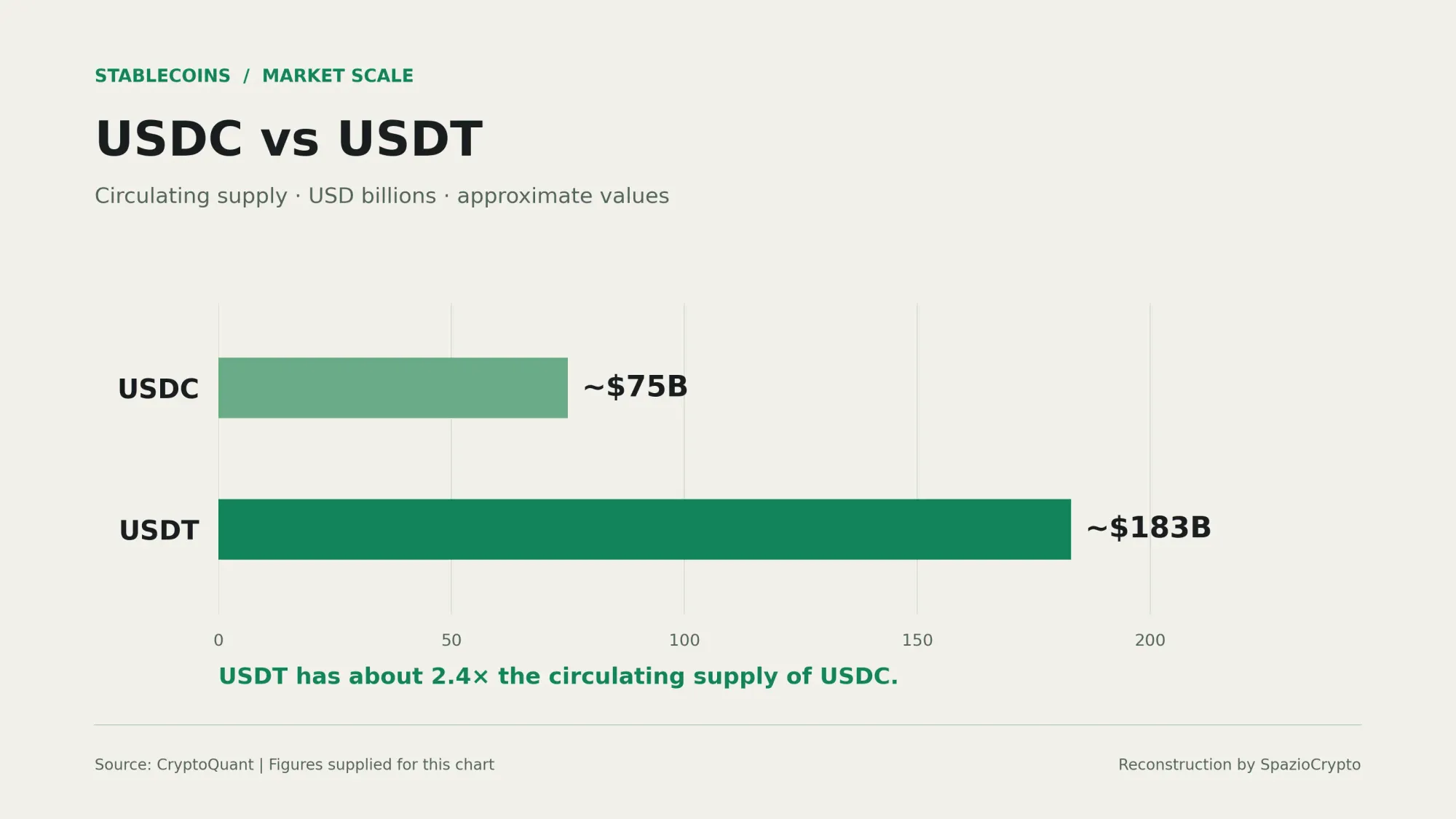
This is the most nuanced part of the story, and precision matters here. The dollar stablecoin market remains dominated by Tether: according to CoinGecko data, USDT's circulating supply stands at roughly $183 billion, compared to approximately $75 billion for USDC. Circle has long sought to expand beyond its historically US-concentrated base, and this Binance deal explicitly targets the international markets where USDT traditionally holds very strong commercial ground.
That said, it would be wrong to conclude that Binance is abandoning USDT, or that USDC is automatically on a path to unseat Tether globally. What concretely changes with this agreement is Binance's financial incentive to promote greater USDC adoption on its platform. That incentive may influence user behavior over time, but it doesn't by itself overturn market dynamics overnight. The trend also connects to a broader shift: stablecoins are increasingly becoming invisible financial infrastructure inside mass-market products, a pattern seen in the launch of World Money and its integration with multiple stablecoins.
Why This Is More Than a Technical Integration
The deal's significance goes beyond the dollar figure. In recent years, Circle has built the institutional and compliance-focused side of the stablecoin economy, positioning transparency and regulatory conformity as its core differentiators. Binance, for its part, controls one of the largest crypto distribution networks in the world, with a particularly strong footprint in emerging markets where access to a stable digital dollar can make a concrete difference for millions of people excluded from traditional banking.
Combining a regulated issuer, a massive distribution channel, and a direct capital investment makes this partnership qualitatively different from a simple technical integration. The dynamic has echoes of what's been observed in Tether's own push to expand beyond its core through private credit: the stablecoin leaders are each looking for durable structural advantages, not just circulation numbers.
The Bigger Picture for Stablecoin Competition
This deal illustrates how competition between the major dollar stablecoins is evolving. It's no longer just a race for circulating supply. The contest is increasingly being decided by economic alignments between issuers and the distribution platforms that sit between them and end users. A regulated issuer that successfully ties itself to the world's largest crypto distribution channel gains an advantage that outlasts any single capital transaction, because it converts a purely technical relationship into a durable, shared economic interest.
Two lessons stand out. First, this episode confirms that the stablecoin battle is shifting toward emerging markets, where access to a stable digital dollar represents a growth opportunity that dwarfs anything available in the already-mature Western markets. Second, caution is warranted before overstating the deal's immediate impact: Tether's dominance in global circulation remains largely intact, and the real test of this partnership will play out over the coming months and years as observers watch whether USDC's share of Binance balances continues to grow at the pace registered since mid-2024. For a foundational primer on these instruments, see our guide on what stablecoins are.