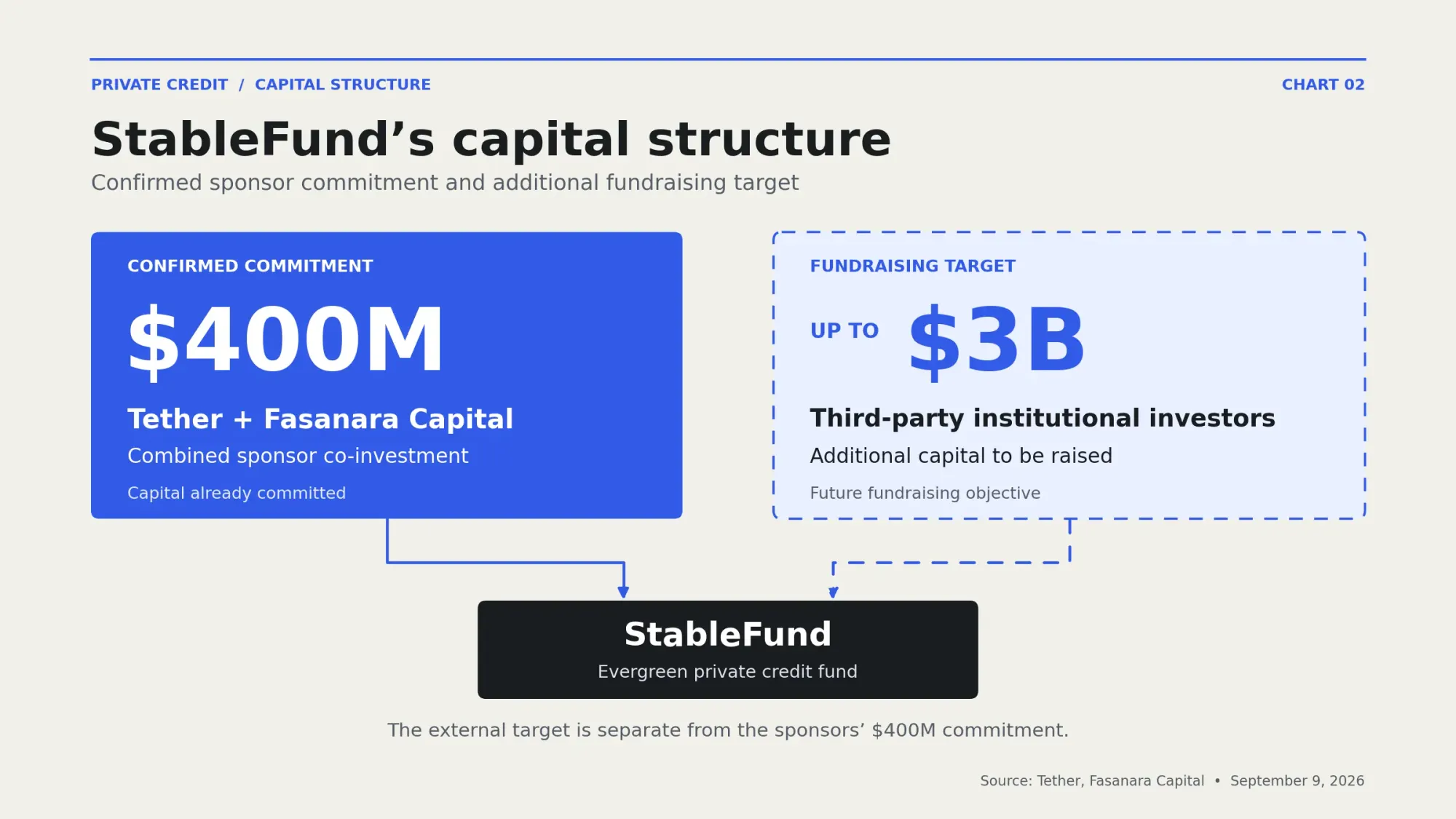
Tether, the company behind the world's largest stablecoin by market cap, is making another move beyond its origins in crypto trading. On September 9, 2026, Tether and Fasanara Capital, a specialist asset manager in technology-enabled private credit, announced StableFund: a new $400 million evergreen fund targeting up to $3 billion from institutional investors, designed to channel lending to small and medium-sized businesses worldwide using USDT as settlement infrastructure. This is a significant chapter in Tether's private credit strategy, and it reframes what a stablecoin company can actually be.
The move is not simply about deploying capital. Tether is positioning itself as a piece of the financial plumbing through which real-economy businesses get funded. Here's how the structure works, and why the strategic shift matters.

What StableFund Actually Does
StableFund is structured as an “evergreen” vehicle: no fixed maturity date, designed to reinvest capital continuously over time. The $400 million figure represents direct co-investment from both sponsors, Tether and Fasanara. One distinction that deserves emphasis: the $3 billion target is a fundraising goal from external institutional investors, not capital already committed. That gap between what's guaranteed today and what's being sought tomorrow is material. Any assessment of this fund's scale should keep it in mind.
The division of labor between the two partners is clear. Fasanara Capital, which manages a fintech lending network active in over sixty countries, will handle the investment management side, deploying capital into short-duration, asset-backed or receivables-backed credit strategies. Tether, for its part, takes the role of “originator”: identifying lending opportunities tied to USDT usage and providing the technological infrastructure for settlement, including the on- and off-ramp systems that convert fiat currency into stablecoin and back, making cross-border capital flows faster and cheaper.
A Massive Market With a Very Specific Gap
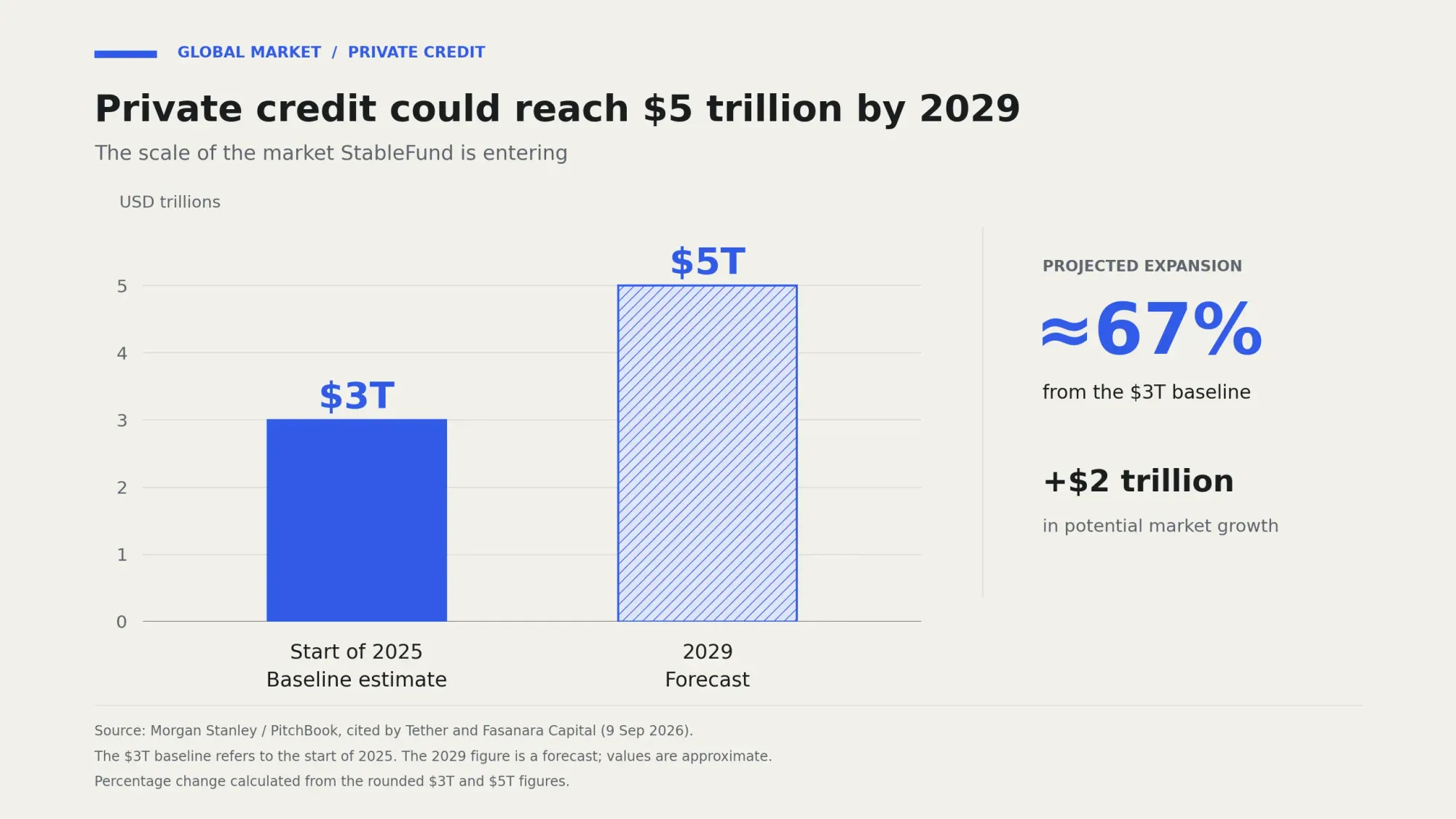
To grasp the ambition here, consider the market Tether and Fasanara are targeting. Private credit, the business of lending to companies outside the traditional banking system, is already a global market worth roughly $3 trillion, according to industry estimates, with projections pointing toward $5 trillion by the end of the decade. Demand is rising as both businesses and investors search for alternatives to conventional bank financing.
Within that already-large market, StableFund targets one particular gap: the financing shortfall facing small and medium-sized enterprises globally, which the company puts at nearly $6 trillion. These are businesses that frequently struggle to access credit through traditional channels, either because they're too small for banks to serve economically, or because they operate in markets where capital access remains structurally limited. Tether's stated vision, as articulated by its CEO in the announcement, is to transform the company's origination network into a direct conduit for capital to reach businesses and communities that need it most, making cross-border credit flows more efficient. A parallel ambition to the on-chain credit model Visa launched for real-economy payments.
Tether's Third Strategic Chapter
This move doesn't come from nowhere. It fits a broader pattern Tether has been building for some time: diversifying revenue streams, which are already enormous thanks to USDT's dominance, by investing in sectors increasingly remote from pure crypto trading. Weeks ago, reporting covered how Tether was making heavy investments in robotics and artificial intelligence, with the goal of embedding its stablecoin into the emerging machine economy. Private credit to real businesses is the third distinct chapter in that same story, one that aims to transform USDT from a trading instrument into a multi-purpose financial infrastructure layer.

There's a piece of context worth naming plainly. Tether has a history of controversy around the transparency of its reserve composition, a topic this publication has approached with care. Against that background, one recent development stands out: in August 2026, KPMG U.S. issued an unqualified audit opinion (the most favorable form available) on the 2025 financial statements of a Tether subsidiary. The company is presenting this as evidence of growing financial credibility, even as it expands aggressively into areas well beyond stablecoin issuance.
The Bigger Picture for Stablecoins
The Tether-Fasanara initiative tells an important and somewhat surprising story about where stablecoins are heading. Born as tools for crypto trading, offering a stable reference point inside a famously volatile market, they're now bidding to become settlement infrastructure for one of the largest segments in traditional finance: business lending. That trajectory intersects directly with the broader tokenization wave, visible in initiatives like the tokenization of Italian non-performing loans on blockchain, or the European bank consortium backing a euro-denominated stablecoin on Ethereum.
Two takeaways emerge for anyone watching this space. First, established stablecoins are actively hunting new use cases, driven by a conviction that their real strength lies not in speculative utility but in their ability to make capital flows more efficient where traditional channels fall short. Second, scrutiny remains essential. There's a meaningful difference between the $400 million already committed by Tether and Fasanara and the $3 billion they hope to raise. Whether this fund delivers concrete lending to businesses that genuinely need it, or joins a long list of ambitious announcements that underdeliver, is a question that only time and performance data will answer.
Institutional investors evaluating StableFund should watch for two milestones: the pace of external capital raised toward that $3 billion target over the next 12 to 18 months, and whether USDT-settled loans actually reach SMEs in underserved markets at meaningful volume. Those two metrics will tell the real story of whether this is a genuine infrastructure play or a well-branded fundraising exercise.