


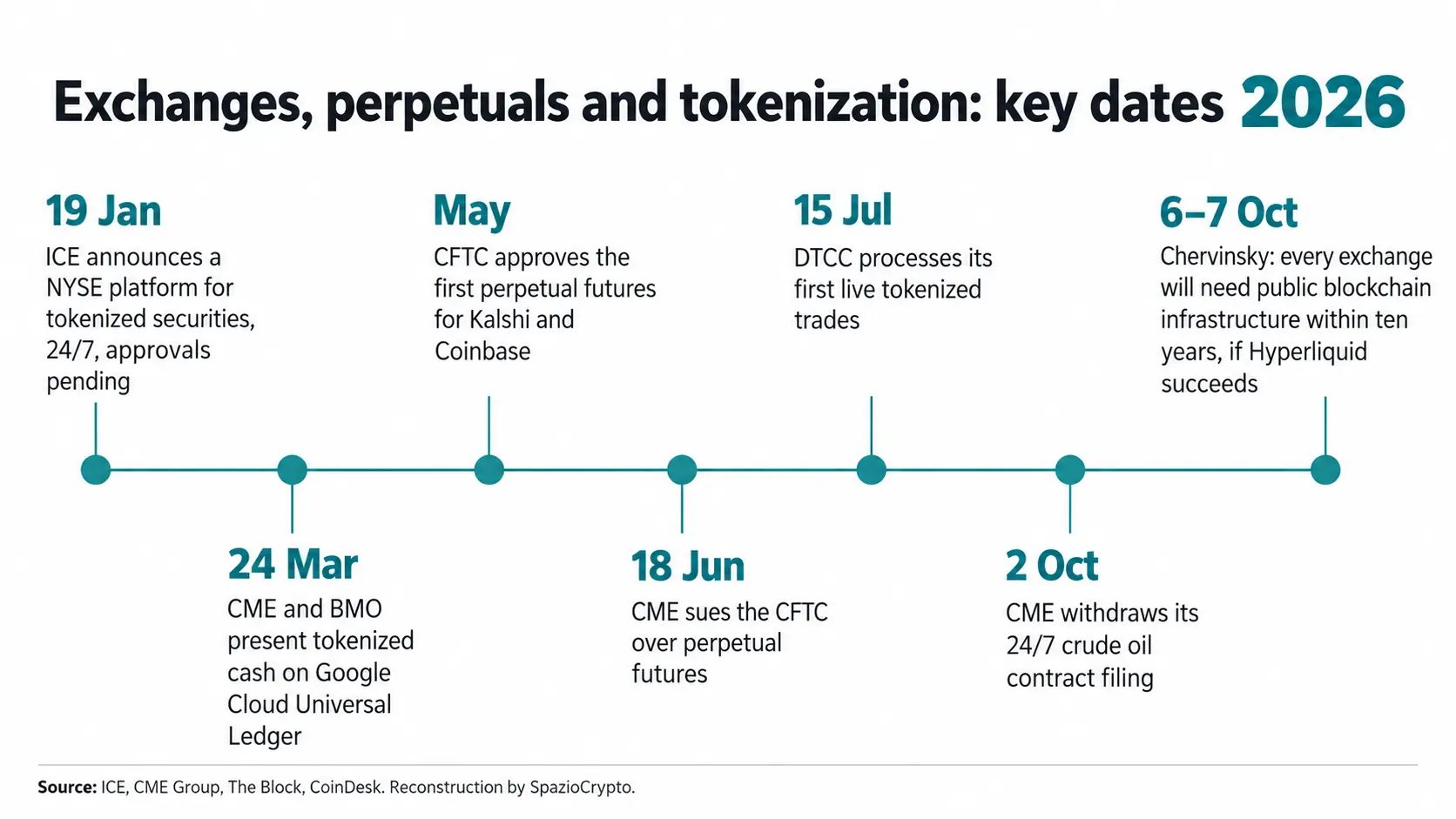
Jake Chervinsky, CEO of the Hyperliquid Policy Center, predicts that within ten years every major exchange, including CME Group and Intercontinental Exchange (ICE), will need to integrate public blockchain infrastructure to stay competitive. Speaking to The Block at the Digital Asset Summit Asia in Singapore on Tuesday, October 6, with the interview published October 7, Chervinsky framed the forecast as conditional: it depends on Hyperliquid's success. This is a sectoral prediction from an interested party, not an operational announcement from CME or ICE. What those two groups have actually announced, based on available sources, points toward permissioned ledgers, not public networks.
What Chervinsky Actually Said
Chervinsky's core argument is that Hyperliquid is not an exchange but an infrastructure layer, comparable to Bitcoin, Ethereum, or Solana, that different entities, including those in the United States, can build on top of. A public blockchain, in his view, has no reason to register as an exchange. The key passage, as reported by The Block, runs: “My imagination is that, if we are successful, ten years from now every single exchange you can think of, whether it’s crypto like Kraken or Coinbase or traditional like Intercontinental Exchange or Chicago Mercantile Exchange, will need to integrate this technology if they want to compete.”
The reasons cited are resilience, security, and the transparency of a shared ledger, plus lower costs and faster settlement. Chervinsky added that Hyperliquid does not aim to compete with Kalshi, Coinbase, Robinhood, or CME directly: Hyperliquid sits one level lower in the technology stack. The conditional framing matters here. The sentence opens with “if we are successful.” Chervinsky is not saying this will happen. He's describing what would happen if the model works.
Who Is Speaking and Why It Matters
The Hyperliquid Policy Center is a nonprofit organization based in Washington, founded on February 18, 2026, to conduct lobbying and research on decentralized finance regulation. According to CoinDesk, the center is funded by the Hyper Foundation, which committed one million HYPE tokens, worth approximately $29 million at launch, to support the Hyperliquid ecosystem. In The Block interview, as far as published reporting shows, this funding relationship was not disclosed. That omission matters: the person predicting that exchanges will adopt a specific technology also leads the advocacy group created to promote it. That doesn't make Chervinsky wrong. It means the forecast should be read as a position, not a neutral estimate.
The same caveat applies to his comments on CME. Chervinsky said CME's lawsuit against the CFTC, currently stalled on a motion to dismiss, has very little chance of success, and that perpetual futures don't cannibalize the dated futures CME already offers. These are opinions, reported as such by The Block.
The CME-CFTC Standoff
In May, the CFTC approved the first perpetual futures products for Kalshi and Coinbase. On June 18, CME filed suit against the CFTC and its chair Michael Selig in federal court in Washington, arguing that those contracts should be classified as swaps and that the agency had reversed course without adequate process. A CFTC spokesperson responded by characterizing the action as “lawfare” against the regulator. According to The Block, the case is now awaiting a ruling on a motion to dismiss, with the CFTC contending that CME lacks standing to sue.
There's also the 24/7 trading chapter. According to Investment Executive, on July 9 the CFTC suspended the listing of a CME oil contract that would have allowed round-the-clock trading while the agency solicits public comment. On October 2, CME withdrew its application for a 10-barrel crude oil contract tradeable 24/7, stating that “key constituents” feared unintended consequences without further review. The Block reported a different reason: staffing problems. The CME press release itself does not cite staffing issues. Chervinsky rejected both explanations, arguing that CME wants to “slow down progress because it's not ready to take advantage of it” and that CME has misread genuine demand for 24/7 energy trading.
What CME, ICE, and Wall Street Are Building Now
The most useful check on Chervinsky's forecast is looking at what's actually in development. ICE, the parent company of NYSE, announced on January 19 a platform for trading and settling tokenized securities on-chain, operating 24 hours a day, collateralizable with stablecoins, and designed to support multiple blockchains without naming a specific one. Regulatory approvals are pending and no launch date has been set. An ICE executive described support for tokenized securities as a critical step in the group's strategy to manage “on-chain market infrastructure.”
CME, on March 24, launched with BMO a tokenized cash service on Google Cloud Universal Ledger designed to meet margin requirements in real time, targeted for the second half of 2026 and still awaiting regulatory approval. The Defiant describes that ledger as a permissioned layer-1, meaning it's not a public network.
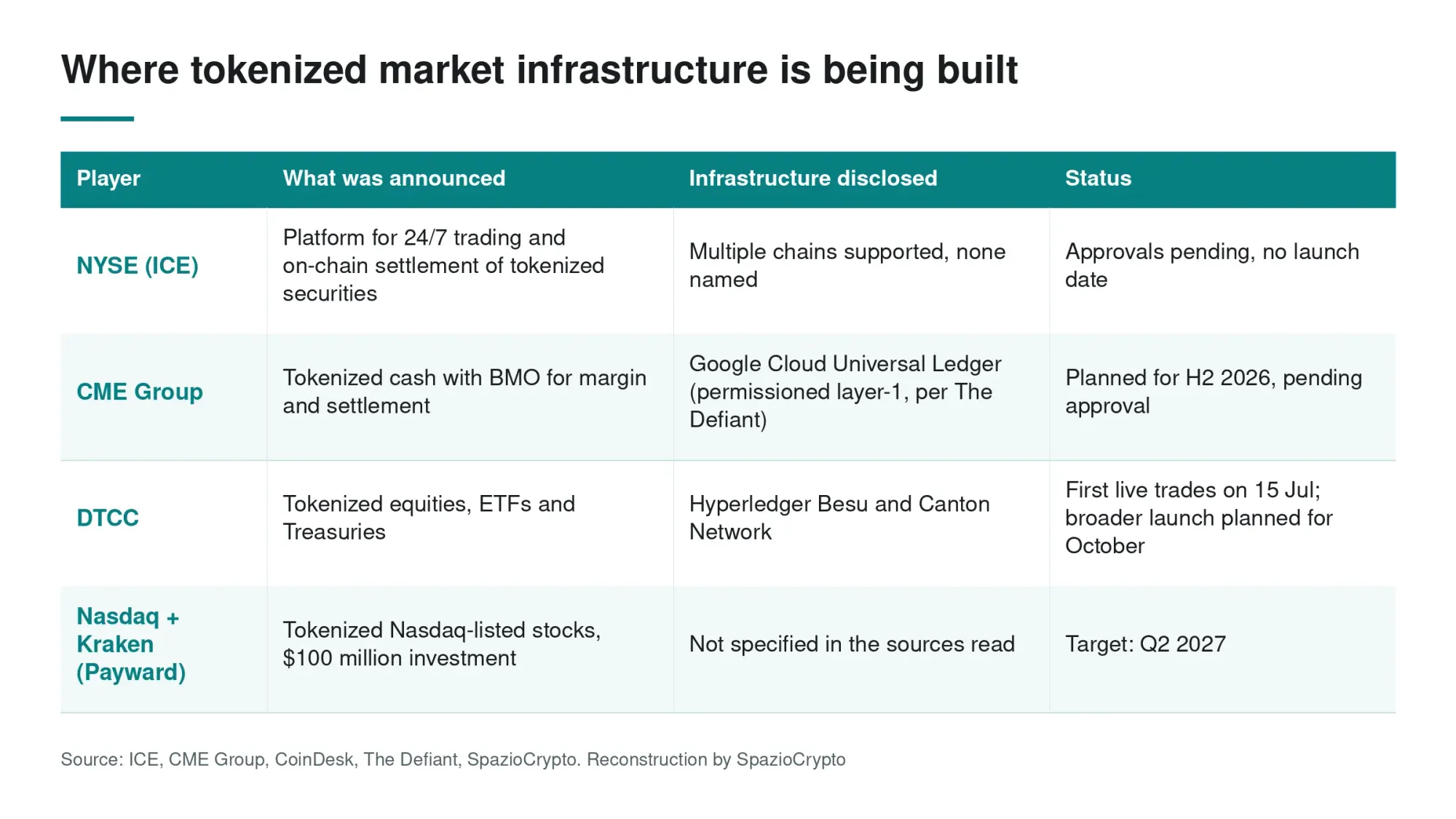
Then there's DTCC, which on July 15 executed its first live transactions in tokenized equities, ETFs, and government bonds settled on Hyperledger Besu and Canton Network, with a broader rollout planned for October. In that trial, JPMorgan used tokenized collateral for margin posting at CME, according to CoinDesk. Tokenization is advancing on parallel tracks elsewhere too: Nasdaq invested $100 million in Kraken for tokenized equities, the London Stock Exchange brought 100 shares on-chain with Kraken, and the European Central Bank made its Pontes system operational for settling tokenized securities in central bank money.
The CME and ICE Forecast: What Was Said, What Was Not
Sources: The Block, CoinDesk, ICE and CME press releases
- Said: Within ten years, every exchange, including CME and ICE, will need to integrate public blockchain infrastructure to compete, “if we are successful” (Chervinsky, October 6).
- Not said: This is not an announcement from CME or ICE. The speaker leads a center funded by the Hyper Foundation, and the CME-CFTC lawsuit is still before a federal court.
- Today: ICE is building a tokenized platform without specifying the network. CME is proposing tokenized cash on a permissioned ledger. DTCC is working on Hyperledger Besu and Canton.
The Bigger Question
The real issue isn't whether CME and ICE will use tokenization. They already are. The question is what kind of network. A permissioned ledger keeps the exchange in control of who participates, what they see. How regulators are engaged. A public network shifts part of that control outside the operator's perimeter. That's precisely why Chervinsky's forecast doesn't describe what CME and ICE have actually announced. It describes what would need to happen for him to be right.
Worth noting: even Hyperliquid, to reach U.S. customers, runs through the hypothesis of a regulated intermediary like Bitnomial, not direct public access. The infrastructure-layer story has its own bottlenecks.
Regulators are watching carefully. ESMA has warned that the links between crypto and traditional finance are now tight enough to transmit shocks across markets. The more traditional finance ties itself to open infrastructure, the more that risk becomes systemic. Three signals are worth tracking to judge whether Chervinsky's bet holds up: the federal court ruling on CME's lawsuit against the CFTC, regulatory clearance for the NYSE's tokenized platform, and the outcome of the Kraken-Bitnomial hypothesis for Hyperliquid perpetuals. Until those arrive, the forecast remains a declared bet from one of the parties involved, with a deadline that won't be verifiable for another decade.