

Blockchain applied to the real world has been promised for years, with far more hype than substance. That's what makes the move just announced by Enel worth paying attention to: Italy's energy giant, working alongside fintech Conio, has launched a service that brings tokenization directly into something every household receives, the electricity bill. It's called ebitts, and it's one of the world's first real-world energy utility tokens.
The concept is as straightforward as it is powerful. Anyone, including apartment dwellers with no rooftop to spare, can now own a digital stake in actual Italian renewable energy plants and see a tangible euro benefit deducted from their bill. This isn't a vague promise. It's a product you can buy today.

How ebitts Works, in Plain Terms
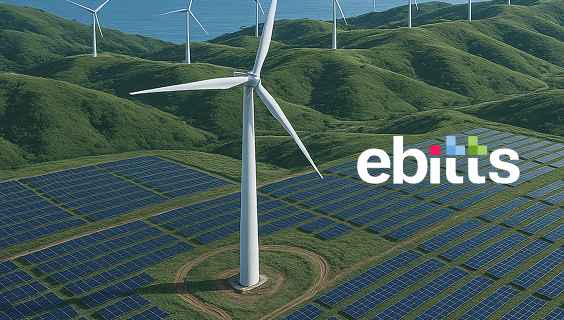
The mechanism is clever in its simplicity. Through the ebitts platform, customers purchase a “Token Box”: a bundle of tokens representing a digital share of the productive capacity of real, operational renewable energy plants. These are not financial abstractions but fractions of physical infrastructure currently running in Italy.
Specifically, the two Enel facilities involved are the Piani della Marina photovoltaic park in the Viterbo area and the Barile Venosa wind farm in the province of Potenza. From there, the mechanism is direct: based on the energy those plants actually generate, hour by hour, the customer receives a corresponding credit on their electricity bill, as if they were producing energy from their own rooftop. If the plants generate more than the customer consumes in any given hour, the surplus isn't lost. It gets valued on the market and credited as an additional discount. In practice, you become a virtual co-owner of a slice of a solar park without installing a single panel.
🚨 BREAKING: 🇮🇹 Italian energy giant @EnelGroup, Europe's largest electricity producer and the second largest in the world, has partnered with @conio to launch a solar panel tokenization product on Algorand⚡️
— Algorand Foundation (@AlgoFoundation) January 20, 2025
Italian residents can now purchase solar panels, have Enel manage…
Blockchain and MiCA: The Infrastructure Behind ebitts
The technology matters here. Understanding exactly what role it plays is key to grasping why this product deserves trust. The blockchain layer isn't a marketing add-on. It guarantees traceability and, critically, a verifiable link between every digital token and the energy actually produced by physical plants. Every digital share corresponds to real generating capacity, with transparent, real-time accounting.
The technology partner is Italian fintech Conio, which handles asset tokenization, sells the Token Boxes, and provides the digital wallet where customers hold their tokens. One detail is decisive for the project's credibility: Conio operates in full compliance with MiCA (the EU's Markets in Crypto-Assets Regulation), acting as an authorized crypto-asset service provider. This is not an experiment in a regulatory grey zone. It's a product built inside the rules, a point that matters enormously to institutional partners and everyday consumers alike. MiCA's full application since December 30, 2024, means European consumers have a regulatory framework they can rely on when using products like ebitts, a context we've covered in depth in our guide to MiCA-authorized platforms.
Why ebitts Stands Apart from Typical Blockchain News
This is why ebitts matters more than a thousand breathless announcements about metaverse tokens or speculative DeFi projects. Three elements make it a genuinely rare real-world use case, legible to anyone even if they've never heard the word “wallet” before.
Three elements that make ebitts a rare case
Why this is concrete tokenization, not speculation
- A brand everyone knows: Enel is a household name across Europe, not an obscure crypto project.
- A physical, real asset: each token is tied to solar and wind plants that exist and generate power in Italy right now.
- A verifiable benefit: the payoff isn't a price that fluctuates, it's a concrete discount on your electricity bill.
This is the real distinction between blockchain used as speculation and blockchain used as a tool. Nobody buys ebitts hoping the token doubles in price. They buy it for a tangible, understandable benefit, exactly as they might buy a solar panel, just without the panel. That's what bridges the technology to ordinary people.
Sharing the Benefit: A Social Dimension
There's one further feature that broadens ebitts' appeal beyond the individual buyer. Purchasing a Token Box doesn't lock the benefits to a single household. Customers can designate up to three beneficiaries, drawn from relatives up to the second degree of kinship and cohabitants, provided they are or become Enel Energia customers. Those beneficiaries receive the discount directly on their own bills.
That detail transforms ebitts from a purely personal financial tool into something shareable. An elderly parent struggling with energy costs, a student renting across town: the Token Box can redirect its bill discount to whoever needs it most. Everything is trackable through an app showing production and consumption in real time. It's the kind of practical functionality that demonstrates what sits behind the word “token” can be genuinely familiar and useful.
The Bigger Picture for RWA Tokenization
The ebitts launch is significant because it represents exactly the kind of adoption the crypto sector has been chasing for years: quiet, useful, and invisible. The average user of this service won't think of themselves as a crypto investor. They probably won't care about the blockchain running underneath. They want to pay less for electricity and contribute to a cleaner grid. The technology works backstage, like an engine, not a showpiece.
That's the most authentic win for real-world asset tokenization. Not price announcements or easy-wealth promises, but a company of Enel's scale choosing blockchain to solve a genuine access problem, making renewables available to people who have no roof to put panels on. When a technology stops being the news and starts being the tool that enables something useful, it has reached maturity. Watching it happen in Italy, with a familiar European brand and inside EU regulatory guardrails, signals that the future of energy and digital finance have started talking to each other. For readers who want to understand what real-world asset tokenization means more broadly, our guide to tokenized real-world assets is a good starting point.