


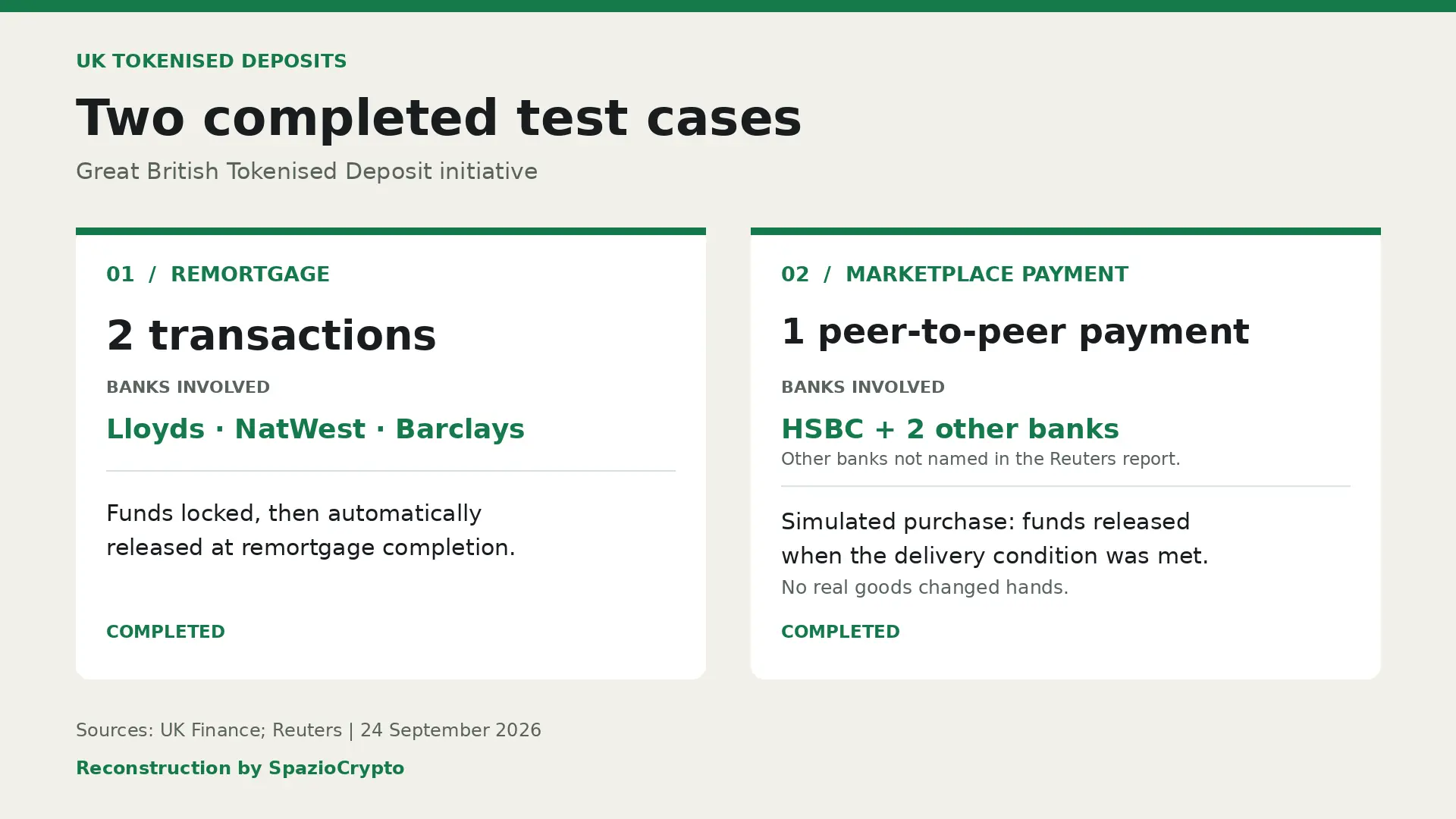
The UK's largest banks have completed the world's first interbank transactions using tokenised bank deposits to move money between institutions. These were not pilot announcements: the operations were actually executed. Lloyds Banking Group, NatWest and Barclays completed two real mortgage remortgage transactions using tokenised deposits, while a separate group of three banks, including HSBC, executed a simulated online marketplace payment. UK bank tokenised deposits have moved from the pilot phase to operational reality.


The central point that distinguishes this news from many other tokenisation stories is that the tokens involved are not a private stablecoin. They represent money already deposited in a bank, and they carry exactly the same legal status and protections as an ordinary current account balance. This piece covers how the tests worked, what comes next, and why this story needs to be read alongside what happened on the European front in the same week.
How the Tests Worked
The project, coordinated by trade body UK Finance and named the “Great British Tokenised Deposit” initiative, involves seven institutions in total: Barclays, HSBC, Lloyds, Monzo, NatWest, Nationwide and Santander, with technical support from Quant Network and advisory input from EY and law firm Linklaters. In the two remortgage tests, funds were locked until blockchain-confirmed title transfer, at which point they were automatically released between the participating banks.
In the HSBC-led test simulating an online marketplace purchase, the mechanism worked differently. The system used programmable deposits to hold the buyer's funds on their account, releasing payment to the seller only after the system confirmed delivery of the purchased item. No physical goods changed hands in this simulated test, but the experiment demonstrated in practice how programmable bank money can reduce fraud risk in transactions, enabling direct settlement between different banks rather than remaining trapped within siloed banking systems.
From Pilot to Production: What Comes Next
The most significant detail in this story concerns what happens from here. As reported by UK Finance on September 24, 2026, participating institutions plan to incorporate a dedicated company and establish a formal governance rulebook, a move that marks the attempt to transform this experiment from a pilot project into genuine production infrastructure, with shared rules and a stable governance structure. The banks involved also plan to issue, in Q1 2027, three tradeable and settleable digital bonds using this same tokenised deposit system.

For completeness: Lloyds had already tested tokenised deposits in a different context. In August, the bank completed three live transactions through Project Agorá, led by the Bank for International Settlements, involving sterling, euro and Swiss franc, linking currency conversion, payment and settlement in a single operation. Separately, the UK government is advancing its own digital gilt project, with the first issuance expected by end of Q1 2027 via HSBC's Orion platform, within the digital securities sandbox managed by the Bank of England and the Financial Conduct Authority.
The Tests at a Glance
What was completed. Source: UK Finance, Reuters, 24 September 2026
- The tests: 2 remortgage transactions (Lloyds, NatWest, Barclays) plus 1 marketplace simulation (HSBC and two others).
- Legal status: identical to an ordinary bank deposit, not a stablecoin.
- Next steps: dedicated company, governance rulebook, 3 digital bonds in Q1 2027.
Three On-Chain Money Models in One Week
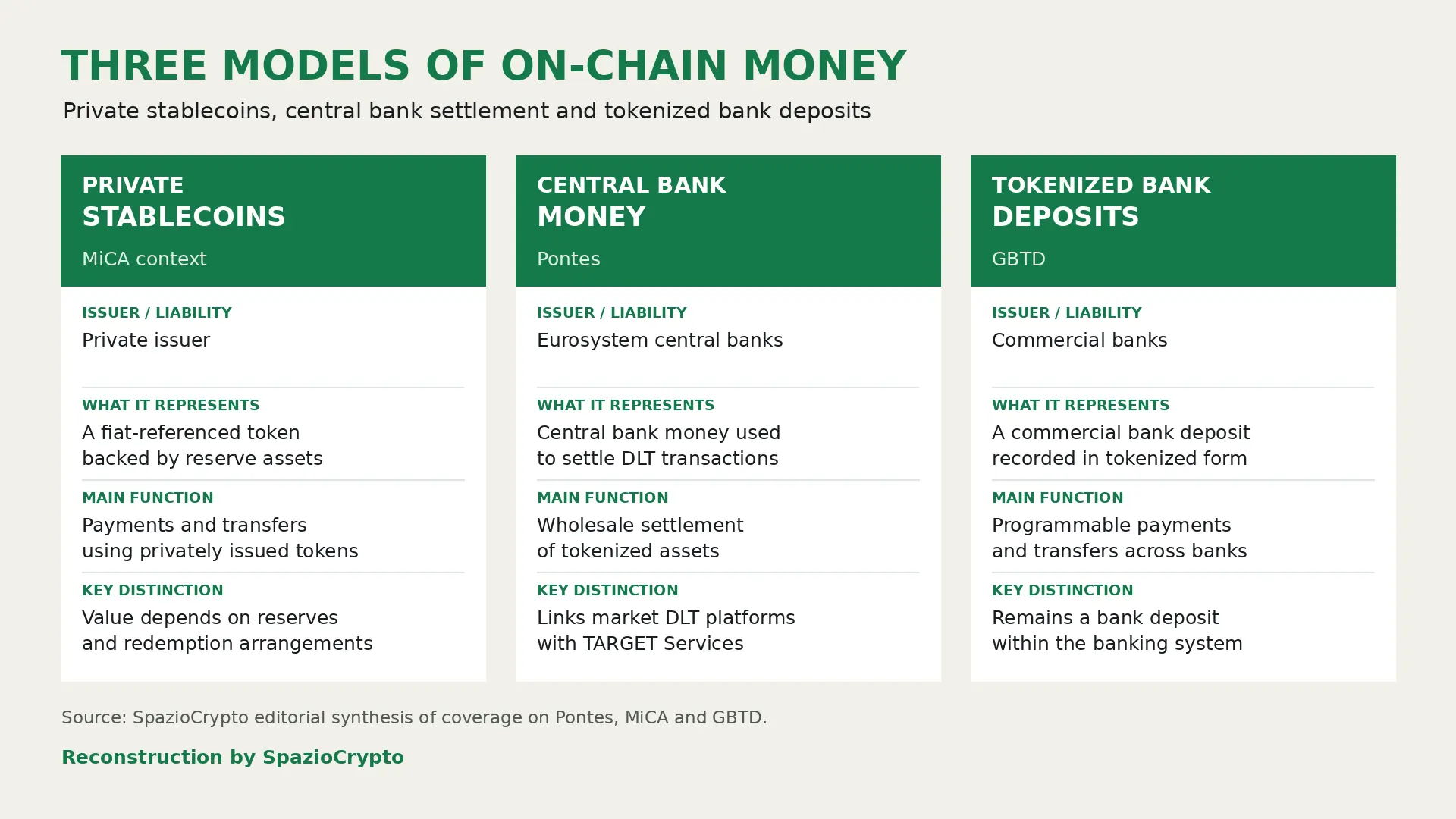
This is where the UK story becomes particularly significant when read in the context of the same week's broader developments. The same week that UK banks completed these live transactions, the Eurosystem activated the infrastructure bringing central bank money into the settlement of tokenised assets, as covered in our in-depth piece on Pontes. The following day, the ECB and EU national central banks called for a review of MiCA rules on private stablecoin reserves.
 HM Treasury
Three distinct models of digital money are now taking shape on-chain, coexisting in the same period: private stablecoins such as USDC and USDT, issued by corporate entities; central bank money distributed through infrastructures like Pontes; and now commercial bank deposits, tokenized yet legally identical to funds held in a standard current account. It's no accident that the Bank of England has expressed a clear preference for innovation through tokenized deposits rather than private stablecoins, given the implications that choice carries for credit creation capacity and national monetary sovereignty.
The Bigger Picture
The framing of “blockchain versus banks” has been overtaken by events. The real question this week's developments pose is which type of money will actually land on-chain, and who will control it: private issuers, central banks, or the commercial banks that have always managed retail deposits. Each model carries different consequences for financial stability, monetary sovereignty, and the banking system's ability to extend credit. That tension is also visible closer to home, in Italian initiatives such as those led by UniCredit and BlockInvest.
Two lessons stand out. First, the fact that four of the UK's largest banks have already settled real transactions, not just lab pilots, confirms that commercial money tokenization has moved from academic concept to live infrastructure. Second, the question of which digital money model prevails, whether private stablecoins, central bank currency, or tokenized bank deposits, or most likely some context-dependent combination of all three, remains one of the most consequential open questions facing the global financial system. Watching how these three models compete, or converge, over the coming months will be essential. For a grounding in the underlying technology, our guide on what cryptocurrencies are offers a useful starting point.