
As of September 21, 2026, Pontes is no longer a pilot project. The Eurosystem has officially launched the infrastructure that bridges distributed ledger platforms with TARGET services, enabling wholesale transactions on tokenized assets to settle directly in central bank money. Thirteen financial institutions and four DLT infrastructure operators are already using it. The ECB's Pontes launch for tokenized finance marks the first concrete operational step of the Eurosystem's strategy in this space, after months of announcements and experiments.
 European Central Bank
There's a second piece of news embedded in the same announcement, one that makes this launch far more significant than a mere technical infrastructure going live: the ECB itself will become a user of tokenized finance, investing a small portion of its own-funds portfolio in euro-denominated tokenized securities. Let's examine exactly what Pontes does, who is already on board, and why that second headline carries as much weight as the first.
How Pontes Works
Pontes provides the cash leg of wholesale DLT-based transactions directly in central bank money, connecting DLT market platforms to the Eurosystem's existing TARGET services. In practice, a bank can trade, say, a tokenized bond on a DLT infrastructure and settle the cash side through the Eurosystem, without needing to rely on a private stablecoin or a tokenized bank deposit. One point deserves emphasis to cut through the noise circulating this week: Pontes is entirely separate from the retail digital euro project aimed at consumers. This system deals exclusively with wholesale transactions between financial institutions.
Thirteen market participants are already operational at launch, according to the ECB's September 21 press release. They include Deutsche Bank, Santander, Société Générale, the European Investment Bank. Several regional German and Spanish banks, along with the Bundesbank itself as a market participant. Four DLT platform operators join them, including Clearstream, a subsidiary of Deutsche Börse. The platform currently runs from 08:00 to 16:00 Central European Time on business days, with a stated goal of reaching round-the-clock operability by 2028. Worth flagging for readers focused on British and European markets: no UK-based institution appears among the thirteen initial participants.
The ECB Becomes an Investor
The second announcement deserves equal attention. As confirmed in the ECB's September 21 press release, the European Central Bank has begun preparatory work to invest a small portion of its own-funds portfolio in euro-denominated tokenized securities, with an initial focus on securities issued by eurozone governments, regional authorities, agencies, and European supranational institutions. Two clarifications matter here: this is not a purchase of cryptocurrencies, and these investments remain entirely separate from monetary policy. The central bank's own-funds portfolio generates income to cover the institution's operating costs, and it's kept distinct from the tools used to conduct actual monetary policy. No specific amount has been disclosed, and the Executive Board will decide on precise timing once preparatory work is complete.
European Central BankThe strategic significance of this choice goes beyond any dollar figure. A detail emerging from sector analysis helps explain it: ECB economists have reportedly expressed concern that dollar-denominated stablecoins could, over time, erode European control over monetary policy if they become the default settlement layer for global tokenized markets. Building infrastructure that keeps settlement in European central bank money, rather than ceding it to private issuers or foreign currencies, is a direct response to that concern.
Pontes at a glance
What the launch covers. Source: ECB, September 21, 2026
- What it does: settles the cash leg of tokenized transactions in central bank money.
- Who's in: 13 participants (Deutsche Bank, Santander, Société Générale among others). No UK bank in the initial group.
- The surprise: the ECB itself will invest in tokenized securities settled via Pontes.
Eleven Days After India: The Race Comes Into Focus
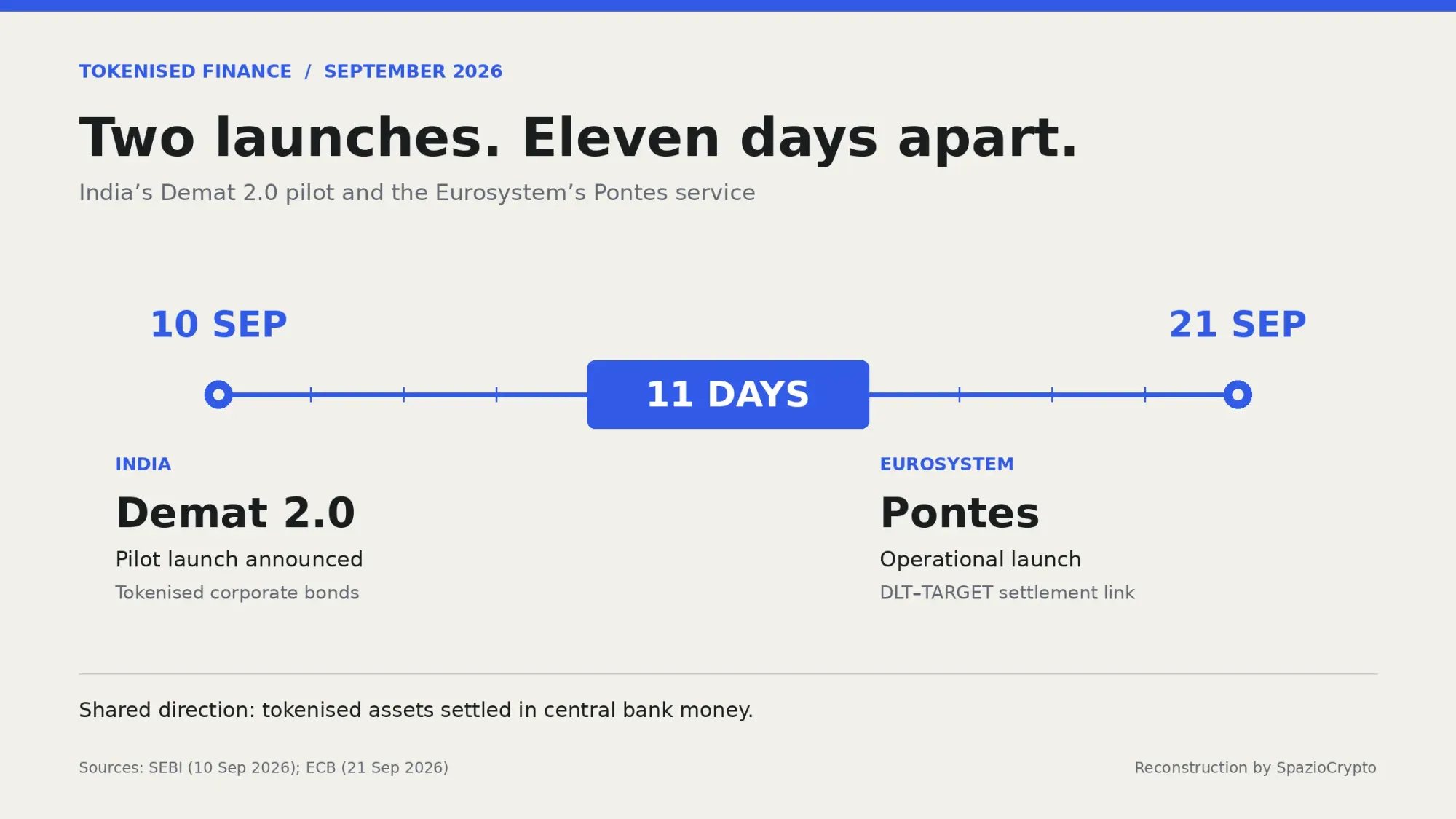
There's a timing detail worth pausing on, because we flagged it in an earlier analysis. Just eleven days before this launch, we reported how India had put the exact same theoretical model into production with its Demat 2.0 project: tokenized bonds settled directly with the central bank's digital rupee, via atomic settlement. At the time, we noted that India appeared to have beaten Europe to the punch on this particular front.
European Central Bank
That forecast is now fact. Pontes goes live on September 11 following India's earlier debut, confirming that the global race to connect tokenized assets with central bank money is a genuine, tightly contested competition, not a scattering of isolated pilot projects, but a contest between entire currency areas vying for a leading role in the next generation of financial infrastructure. The stakes are directly relevant to Italian banks as well, as shown by the path already underway with Italy's first tokenized bond settled in central bank money, even though Italy remains outside the initial group of Pontes participants.
European Central Bank
Why It Matters, Even for Those Outside the First Thirteen
For Italian banks and financial infrastructure operators, absence from the founding group does not mean irrelevance. Pontes is a new Eurosystem-wide infrastructure, and Banca d'Italia is a full member of the Eurosystem. The ECB itself has stated that additional participants are expected to join in the coming months. The initial group being composed primarily of large German, Spanish, and French banks, alongside supranational bodies, most likely reflects differences in each national banking system's technical readiness rather than any definitive exclusion.
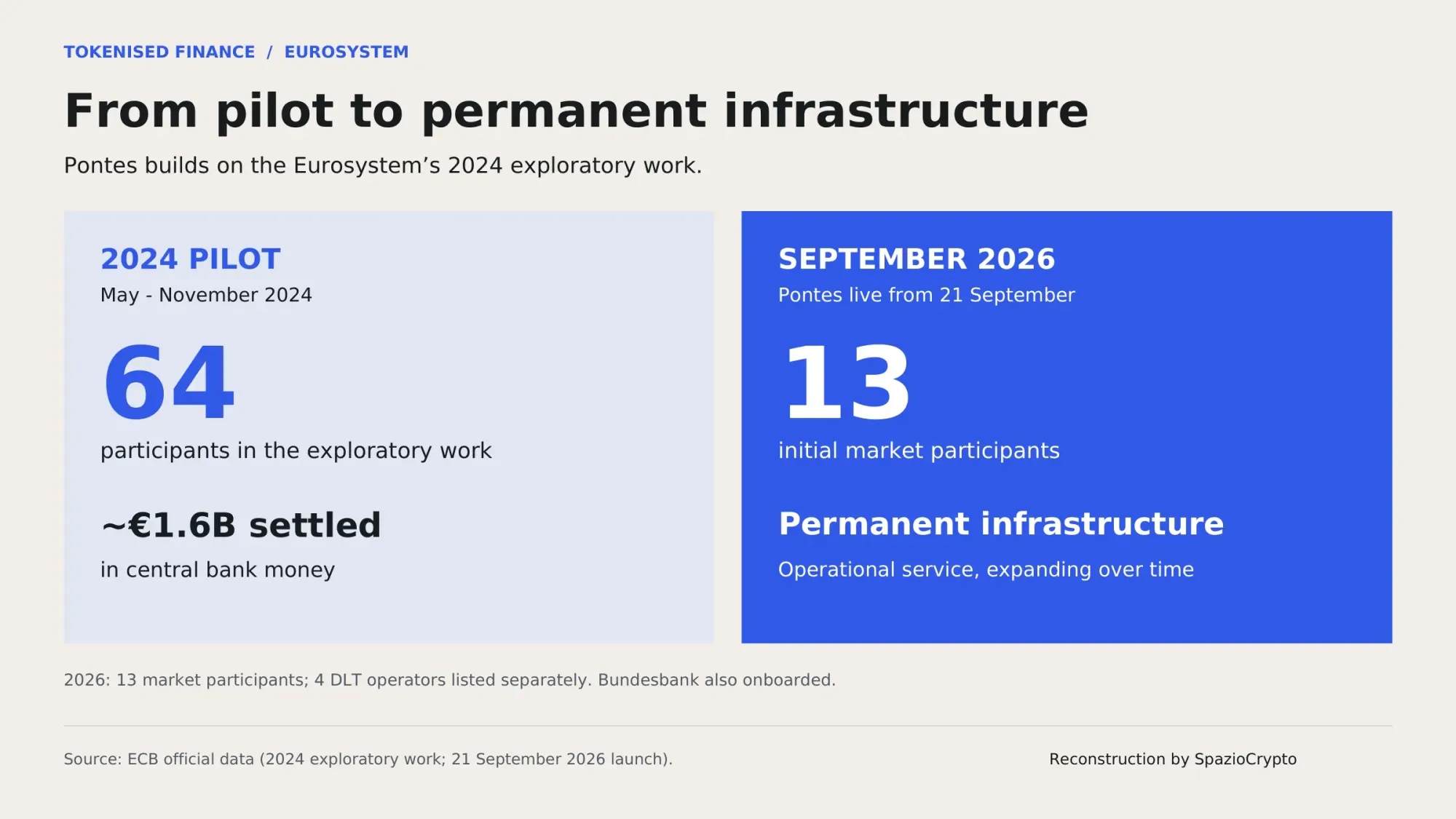
If the infrastructure does scale toward bonds, securities, collateral, deposits, and other instruments, as the project's own architects have outlined, September 21, 2026 may be remembered not as the launch of yet another payments platform but as an early milestone in building Europe's next wholesale financial market. That trajectory connects directly to the growing role of data infrastructure for tokenized finance, as seen in the S&P Global and Nasdaq investment in Kaiko.
The Bigger Picture
The Pontes launch marks a genuine inflection point for European tokenized finance, because it resolves, at least at the infrastructure level, one of the sector's most debated problems: how to settle tokenized transactions in an asset free of the credit risk attached to any private issuer. Until now, anyone seeking to tokenize a security had to choose between private stablecoins, tokenized bank deposits, or hybrid arrangements, each carrying its own trade-offs. For an initial group of European operators, there is now an alternative that pushes settlement to the safest possible tier, central bank money itself.
Two lessons stand out. First, this launch confirms that the global institutional tokenization race is being decided on highly concrete terms, specifically who manages to build central bank money settlement infrastructure first and at sufficient scale. Europe arrives second after India, per the ECB's own project timeline, but still ranks among the earliest movers globally. Second, the ECB's decision to invest directly in these instruments, even if the precise figures remain undisclosed in its press communications, signals institutional conviction that goes well beyond building a technical platform and could accelerate adoption by other operators over the coming months. Watching which institutions join the original thirteen participants, and whether Italian banks opt in during this first expansion phase, will be worth following closely. For broader context on the underlying technology, our guide on what cryptocurrencies and blockchain are remains a useful starting point.