


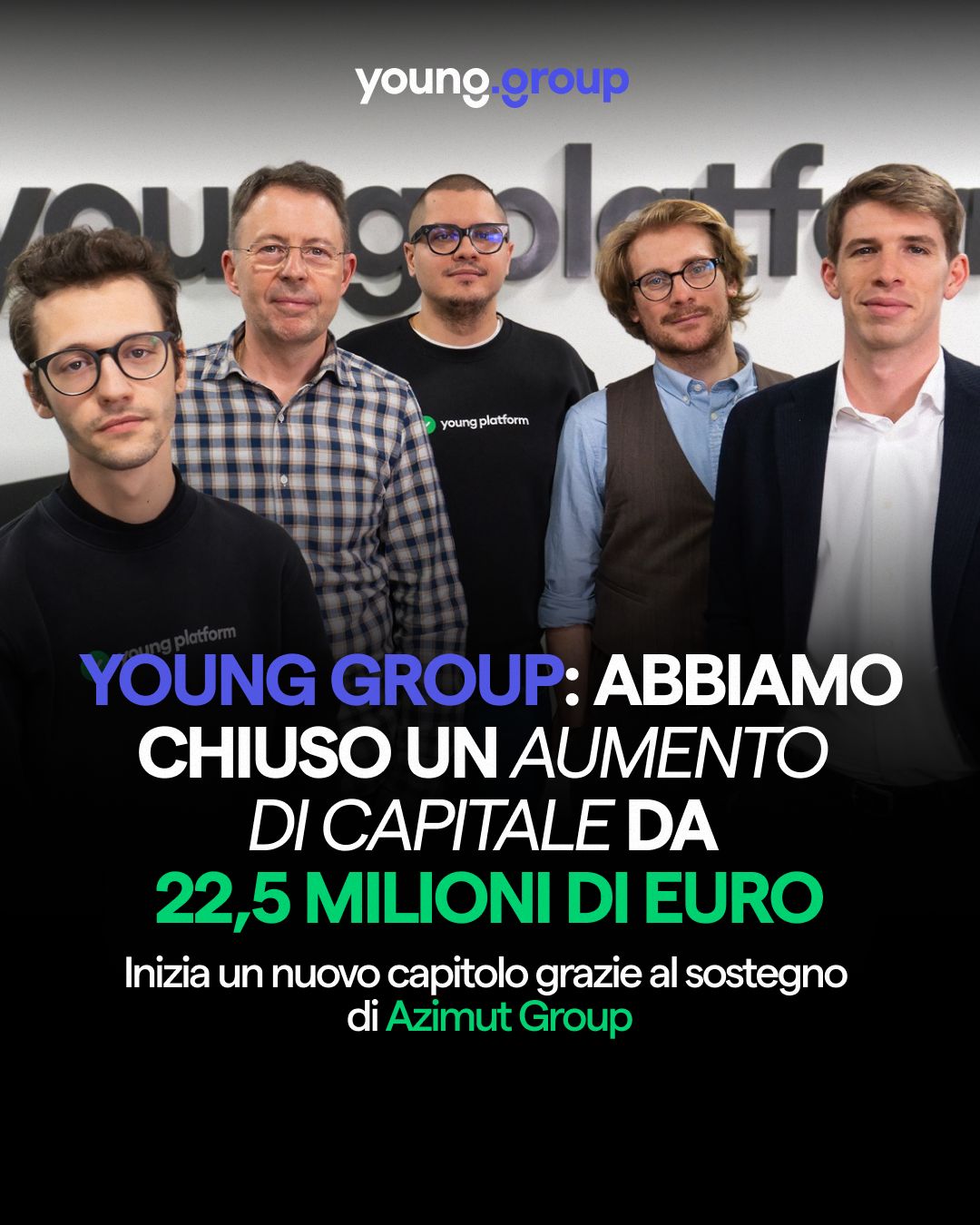
While most cryptocurrency news comes out of the United States and Asia, one of the most interesting stories of the moment is entirely Italian. Young Group, the Turin-based fintech that grew out of Young Platform, has raised €22.5 million in a round led by Azimut Group. The goal is ambitious: to build an Italian hub that brings crypto investing, digital banking services and the tokenization of financial instruments together on a single platform.
The news deserves attention because it is the story of a homegrown success growing in a cutting-edge sector, and because it marks the convergence between crypto and Italy's traditional finance industry. Here are the details of the deal, what the group wants to build and why this story matters well beyond a single company.
The details of the deal
Let's start with the facts. Young Group has completed a €22.5 million capital increase, with Azimut Group, one of Europe's leading independent asset managers, as lead investor. The investment was made through a dedicated vehicle that allowed clients of Azimut's financial advisor network to take part, an interesting detail because it brings traditional savings closer to the world of digital assets.
This is not a chance encounter but an established relationship: Azimut had already invested in Young Platform, leading a €16 million round in 2022 and adding more capital in 2024. With this new deal, the Turin group has raised more than €45 million since 2019. As co-founder Andrea Ferrero put it, the aim is to make Azimut an increasingly industrial partner, not just a financial one, a sign of a bond that goes beyond simply supplying capital.
 Young Platform
What Young Group wants to build
So what is the vision behind this investment? This is where it gets most interesting. Young Group is the recently formed holding company that brings two complementary businesses under one roof. The first is Young Platform, the cryptocurrency exchange that made the company known, with more than two million registered users and one of the few European authorizations obtained in Italy. The second is Fleap, a company specializing in the tokenization of financial instruments, that is, turning assets such as fund units and shares into digital versions on a blockchain.
The ambition is to combine these two worlds, together with digital banking services, into a single integrated experience. In practice, the group wants to build a platform where a user can invest in cryptocurrencies, manage an account and payments, and access tokenized investments, all in a simple and regulated way. As Ferrero explained, the philosophy is not to replace traditional finance but to integrate it with new technologies. It is a vision that aims to let the old and new worlds of finance live side by side rather than pitting them against each other.
The Young Group deal at a glance
The numbers and the strategy. Source: Young Group, Milano Finanza, 2026
- The round: €22.5 million led by Azimut, a long-standing partner. More than €45 million raised since 2019.
- The holding: Young Group brings together Young Platform (crypto) and Fleap (tokenization of financial instruments).
- The vision: a single hub that combines crypto, digital banking and tokenization, simple and regulated.
Why this story matters
Beyond the numbers, the deal is important for several reasons. The first is that it is a case of Italian entrepreneurial success in a high-tech sector. Started almost as a game among friends in Turin less than ten years ago, with an app designed to bring young people closer to cryptocurrencies, the company has grown into a structured financial group able to attract major investment. It is the kind of trajectory that shows Italy, too, can build significant innovative companies.
The second reason is that it confirms an underlying trend: the convergence between crypto and traditional finance. When a major asset management group like Azimut invests with conviction in a project that combines crypto, banking and tokenization, it signals that these once separate worlds are merging. It is no longer a matter of betting on Bitcoin, but of building the financial infrastructure of the future, where digital and traditional assets coexist. The third reason is the central role of regulation: the group was able to grow partly because it obtained the necessary authorizations, showing that in the new European landscape, regulatory compliance has become a competitive advantage rather than an obstacle. It is no coincidence that Young Platform is among the few operators to have obtained Italian authorization as a crypto service provider.
Challenges not to be underestimated
It would not be fair, however, to tell only the positive side. A project this ambitious also brings concrete challenges, which industry observers themselves have pointed out. Integrating worlds as different as cryptocurrencies, banking services and tokenization into a single platform is a technically and organizationally complex undertaking. Different technologies have to be harmonized, governance spanning several companies has to be managed, and above all profitability has to be reached, a goal that is far from guaranteed for a fast-growing business still in its expansion phase.
Then there is the challenge of distribution and competition: building an integrated ecosystem means competing not only with other exchanges but also with traditional banks and large international platforms. The capital raised is meant precisely to tackle these challenges, but the road ahead is demanding. Reporting these aspects takes nothing away from the value of the deal. On the contrary, it helps frame it realistically, as an ambitious and promising bet whose success will have to be proven in practice. It is the sign of a maturing sector, where promises come with concrete tests to pass.
The bigger picture
The Young Group story captures, on an Italian scale, the sweeping transformation under way in global finance. Cryptocurrencies are leaving their niche to integrate with banking services and traditional finance, giving rise to a new kind of infrastructure in which digital assets and conventional instruments coexist. And this transformation is not limited to the American giants: it also involves national players able to carve out a leading role for themselves.
For observers, this story offers two takeaways. The first is that Italy, often seen as peripheral to the major centers of financial innovation, can produce companies of excellence that are able to compete, especially when they combine technological expertise with attention to the rules. The second is that the future of finance is, ever more clearly, hybrid: a world where the solidity of traditional finance combines with the flexibility and innovation of blockchain technologies. That a large asset management group and a young crypto fintech are joining forces to build this future is perhaps the most telling sign of where the whole sector is heading. Readers who want to learn more about tokenization can read our guide on what tokenized assets are.