

Moody's Ratings and Chainlink completed a testnet pilot on November 10, 2026, connecting Moody's Token Integration Engine to Chainlink's Cross-Chain Interoperability Protocol to distribute rating data simultaneously across multiple blockchains. The result is a technical demonstration, not a live service: no real credit ratings were published on-chain, and neither company has announced a commercial launch date.
This article draws on the joint press release, The Block's reconstruction of events, and the series of announcements Moody's has issued around its blockchain engine throughout 2026. Chainlink's post on X was not accessible to our tools at time of writing.
What Was Actually Tested
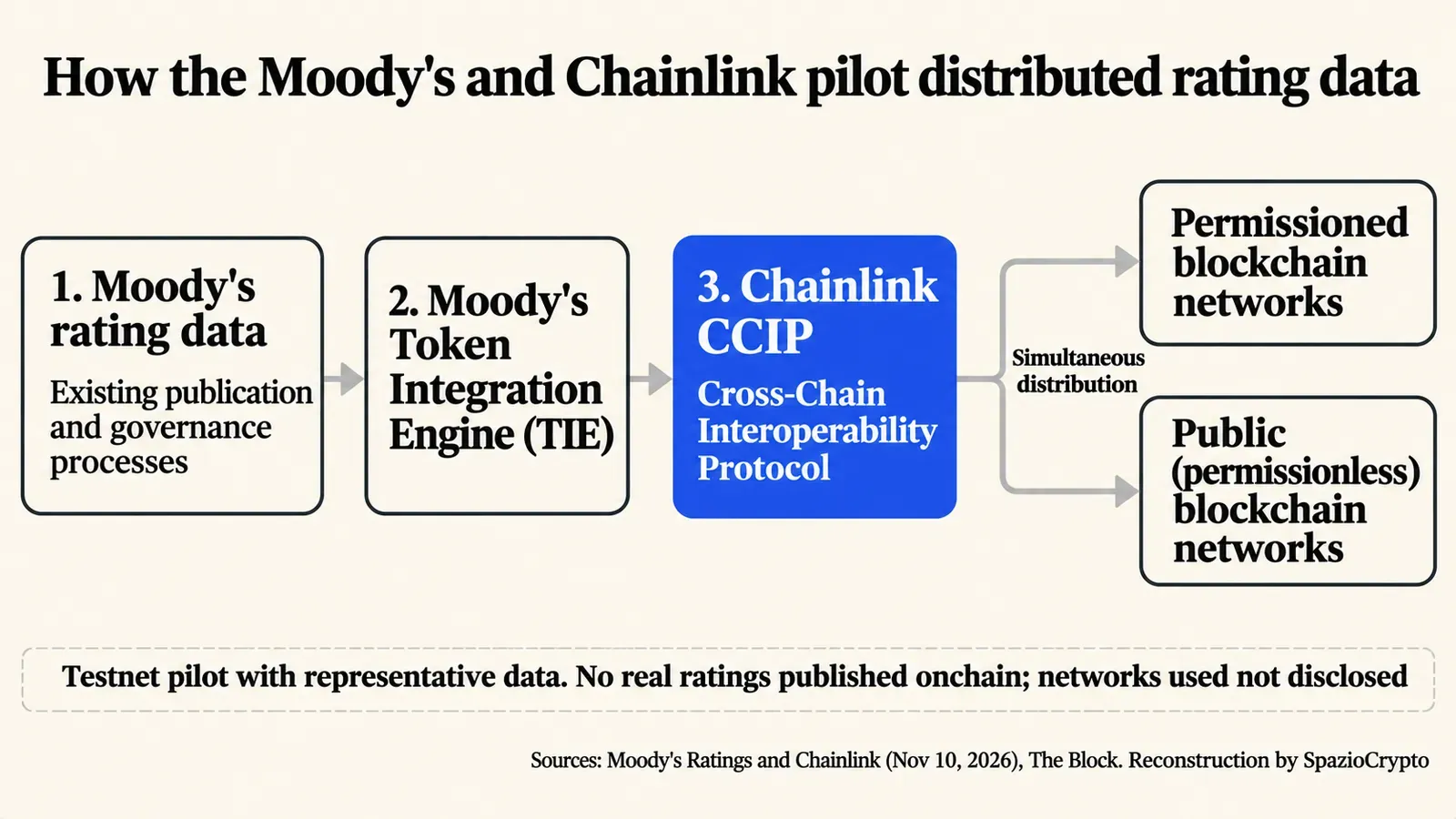
The Token Integration Engine, known as the TIE, is Moody's tool for bringing credit analysis onto blockchain networks. In the pilot, the TIE was connected to Chainlink's CCIP, the protocol designed to transmit data and messages across different blockchain networks. The combined system delivered a single publication of rating data simultaneously to both permissioned networks (closed, restricted to authorized participants) and permissionless networks (open to anyone).
The detail Moody's emphasizes is governance: distributing ratings across multiple networks preserved the agency's existing publication processes and internal governance. The rating itself is still born, reviewed, and approved exactly as before. Only the delivery channel changes. For readers who want to understand why cross-chain interoperability is a genuinely hard engineering problem, our guide to blockchain interoperability covers the solutions currently in use.
A Test, Not a Service
The joint press release is explicit about the limitations. The implementation ran in a test environment using representative data: no real rating actions were published on-chain, and actual publication processes were not involved. According to both companies, the future model could also handle rating actions such as upgrades and downgrades, while keeping Moody's existing publication procedures intact.
Several details remain absent. Neither the press release nor The Block's coverage identifies which specific blockchains were used in the test. There are no named issuers, no timelines, and no cost figures. Anyone reading this news as confirmation that Moody's ratings are now live on all blockchains is reading beyond the facts. For now, it's a technical demonstration.
Moody's 2026 Blockchain Roadmap
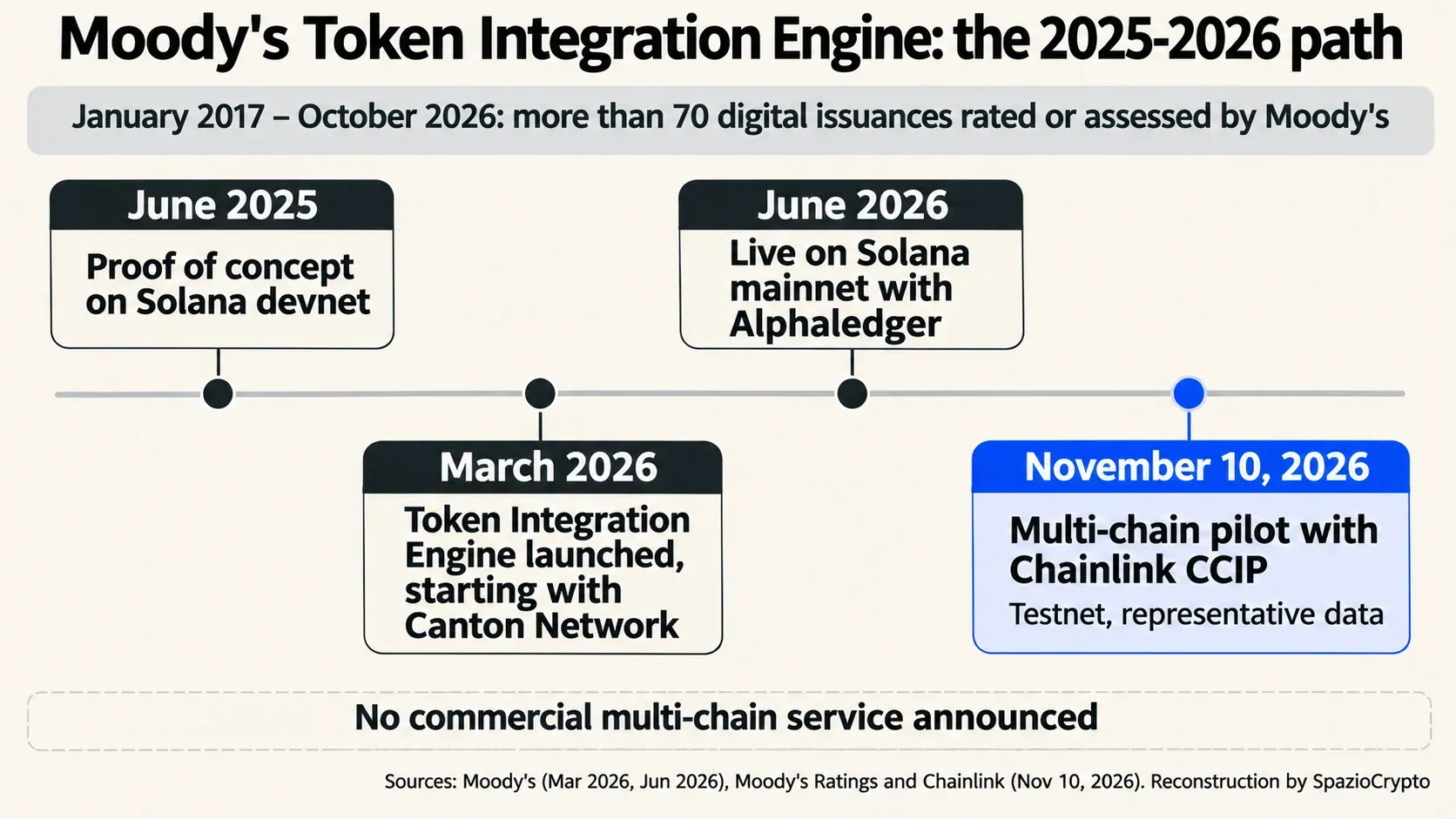
The Chainlink pilot is the third milestone of the year for Moody's. In March 2026, Moody's launched the Token Integration Engine starting from Canton, the institutional finance network, positioning itself as the first rating agency to operate a node on that network. Canton's infrastructure is the same whose token was the subject of the SEC's no-action letter on Canton Coin.
In June, Moody's extended the TIE to Solana mainnet, together with Alphaledger, a fixed-income tokenization platform. Issuers tokenizing bonds on Alphaledger can choose to have Moody's rating travel with the security. The November pilot attempts to move beyond the one-network-at-a-time logic. As Fabian Astic, Moody's Ratings global head of digital economy, stated in the joint release: the future of tokenized finance will likely not reside on a single blockchain, platform, or market infrastructure.
Why Ratings Need to Follow the Security
The underlying problem is concrete. According to the joint press release, between January 2017 and October 2026 Moody's rated or analyzed more than 70 digital issuances, covering digital bonds and tokenized funds. These securities live on different networks, and an investor buying one on a given blockchain typically finds the rating elsewhere: on a website or in a data terminal.
If the rating data lives alongside the security itself, a protocol or fund manager can read it and act on it programmatically. One direct use case: automatically determining which securities are eligible as collateral. Chainlink is well-positioned here. Its protocol already connects tokenized funds across multiple networks, including the Amundi-Spiko SAFO fund, which uses Chainlink for net asset value calculation and cross-chain interoperability, as we covered in our SAFO launch piece. Johann Eid, chief business officer of Chainlink Labs, put it plainly in the joint release: if financial assets move on-chain, credit information needs to move with them. For a primer on how the network works, see our Chainlink guide.
The Ratings Agency Race
Moody's isn't alone in this space. S&P Global Ratings has been publishing its stablecoin stability assessments on-chain via Chainlink since October 2025, the same assessments that led to the downgrade of Tether. On November 10, 2026 specifically, S&P and Chainlink extended that agreement to cover lending vault risk assessments, initially published on Base. S&P has clarified that those assessments are not credit ratings.
The distinction between the two agencies' approaches matters. S&P is bringing already-public, active data on-chain for products native to decentralized finance. Moody's is working on traditional credit ratings, the core of its business, but with considerably more caution: a testnet pilot, no real publication, and no announced timeline.
European Regulatory Context
The question raised by this pilot is not purely technical. Across Europe, tokenized bond issuances are growing. Under MiCA and existing ESMA frameworks, credit rating agencies operating in the EU are registered and supervised by ESMA directly. Any model that publishes ratings on open, permissionless networks will need to reconcile that activity with ESMA's disclosure and integrity rules, which were written for traditional distribution channels.
For institutional investors on either side of the Atlantic, the practical question is straightforward: when tokenized securities become liquid enough to trade across platforms, manually retrieving a rating from a separate terminal becomes a friction point. Rating data embedded in the security itself removes that friction and opens the door to automated compliance and collateral management tools.
Moody's and Chainlink Pilot: Confirmed and Unconfirmed
What is confirmed, and what is not:
- Confirmed: Moody's Ratings and Chainlink completed a pilot in which the Token Integration Engine, connected to CCIP, distributed rating data simultaneously across permissioned and public blockchain networks, preserving Moody's existing publication and governance processes.
- Not disclosed: which blockchains were used in the test, any issuers involved, timelines, costs, or a commercial service launch date. The test ran in a testnet environment with representative data and no real ratings were published on-chain.
- To watch: the transition from testnet to live networks, the first real rating action published on-chain, and how S&P and Fitch respond on the same terrain.
The Bigger Picture
Our editorial read, stated as such: the major rating agencies have recognized that tokenized finance won't concentrate on a single network, and they don't want to be absent from the circuits where securities will actually trade. For Moody's, choosing a cross-chain protocol is also a bet on neutrality. The agency doesn't need to pick a winning blockchain. For Chainlink, the pilot is another validation of its role as the data infrastructure layer for institutions, alongside the relationship it has already built with S&P.
Four concrete signals are worth watching. First, the initial real rating published through this system, and on which networks. Second, which issuers choose to embed a rating in their tokenized security. Third, how ESMA and other regulators respond to rating publication on open networks. Fourth, whether on-chain rating data actually gets consumed by protocols in production: that outcome, more than any press release, will determine whether this is infrastructure or showcase.