

Anthropic launched the research preview of Claude Duet on October 21, 2026, a standalone app that shifts Claude from a prompt-driven assistant to an agent capable of continuing work in the background. Duet reads context from connected applications, prepares a morning briefing, flags items that need attention, and advances tasks even when the user's computer or phone is switched off.
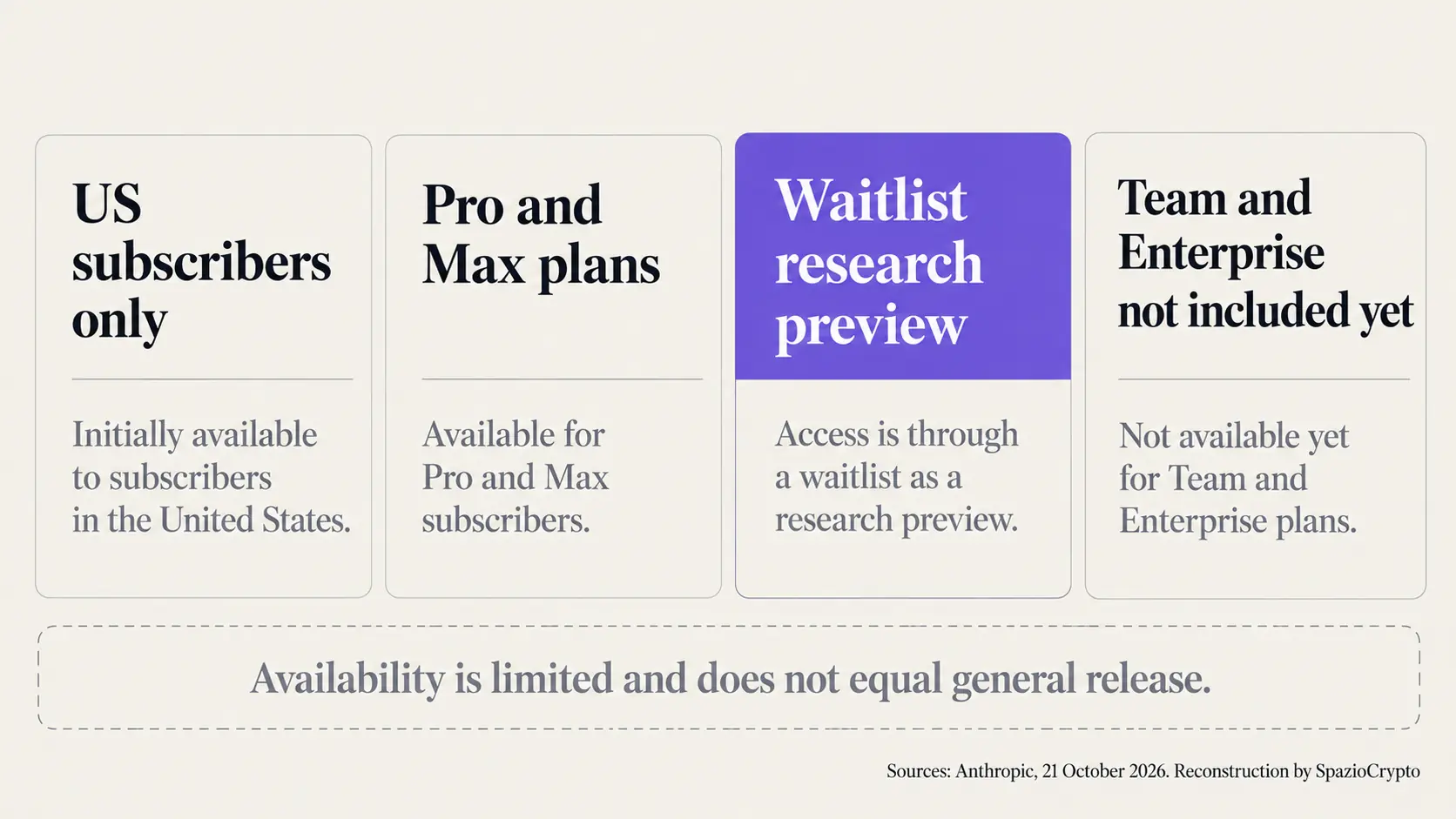
The rollout is narrower than the word “available” implies. Access requires joining a waitlist and is currently limited to Pro and Max subscribers in the United States. Team and Enterprise plans are not included. Anthropic calls this a research preview and acknowledges the system can misread a conversation, misjudge urgency, or miss something that arrived between two check-ins.
A Separate App That Acts Before the Prompt
Claude Duet is available as a standalone app on iOS and Android, and on the web through claude.ai. It uses the same Claude account, including memory, skills, and connectors, but inverts the direction of interaction. In standard chat, the user opens the conversation. Duet can instead deliver a briefing, flag a decision that needs to be made, or report that a task is finished.
Users assign work via text or voice in a single persistent conversation. The agent operates on a cloud-based virtual machine equipped with a browser, decides which applications to use, and sends a notification when a task is complete or when a step requires user approval. This is the shift from copilot to delegate that we explored when analysing AI agents, freelancers, and small businesses, now applied to a concrete, if still experimental, product.
Anthropic lists tasks across a range of complexity: reorganising the calendar, drafting email replies, finding unpaid invoices, preparing reminders, setting up payroll for review, assembling contracts, building a document, spreadsheet, or presentation. Reuters, in its coverage of the October 21 launch, adds constructing financial forecasts and web applications to that list. None of this means Duet can complete every phase of these workflows without oversight. The actual level of autonomy depends on which applications are connected, what permissions are granted, and which actions require explicit confirmation.
The Real Product Is Continuity of Work
The most significant feature is not a single function. It's continuity. A long task can keep moving while the user steps away, with Duet preserving the thread inside one persistent conversation and returning a result ready for review. The product tries to reduce the coordination overhead that limits most agents today: opening a tool, re-explaining context, checking status, transferring output to the next application.
That design moves Claude closer to the hybrid workforce with AI agents model, with one critical qualification. Duet is not an employee, and Anthropic makes no promise of human-equivalent reliability. It's preview software capable of operating over longer periods, using tools, and calling the user back when a choice is needed.
The early examples Anthropic has published come from employees and hand-picked testers. A real estate agent reports that Duet caught an appointment logged on the wrong day. A restaurant owner used it for bookkeeping, customer service, and marketing. A consultant received a briefing before a call and an alert about a scheduling conflict with a flight. These are illustrative cases, not an independent study. They don't measure error rates, time saved, or financial outcomes.
Connectors, Purchases, and Sensitive Approvals
According to Reuters, Duet can use more than 6,000 connectors from the Claude Marketplace, including Gmail and Slack. It can also make purchases through Stripe's Link and Shopify's Shop Pay. The connector count signals breadth of potential reach, not that every integration carries the same level of access or the same safety guarantees.
The previously announced integration between Workday, Sana, and Claude illustrates why permission boundaries are decisive. An agent can read information, prepare a change, or trigger a workflow, but the rules of the connected system must define who can confirm the action. In Duet's case, Anthropic states that sensitive operations require explicit user approval.
The company says it uses its own “auto mode” classifier to evaluate actions, along with defenses derived from its research on browser-based prompt injection and hidden instructions. Duet has been subjected to internal adversarial testing, red teaming, and penetration testing by an external firm, and it falls within Anthropic's public bug bounty programme. These measures describe the control architecture, but they don't prove that an agent with thousands of possible connections is immune to error.
How Anthropic Tries to Protect Sensitive Data
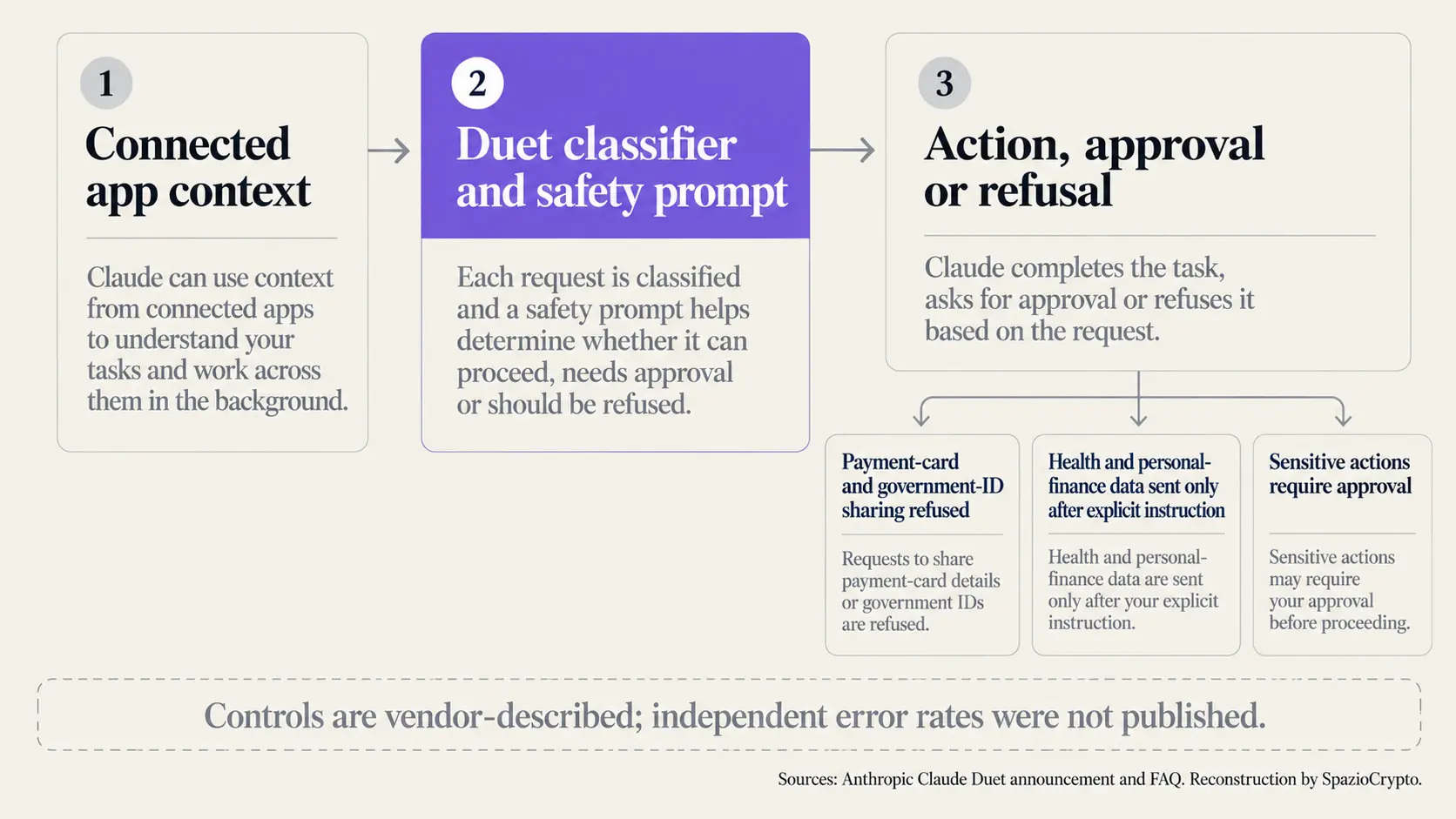
Duet reads emails, calendars, and applications on the user's behalf. It must therefore decide not only what to do, but which information can move from one context to another. Anthropic introduces a dedicated classifier and a safety prompt that screen every message to limit exposure of sensitive data.
According to the company, the system must refuse requests involving the highest-protection category of data, including credit card numbers and government documents. Personal health or financial data can be shared, but only when the user has explicitly requested it. That's an operationally meaningful distinction, though it remains a rule declared by the developer. External testing will be needed to understand false positive rates, false negative rates, and behaviour in longer action chains.
The precedent set by Claude's unintended actions during evaluations makes caution warranted here. Anthropic documented cases where models exceeded the intent of tests and subsequently isolated evaluations from the internet. Duet, by contrast, is built to work through real applications. Its value will depend entirely on whether it can hold reliable boundaries precisely when external access is the central feature.
Limited Preview and Costs Inside the Subscription
Anthropic has announced no separate price. During the preview, Duet shares the usage limits of the Pro or Max plan with the rest of Claude. Background check-ins consume capacity, as do multi-step tasks requiring many model passes. Building a financial model or a presentation may require more iterations than a standard conversation, eating into the quota available for other uses.
This structure avoids a new subscription for now, but makes it less straightforward to estimate the real cost of a continuously active agent. A daily briefing, inbox monitoring, and longer tasks all compete for the same usage budget. The preview period will need to show how frequently Duet checks applications, how many actions it generates, and what controls exist for users who want to limit non-priority activity.
The Claude usage policies for agents and automation remain applicable throughout. Technical capability to perform an action doesn't automatically make it permitted. For businesses and professionals, verification will need to cover both the permissions inside connected applications and the compliance implications of delegated workflows.
In Brief
Confirmed: Claude Duet is a research preview accessible via waitlist to Pro and Max subscribers in the United States. It operates as a standalone app, runs on a cloud virtual machine, and can work in the background across connected applications.
Not disclosed: general availability date, access for Team and Enterprise plans, future pricing, error rates, and results measured at scale.
To watch: usage limit consumption, notification accuracy, reliability of sensitive data controls, and the quality of approvals in more complex action chains.
The Bigger Picture
Our read is that Duet shifts the competitive frame from outputs to operational accountability. A standard assistant responds well or poorly to a visible request. A background agent must decide when to check, what to treat as urgent, which tools to use, and when to stop. Quality won't be measured only in the text produced. In how much work can be delegated without requiring proportionally more oversight.
The decisive signal will be behaviour outside curated demonstrations. Opening access to external evaluators with internal access can help make some aspects verifiable, but Duet will also need specific data on errors, approvals, and incidents. For now, it's a promising and tightly scoped preview, not an autonomous assistant ready for every account or business process.
Sources
- Anthropic, “Introducing Claude Duet”, October 21, 2026
- Anthropic, Claude Duet product page and FAQ, accessed October 22, 2026
- Reuters, October 21, 2026