


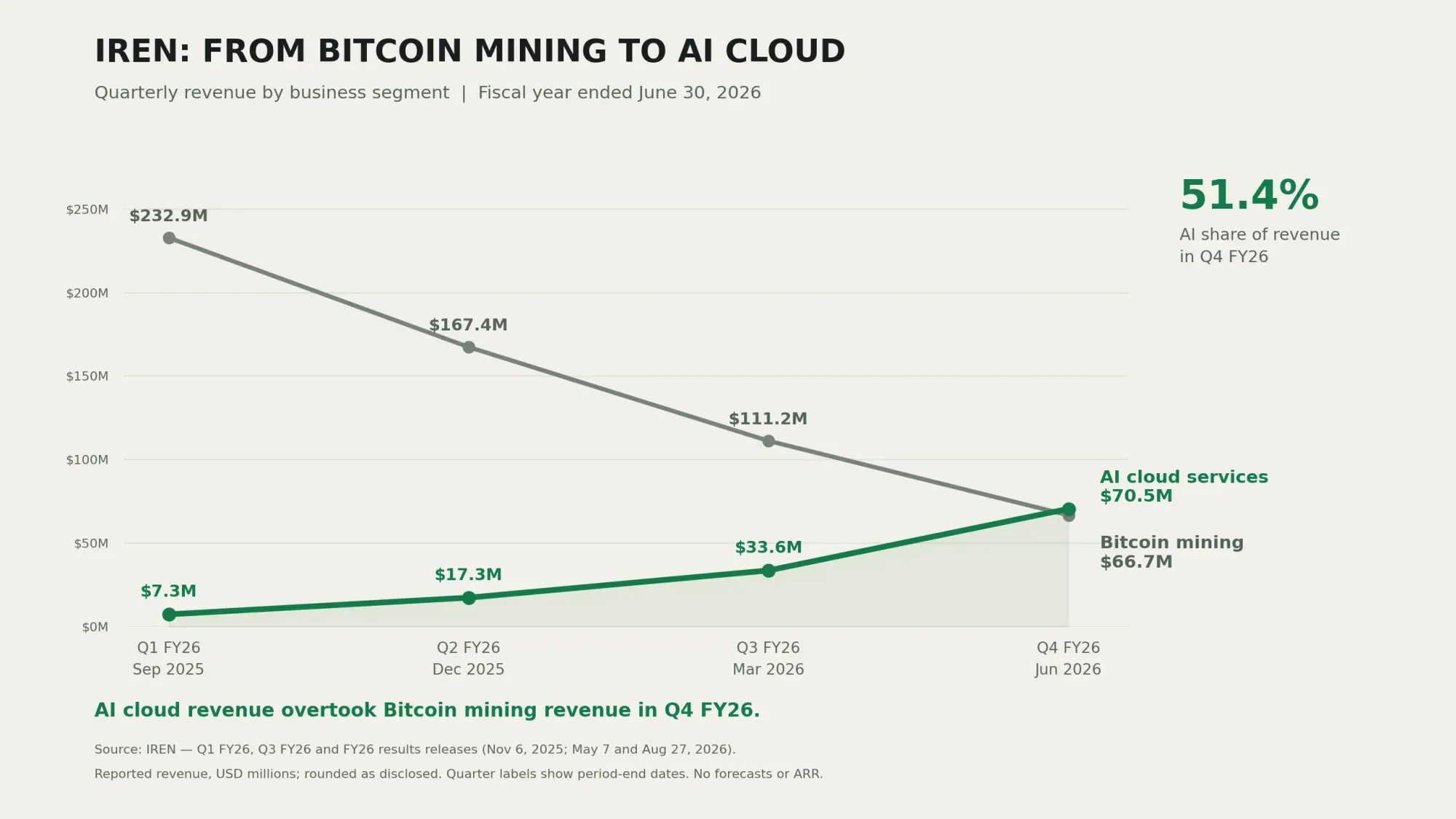
There is one company that shows better than any other how the worlds of cryptocurrency and artificial intelligence are merging. It is called IREN, it started out as a Bitcoin mining operator, and today it is preparing to invest up to $30 billion to build data centers dedicated to artificial intelligence. Its bet, spelled out by its co-CEO in a new interview, is a bold one: global demand for AI computing power may never be fully met. The transformation of IREN from Bitcoin miner to AI data center giant is one of the most telling cases of the moment.
This is more than a story about a company building data centers. It is the clearest example of a deep transformation sweeping the entire crypto mining industry, in which the physical infrastructure built to “mine” Bitcoin is becoming a strategic asset in the global race for artificial intelligence. Here is what is happening and why this story matters well beyond a single company.


From Bitcoin factory to AI compute factory
To grasp the scale of the shift, you have to start with what companies like IREN used to do. Bitcoin mining essentially means running huge numbers of specialized computers to validate the network's transactions and earn new Bitcoin. The business needs three basic ingredients: vast amounts of cheap electricity, large plots of land on which to build the sheds, and high-capacity connections to the power grid. Over the years, miners have built up a rare skill: turning enormous amounts of energy into computing capacity on an industrial scale.


And it is exactly this skill that is now worth its weight in gold in the world of artificial intelligence. AI data centers need the same things: abundant energy, enormous spaces and high-capacity connections. IREN understood before others that the infrastructure built for mining could be repurposed to host the extremely powerful graphics cards, or GPUs, needed to train and run artificial intelligence models. In fairness, one point needs to be stated precisely: IREN is in fact exiting Bitcoin mining altogether and decommissioning its old facilities. What it is repurposing, then, is not the mining business itself but the core expertise that made it possible, moving it toward a market that today offers potentially much higher returns.
 IREN Limited

Giant-sized numbers, and top-tier customers
The scale of this transformation is striking. IREN is now valued at around $17 billion, has raised about $19 billion over the past year and serves some of the biggest names in global technology. Its customers include giants such as Microsoft, with which it signed a contract worth almost $10 billion, and Perplexity, one of the best-known emerging AI companies. Even more significant is its relationship with Nvidia, the maker of the most sought-after GPUs: for IREN, Nvidia is at once the supplier of its chips, a customer for its services and an investor in the company, a web of ties that shows how closely intertwined this industry has become.
The underlying bet is the one voiced by co-CEO Daniel Roberts: demand for AI computing capacity is so voracious that it may never be fully satisfied. The reasoning is that the more computing power becomes available, the more new models, agents and applications appear to consume it, in a growth spiral with no apparent end. He is not alone in this view: a Goldman Sachs estimate projects that US data center capacity could triple by 2030, a sign of how structural the market considers this hunger for compute.
Mind the risks: a costly bet
It would be a mistake, however, to tell this story in purely triumphant tones, and some balance is needed here. The transition comes at an enormous cost and carries real risks. IREN itself recently reported a sizable net loss, largely due to accounting write-downs on the old mining facilities retired to make room for the new AI infrastructure. And the $30 billion investment plan initially rattled investors, who were worried by such a large figure.
The company responded by explaining how it plans to fund it: not mainly by drawing on its own capital, but above all through customer prepayments, which cover a significant share of GPU costs, and through debt. The model reduces risk, yet it remains a colossal bet on a market, AI, whose future growth, however likely, is not guaranteed. Heavy reliance on a handful of large customers and a huge financial exposure are factors to keep in mind. This caution ties into a broader theme we covered recently, the systemic risks linked to the expansion of AI, which have also been raised by authoritative institutional voices, as in the case of the financial stability warning issued by the Governor of the Bank of England.
The bigger picture
IREN's story is emblematic of a historic convergence between two of the biggest technology trends of our time: cryptocurrencies and artificial intelligence. The physical infrastructure of energy, land and data centers built during the Bitcoin mining boom is proving to be a valuable, convertible resource for powering the AI revolution. It is a textbook example of how skills and assets developed in one sector can find new life and value in another that seems distant but is in fact technically close. The link between crypto and AI is tightening on several fronts, as we saw when covering Tether's vision for the machine economy.
For observers, the lesson is twofold. On one hand, this story is an invitation to drop a siloed view of technology: crypto and AI are not separate worlds but increasingly intertwined ones, and companies operating in one can suddenly find themselves leading players in the other. The real expertise of firms like IREN, it turns out, was never “making Bitcoin” but mastering large-scale computing infrastructure, a skill in extraordinary demand today. On the other hand, the story calls for realism: behind the dizzying figures and visions of endless growth lie concrete risks, colossal investments and bets whose outcome is far from certain. AI's hunger for compute is real and massive, but turning it into sustainable profits is still an open challenge. What we are watching is one of the most fascinating chapters of the ongoing digital transformation, in which the boundaries between sectors are dissolving and new giants are emerging. To get a better grip on the basics of these worlds, our guide to what cryptocurrencies and blockchain are remains a useful starting point.