

The tech stock sell-off reached Asian markets at the open on November 23, 2026, while Wall Street futures attempted to recover part of the previous week's losses. According to Reuters, the Nasdaq had just closed its worst weekly decline since March 2020, shedding close to 10%. The gap between rebounding US derivatives and still-fragile Asian markets shows how sharply the reassessment of artificial intelligence expectations has spread beyond the United States.
A Futures Rebound Does Not Erase the Nasdaq's 10% Weekly Drop
In Reuters' first reading of November 23 trading, Nasdaq 100 futures were up roughly 2% and S&P 500 futures were up around 1%. The move was still preliminary: futures reflect market expectations on the index but do not represent actual stock closes, and there is no guarantee any bounce holds through the US open. In a later Reuters update, Nasdaq 100 contracts had risen close to 3% and S&P 500 contracts close to 2%. These are snapshots from different moments, not competing data points.
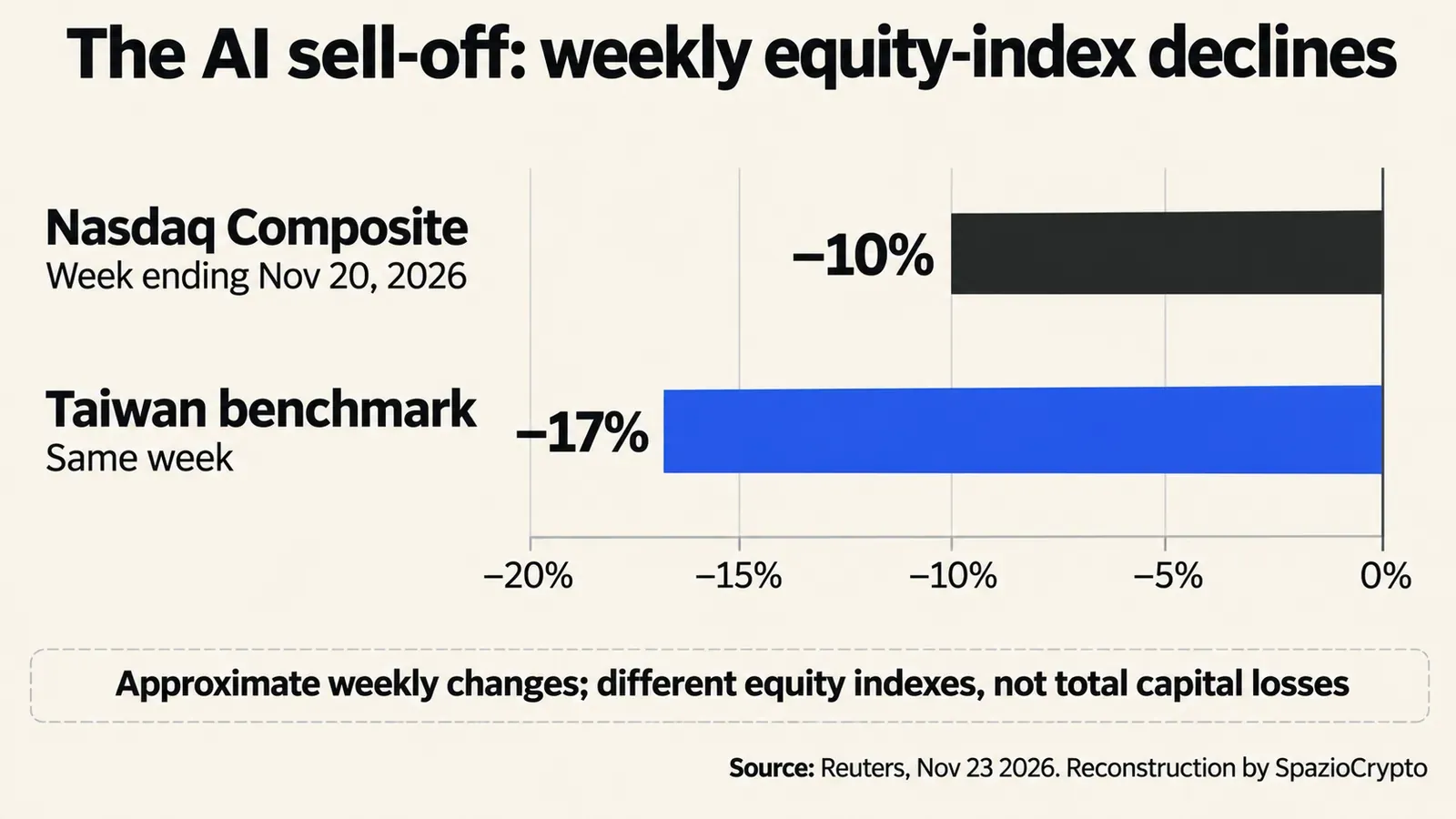
The scale of the prior decline matters more than an early-hours recovery. According to Reuters, the Nasdaq lost roughly 10% in the week ending November 20, as the market questioned how quickly investments in computing capacity can translate into earnings. SpazioCrypto had already covered the sharp Nasdaq drop on November 5, tied to concerns about data center costs and returns. This latest leg extends the correction over a broader timeframe.
Asia Feels the Pressure on Semiconductors and Equity Markets
At the session open, Australia fell roughly 0.5%, while futures on the Hang Seng and Japan pointed lower. The Tokyo Stock Exchange was closed for a public holiday: moves in Japanese futures should not be confused with an actual open equity session. Taiwan and South Korea, two critical nodes in the global chip supply chain, were the focal points after a week of exceptionally heavy selling.
According to Reuters, Taiwan's index had shed roughly 17% in the previous week, its steepest weekly decline since 1990. The US Philadelphia Semiconductor Index lost around 10% on Friday, November 20 alone. These are not directly comparable intervals, though both capture the intensity of pressure on the sector. In a later Monday update, Reuters indicated Taiwan recovering around 2%, while South Korea's KOSPI dropped about 5% before partially stabilizing. Asia is not moving in a single direction.
Anthropic's stock market debut added a concrete stress test to the sector's elevated expectations. In SpazioCrypto's earlier analysis of the Anthropic IPO on Nasdaq, we distinguished between the placement price and expected trading levels. The subsequent drop cited by Reuters fits within the broader nervousness around AI, but it would be misleading to attribute the entire global market move to that single company.
Taiwan Tightens Short Selling Without Banning It Outright
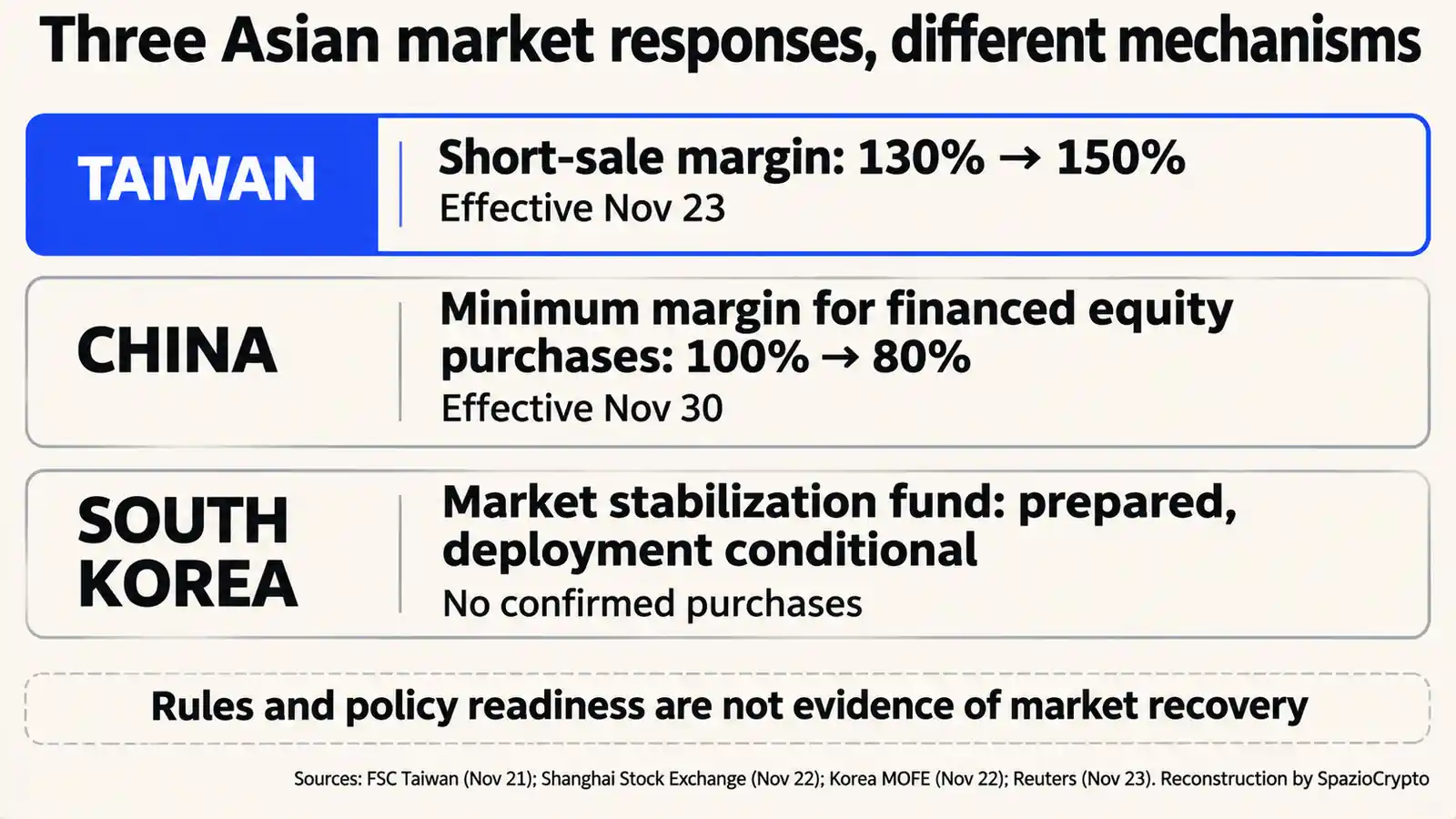
On November 21, Taiwan's Financial Supervisory Commission announced five measures taking effect November 23. The main rule generally prohibits short selling a listed stock below the previous session's closing price. Exceptions exist for certain hedging operations by intermediaries and futures operators. The distinction matters: this is not an outright ban on all short selling.
The commission also raised the minimum margin for short sales from 130% to 150%. It suspended acceptance of new put warrant issuance applications, encouraged share buybacks, and urged market participants to limit securities lending. These measures aim to contain some downward pricing dynamics but do not, by themselves, change the growth outlook for semiconductor manufacturers. Their effectiveness will need to be assessed against observable market conditions, not just the publication of the rules.
China and South Korea Choose Different Tools
China's response moves in the opposite direction from Taiwan's stricter short-seller requirements. On November 22, the Shanghai, Shenzhen, and Beijing exchanges announced a reduction of the minimum margin for leveraged stock purchases from 100% to 80%. The Shanghai Stock Exchange specified that the change takes effect on November 30, 2026. Loosening margin requirements allows more purchases to be financed with the same collateral, though it can also increase leverage exposure if prices keep falling.
Seoul chose operational readiness. South Korea's Ministry of Economy and Finance documented an emergency meeting on November 22 to discuss the fallout from the US decline. According to reports from Korean press outlets and Reuters, authorities are preparing a stabilization fund to deploy if needed, alongside tighter oversight of illegal short selling and measures on corporate buybacks. Preparing an intervention is not the same as the fund having already bought shares: actual amounts invested and activation conditions were not established in the material reviewed.
The Cost of AI Runs Through the Cost of Capital
The underlying economic tension extends well beyond a single week of volatility. Building data centers requires electrical infrastructure, chips, real estate, and loans; future cash flows must justify the costs being incurred today. Reuters describes investors growing increasingly focused on the time required to convert AI investments into profits capable of supporting elevated valuations. A technology with genuine demand can still struggle on public markets when financing costs rise or margin expectations are trimmed.
Debt is not a hypothetical concern. In the Federal Reserve's Financial Stability Report analyzed by SpazioCrypto, financing linked to advanced computing infrastructure exceeded $680 billion in the first ten months of 2026. That figure does not equal stock market losses, but it measures the scale of financial commitments tied to the sector. Another example is the guarantee agreement between Google, TeraWulf, and Anthropic, which illustrates how contracts, counterparties, and infrastructure have become central to investor judgment.
Our read is that the market is shifting its question: from how much computing capacity will be built, to how much return that capacity can generate and over what timeframe. This is not evidence that AI growth is over. It reflects a change in the valuation framework being applied: less weight on isolated expansion forecasts, more weight on the financial sustainability of those funding and operating the infrastructure.
Bitcoin and the Nasdaq: No Guaranteed Correlation
The contagion to crypto should not be framed as automatic. In stress sessions, investors may reduce exposure across multiple assets perceived as risky, but Bitcoin does not replicate every Nasdaq move, and no fixed relationship exists between the two series. In SpazioCrypto's article on Bitcoin falling below $60,000 on November 21, we noted the timing overlap between crypto selling and tech stock pressure. Timing overlap and shared vulnerability to liquidity conditions do not, on their own, establish direct causality.
A more tangible channel involves mining companies that have invested in, or pivoted toward, AI data centers. For these firms, valuations can reflect both crypto revenue and expectations around compute demand and required financing. Exposure to both cycles may amplify price sensitivity, without predetermining Bitcoin's direction. Equity market news should therefore be read alongside crypto-specific prices, liquidations, and flows.
For Investors Based in Europe: Portfolios, Rates, and Currency
For anyone investing from a euro-denominated base, the primary link is financial rather than regulatory. Global ETFs, funds exposed to U.S. tech equities, semiconductor stocks, and crypto positions can all be affected by a broad shift in risk appetite. Nothing in the reviewed source material points to any European measure directly tied to Taiwan's restrictions or the interventions announced by China and South Korea.
Borrowing costs matter here too. SpazioCrypto's analysis of U.S. inflation and Fed expectations explains why bond yields and interest rates influence growth-asset valuations. Anyone measuring returns in euros must separate the dollar-denominated performance of a holding from the outcome after EUR/USD conversion. A favorable exchange-rate move can cushion a loss on the underlying asset, or it can magnify it. There is no automatic protection either way.
Tech Sell-Off: What's Confirmed and What Isn't
A quick summary of the evidence
- Confirmed: Nasdaq down roughly 10% in the preceding week, per Reuters; U.S. futures rebounding in the early hours of November 23; Taiwan and China both announced regulatory measures with different effective dates.
- Not established: Duration of the U.S. rebound, the actual size of any South Korean fund purchases, and any measurable impact on crypto markets.
- To watch: Asian market closes, the effective Wall Street open, semiconductor stock reactions, and enforcement of the announced measures.
The Bigger Picture
Our own reading, stated as such, is that November 23 set three distinct risks against each other: AI valuation risk in the United States, industrial concentration across Asian markets, and the risk of interventions that temporarily alter trading conditions. The U.S. futures rebound does not resolve the question of data center returns. Short-selling restrictions do not erase losses already incurred. Easier credit conditions in China do not guarantee fresh demand for equities.
The most useful signals to track are whether the rebound holds at the Wall Street open, how Asian indices close, how semiconductor stocks respond, and what official communications say about any actual deployment of South Korea's stabilization fund. It is also worth distinguishing Taiwan's measures, effective November 23, from China's revised margin requirements, effective November 30. All figures cited here are point-in-time readings of a moving market, not final prices or forecasts for any subsequent session.
Sources
U.S. markets and futures: Reuters via Investing.com, first reading of November 23 and Reuters, intraday update; cross-reference Associated Press, November 23. Official measures: Financial Supervisory Commission Taiwan, November 21, Shanghai Stock Exchange, November 22 and South Korean Ministry of Finance, meeting of November 22; China context: Reuters, November 22. Financial Times, headline visible, full text not accessed.