

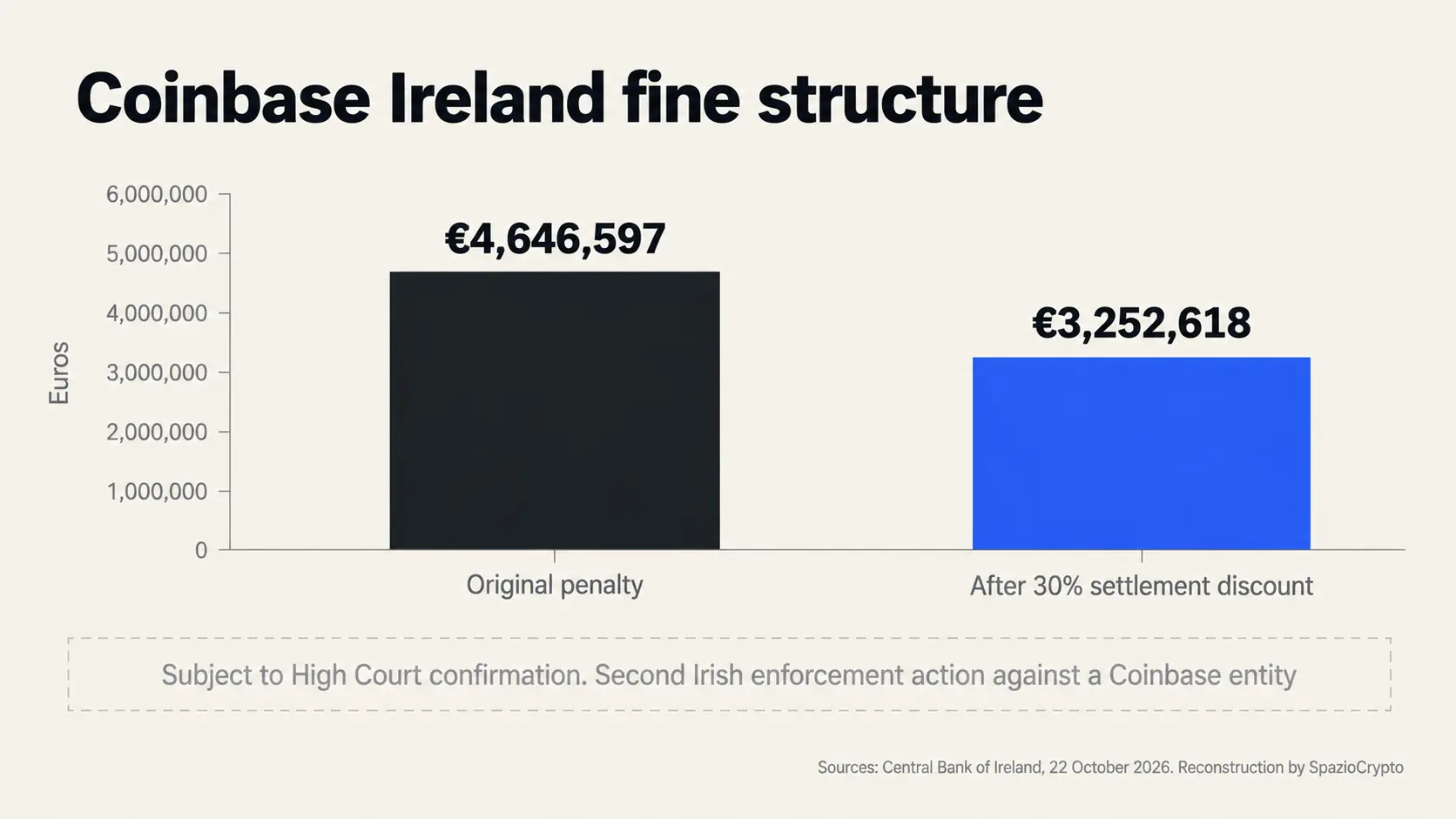
Coinbase Ireland was fined 3,252,618 euros by the Central Bank of Ireland on October 22, 2026, for safeguarding and outsourcing failures spanning from November 1, 2020 to August 19, 2025. No customers lost funds or access, according to Coinbase, but the fine reflects how seriously European regulators now treat structural compliance gaps, not just actual losses.
This article is based on the Central Bank of Ireland’s official press release of October 22, 2026, its related Settlement Notice, and reporting by Reuters, Decrypt, The Block, and the Irish Times. The full Settlement Notice has not been reviewed in its entirety; it is cited through these sources.
What the Central Bank of Ireland Found
Coinbase Ireland Limited is an authorized electronic money institution (EMI) in Ireland. It issues e-money in exchange for fiat currency, which customers then use to purchase crypto on the wider Coinbase platform. The Central Bank found three categories of violations under the Electronic Money Regulations 2011.
First: excessive dependence on the U.S.-based Coinbase group as an outsourced service provider for safeguarding processes, without sufficient local expertise in Ireland to oversee the function. Second: the designated safeguard account remained underfunded for prolonged periods due to inadequate system design and insufficient controls. Third: internal control, escalation, and governance procedures were inadequate to identify and report material changes in safeguarding to the regulator.
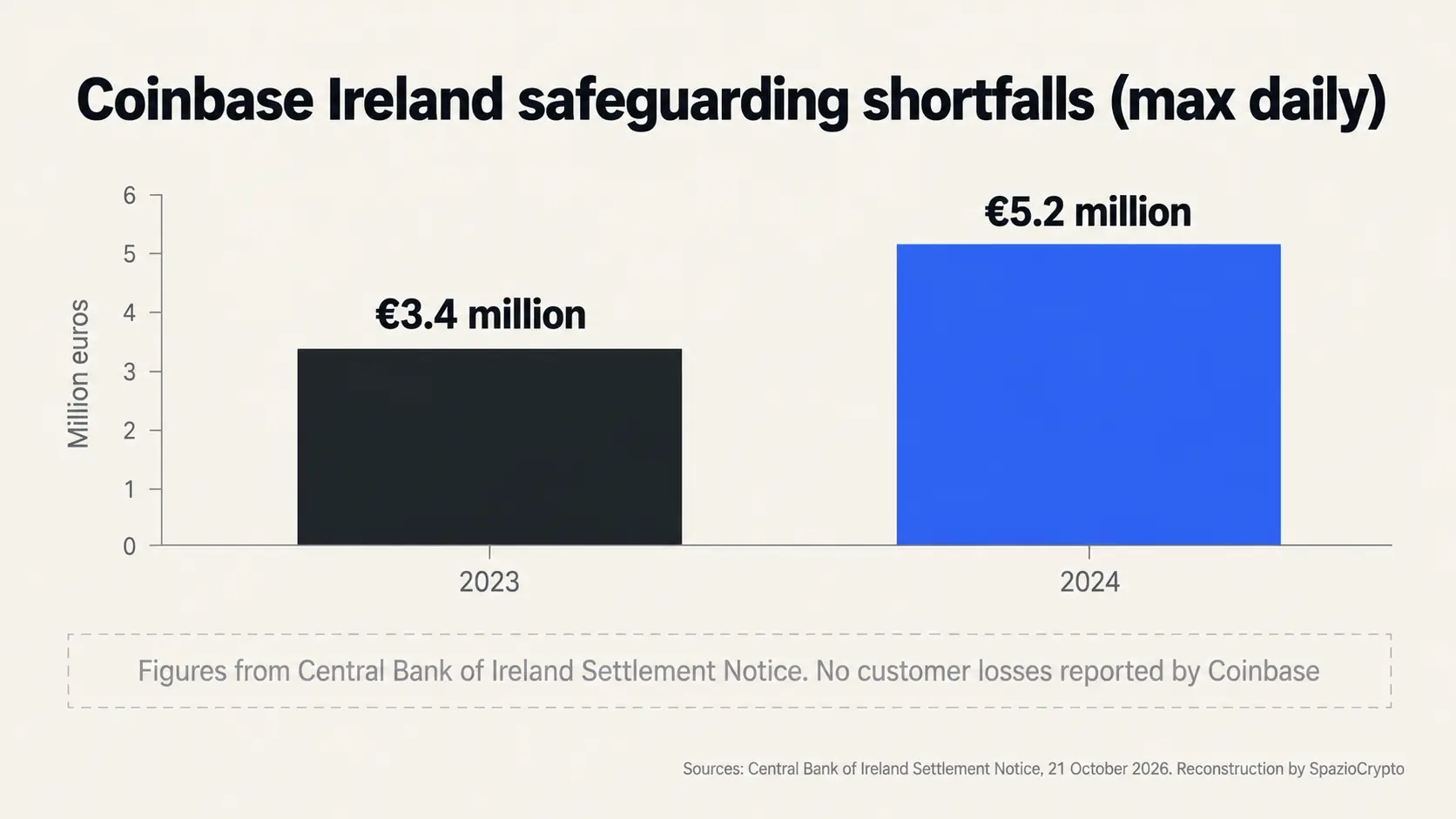
According to the Settlement Notice, maximum daily shortfalls on the safeguard account reached 3.4 million euros in 2023 and 5.2 million euros in 2024. During certain periods, client funds were commingled with funds belonging to other Coinbase group entities. The Central Bank warned that, in the event of insolvency, customers could have faced difficulty recovering their funds promptly and in full.
Coinbase’s Response: No Customer Losses
Coinbase admitted the violations and accepted the facts of the Settlement Notice. A spokesperson told Reuters that the company self-reported the issues and that “no customer suffered financial loss or was unable to access their funds.” According to the company, the problems arose largely in the context of measures taken to protect customers during periods of significant market disruption, and the issues have since been resolved.
The original fine set by the Central Bank was 4,646,597 euros. The 30% settlement scheme discount brought it down to 3,252,618 euros. The sanction also includes a formal reprimand and is subject to confirmation by the Irish High Court before it takes legal effect.
Karen O’Leary, Director of Enforcement at the Central Bank of Ireland, stated that “payment and e-money firms have a fundamental obligation to fully safeguard client funds” and that the Central Bank has “no tolerance for weaknesses in safeguarding arrangements.”
Not the First Irish Enforcement Action
This is the second enforcement action by the Central Bank of Ireland against a Coinbase group entity in under a year. The same regulator previously fined Coinbase Europe 21.5 million euros for deficiencies in transaction monitoring for anti-money laundering and counter-terrorism financing purposes. The October 22 press release references this explicitly.
This particular case concerns Coinbase Ireland specifically as an e-money institution, and the obligations covering fiat and e-money funds. It does not directly address crypto assets held in custody. Coinbase also operates in Europe with a MiCA CASP license based in Luxembourg, as listed in our guide to MiCA-authorized exchanges.
Why This Matters for European Crypto Users
Safeguarding obligations for e-money institutions exist precisely to ensure that client funds remain segregated and accessible even if the intermediary runs into trouble. When an EU-authorized entity (here, an Irish EMI) issues e-money used on a crypto platform, European customers routing through that channel depend entirely on those protections holding up.
The Central Bank noted that assurances given during the authorization process were not upheld, and that material changes were not reported. Our read: the case illustrates how cross-border outsourcing, when not governed by genuine local substance, can hollow out the protections that a European passport is supposed to guarantee.
For UK-based users, the equivalent reference point is the FCA’s CASS rules and the safeguarding requirements under the Electronic Money Regulations 2011 (UK). The structural question raised here, namely whether a local EMI has real oversight capacity over a U.S. parent providing core compliance functions, is equally live in FCA-regulated contexts. For euro-area users under MiCA, this case is a direct data point on what regulators consider a minimum standard for local substance.
What About Coinbase Users Outside Ireland?
No communications from the FCA, BaFin, or other European regulators indicating direct impact on users outside Ireland have been identified at the time of publication. Coinbase is not registered as a CASP in most individual EU member states; European customers access the platform through the group’s EU-authorized entities, which benefit from MiCA passporting or applicable national rules.
The case reinforces a broader regulatory theme taking shape across the EU: regulators are checking not just whether a license exists, but whether the licensee has genuine local capacity to protect customers. The question of local substance under MiCA is no longer theoretical.
For individual users, the practical fact remains as stated: no access was lost and no losses were reported in this case. The High Court confirmation is still the open procedural step.
Coinbase Ireland: Key Facts
What is confirmed and what is not yet settled
- Confirmed: fine of 3,252,618 euros (post-discount) for safeguarding and outsourcing violations from November 1, 2020 to August 19, 2025; settlement dated October 21; no customer losses according to Coinbase.
- Not yet determined: High Court confirmation (still required); full details of coding errors and fund-mixing flows beyond what the Settlement Notice discloses; operational impact on users outside Ireland.
- To watch: High Court confirmation timeline; any further enforcement actions against other Coinbase group entities; how European regulators evolve their expectations around local substance under MiCA and e-money rules.
The Bigger Picture
The sanction did not stem from any customer actually losing money. It stemmed from violations of rules designed to prevent that from happening. The Central Bank of Ireland concluded that excessive reliance on the U.S. parent and prolonged shortfalls in the safeguard account represented an unacceptable risk to European customer protection, even in the absence of realized harm.
Three things are worth watching from here. First, whether the Irish High Court confirms the fine without modification. Second, whether Coinbase publishes any structural changes to its local governance in Ireland following the settlement. Third, whether other European regulators, particularly the FCA and BaFin, draw on this case when setting their own substance expectations for EMI and CASP license holders operating cross-border. For users, the stays unchanged: no losses, no access failures, but a regulator that found the gaps serious enough to warrant a fine, a reprimand, and a court referral.