The Banca d'Italia is urging merchants to join the digital euro pilot. On October 12, at the Confesercenti forum in Rome, Massimiliano Renzetti, deputy head of the Digital Euro Unit, invited physical retailers, e-commerce businesses, and trade associations to apply for the Eurosystem experiment, which is set to launch in the second half of 2027 and run for twelve months, according to ANSA. The invitation carries a firm deadline: October 27 at 5 p.m. The ECB call that closes on that date, though, covers only e-commerce and app-based commerce. For physical stores, the pilot rules assign merchant selection to national central banks.
Renzetti's remarks were reported by ANSA. The pilot details come from ECB documents: the July 14 press release listing the 36 selected operators, the September 15 notice, and the official pilot FAQ, along with materials published by the Banca d'Italia. SpazioCrypto covered the online merchant call on September 28. This article focuses on what Bankitalia's direct appeal adds to that picture.
 Redazione ANSA
What Renzetti Said at the Confesercenti Forum
Renzetti spoke at the Confesercenti forum “Aperti,” held in Rome's Piazza del Popolo from October 9 to 14. Reporting by ANSA indicates he reminded attendees that the open call was published on September 15 and “closes October 27,” and that “Italy will play a leading role in the pilot.” Italian operators, he explained, cover different roles and scales, from distributing the digital euro to citizens to enabling merchant acceptance, allowing the entire value chain to be tested. The experiment will use “a beta version of the digital euro, close to the legislative proposal but without legal tender status,” to verify that the system is robust, simple, and scalable, both online and offline.
Three use cases are planned: person-to-person payments, in-store payments (including POS terminals and contactless technology), and e-commerce. Renzetti added two details that set the scale: a limited number of merchants will take part, and users will be Eurosystem central bank employees, not the general public.
Who Can Actually Apply, and How
For online merchants, the route is the ECB call published on September 15 and relaunched by Banca d'Italia on September 23. Applications are submitted by email before 5 p.m. on October 27. According to the ECB's pilot FAQ, applicants must be legally established in the European Union and serve at least two of the localities involved in the pilot. The number of merchants selected will depend on the eligible applications received. Chosen merchants sign a participation agreement with the ECB and a separate contract with one of the pilot's payment service providers. No transaction fees are charged to merchants for pilot services, but they bear their own integration and operational costs, with no grants or reimbursements. Full eligibility criteria are covered in our article on the e-commerce call.
 Banca d'Italia
For physical stores, the picture is different. The ECB FAQ states that the open call covers only remote payments between individuals and businesses, and that national central banks will identify merchants in their respective localities. In-store payments will be processed through a SoftPOS application that turns a smartphone or tablet into a payment terminal. The ECB's own example: an ECB employee pays for lunch in the institution's canteen using a phone. As of publication, the Banca d'Italia's pages include no dedicated call for physical retailers, and ANSA does not specify a channel. That's the open question for any merchant who heard Renzetti's appeal and has a shopfront rather than a website.
Italy's Weight in the Pilot: Seven Operators out of 36
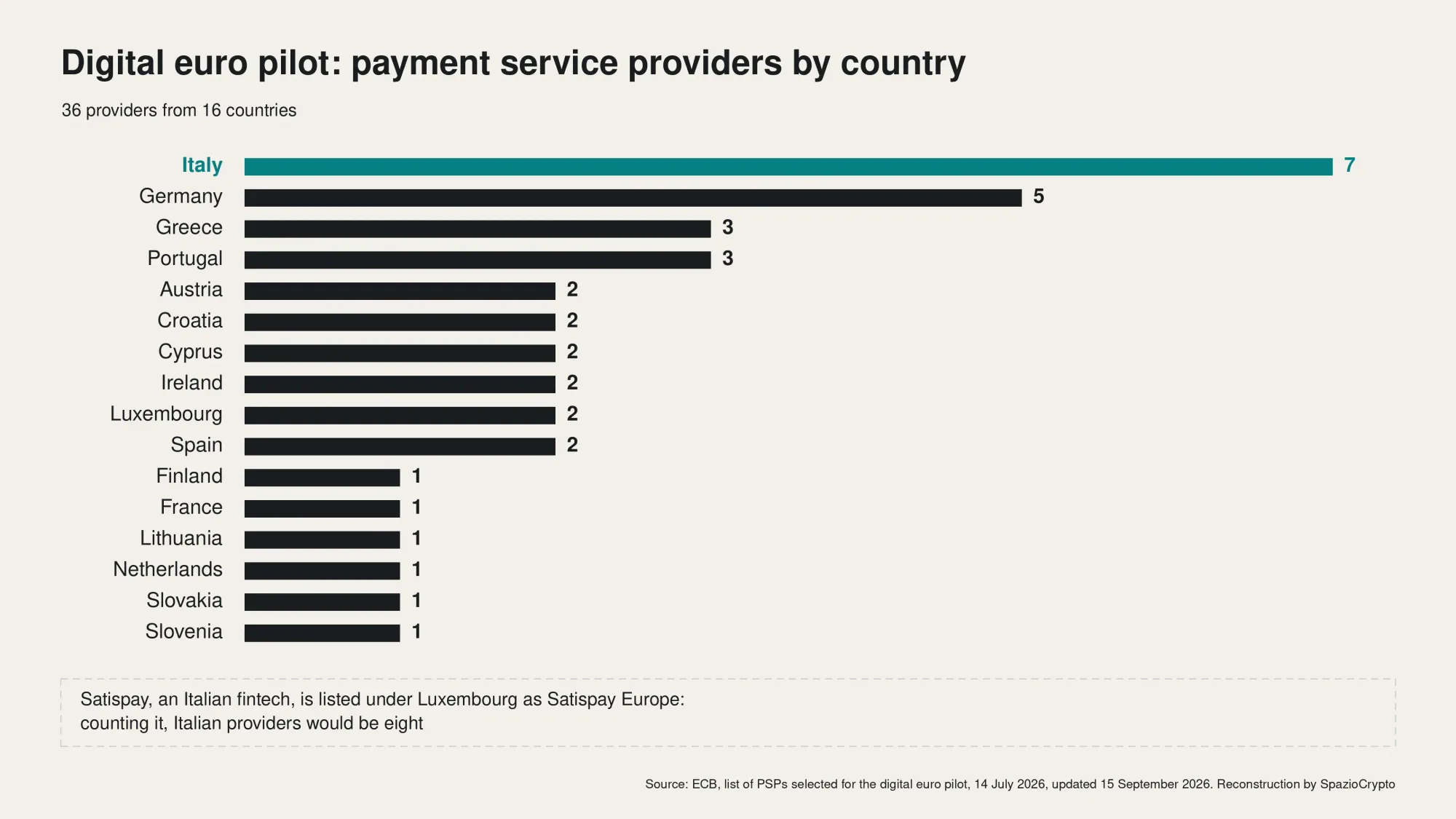
The ECB selected 36 payment service providers from more than 50 applicants across 16 countries. Italy leads the field with seven operators: Banca Monte dei Paschi di Siena, Banca Sella, isybank, Nexi Payments, Numia, Poste Italiane, and UniCredit. Germany follows with five; Greece and Portugal each have three, with a range of other countries contributing one or two. ANSA counts eight Italian-linked operators by including Satispay, an Italian company that appears on the ECB's list as Satispay Europe, registered in Luxembourg.
Operators can serve one or both of two roles, according to the ECB: distributing the digital euro to users, or enabling merchant acceptance. Some cover both. Among Italy's seven, the group includes traditional banks, a digital bank, Poste Italiane, and two payment specialists. Several are also working on private-sector alternatives: UniCredit, for instance, is part of the Qivalis consortium preparing a euro stablecoin with other European banks. Public and private money are advancing in parallel, with the same intermediaries at the centre of both tracks.
What Remains Undecided: Fees, Acceptance Rules, Limits
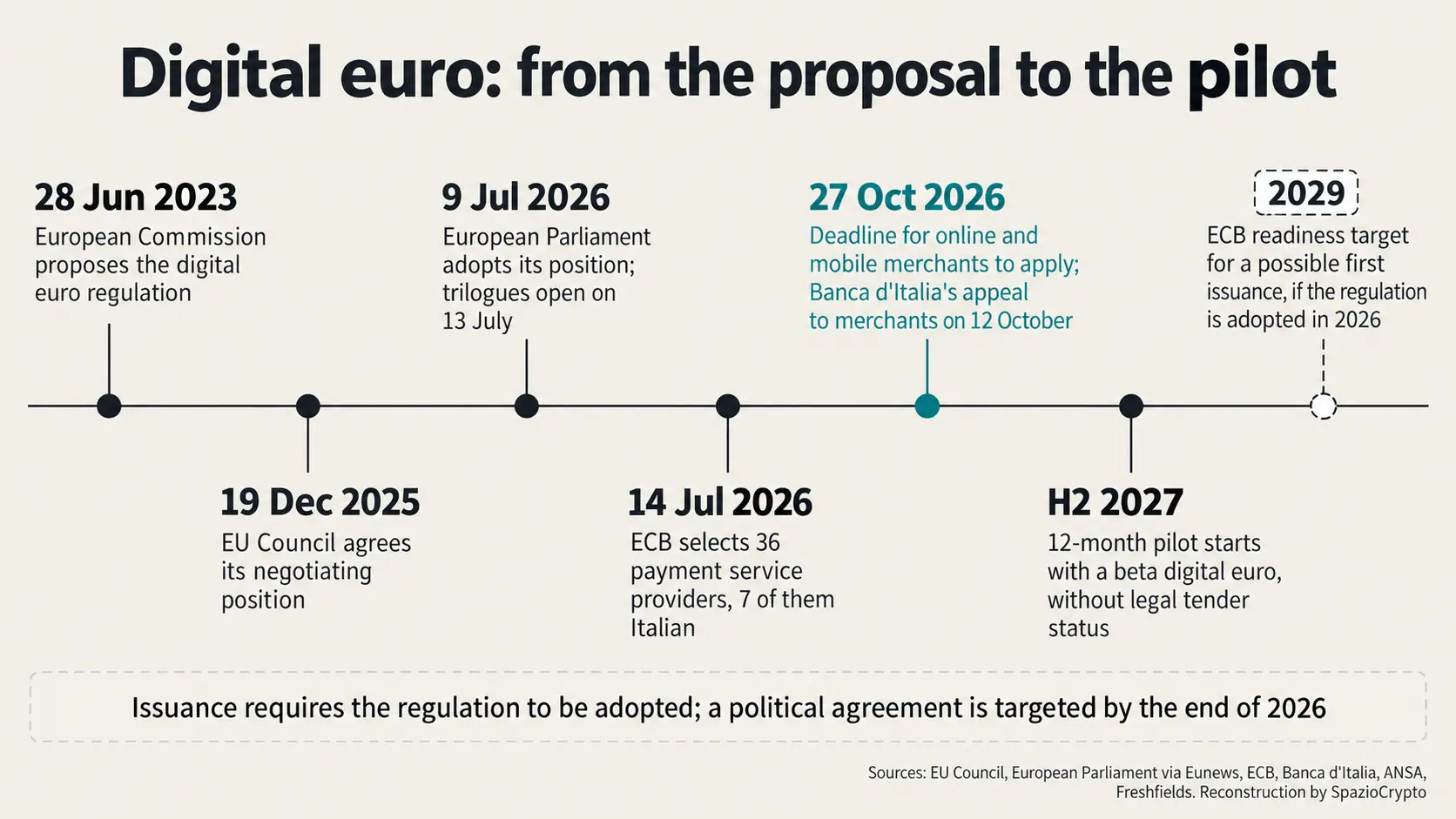
For merchants, the rules that matter most are not yet written. The European Commission tabled its proposal on June 28, 2023. The Council set its position on December 19, 2025; the European Parliament adopted its stance on July 9, 2026; and the first trilogue meeting took place on July 13. According to Freshfields, the target is a political agreement before the end of 2026, while the ECB aims to be ready for a possible first issuance in 2029, provided the regulation is adopted this year. The decision on whether to actually issue a digital euro will come only after the legislation is in force.
On fees, the Freshfields analysis shows Parliament and Council both propose uniform caps across the euro area, starting with a transitional model and then moving to cost-plus-reasonable-margin pricing, but they diverge on duration and safeguard mechanisms: Parliament favors caps set per individual merchant, while the Council sets them at national level. Both allow exemptions from the acceptance obligation, and Parliament explicitly exempts micro and small enterprises, according to Eunews those that don't already accept other digital payments. The ceiling on how much digital euro a user can hold remains to be fixed. These are precisely the issues on which trade associations, including Confesercenti, have called for zero fees on micropayments and no costs for POS terminals, and on which Banca d'Italia Deputy Director General Chiara Scotti stated that the digital euro will serve payments, not replace bank deposits.
The pilot and merchants: a snapshot
What is confirmed, what is not
- Confirmed: Banca d'Italia outreach to merchants on 12 October; ECB call for e-commerce and m-commerce applicants open until 17:00 on 27 October; 36 operators selected, seven Italian; pilot launch in the second half of 2027 for twelve months; beta version with no legal tender status, used by central bank staff.
- Not specified: a formal call or channel for physical stores in Italy; how many merchants will be selected; the individual role of each Italian operator.
- To watch: Banca d'Italia guidance for physical retailers, the political agreement on the regulation expected before end of 2026, fee caps, and the mandatory acceptance obligation.
The bigger picture
A central bank walking into a merchants’ forum to solicit applications says something revealing about where the real battle is being fought: a payment instrument only works if the shop accepts it, and what shops care about are costs, terminal setup, and settlement timing. The pilot is designed, in part, to measure merchant experience before the rules on fees and acceptance are locked in. Europe's direction runs counter to the American approach, where the central bank is barred from issuing a digital dollar and digital money is left to private stablecoins, a model whose risks for bank deposits Banca d'Italia has already flagged in its analysis of the GENIUS Act and MiCA stablecoin provisions.
The signals worth tracking are concrete: how many Italian merchants enter the test, how Banca d'Italia identifies physical stores, the outcome of European negotiations on fees and acceptance obligations, and the pilot results after 2027. Italy's strong showing among the 36 selected operators gives the country genuine weight in shaping the final product. Whether that translates into favorable terms for the businesses that will accept digital euro day in, day out remains to be seen.