

The digital euro must remain a payment instrument, not a savings alternative to bank deposits. Chiara Scotti, Deputy Governor of the Banca d'Italia, made this position unmistakably clear on September 25 at Rome Future Week, during a conference titled “Digital Euro: Working Towards the Future of Money.” Her statement locks in a significant architectural constraint for the European project at a moment when the regulation is navigating its most sensitive legislative stage. Two concrete developments emerged on the same day, and together they paint a far sharper picture than the usual abstract debate about central bank digital currencies.
 Luca Trequattrini, Chiara Scotti, Sergio Nicoletti Altimari
While Scotti spoke in Rome, Italy's leading retail trade associations were simultaneously presenting a detailed joint position to the Banca d'Italia on how they want the digital euro to function in everyday commerce. Taken together, the two developments move the conversation from principle to economic model. Here is what Scotti said, and what merchants are demanding.
The Bank of Italy's Red Line
Scotti opened her remarks with a data point that frames the shift already underway. According to Banca d'Italia figures, just a few years ago nearly sixty percent of point-of-sale payments in Italy were made in cash; today that share has fallen to forty-nine percent. That trend, she noted, is gradually reshaping the entire payments architecture, in a context where cash remains the only form of central bank money directly accessible to all citizens.
For precisely that reason, Scotti argued, the digital euro must be “simple to use, privacy-respecting and genuinely inclusive,” as well as “convenient for citizens and merchants and sustainable for the intermediaries that will distribute it,” capable of “strengthening resilience without compromising financial stability.” The sharpest point in her address, though, concerns the deposit limit: the digital euro must remain “primarily a payment instrument” and must not become “an alternative savings instrument to bank deposits.”
Scotti noted that central bankers are watching Brussels closely, where the trilogue between the European Parliament, the Council and the Commission will settle what the digital euro actually is, who can use it, how it will be distributed, and what rights and protections citizens and businesses will have. All of that must be resolved before the pilot phase begins, in which Italian payment service providers are expected to participate in significant numbers.


What Merchants Want: Zero Fees and No New Hardware
On the same day, Confcommercio, Confesercenti, FIPE and Netcomm submitted a joint position to the Banca d'Italia, framing the digital euro as a strategic opportunity to strengthen competition, boost transparency and reduce dependence on large international payment networks. Their four specific demands: zero fees on micropayments; automatic integration of the digital euro into the roughly four million POS terminals already deployed across Italy, with no new hardware investment required from merchants; offline functionality, to prevent lost sales during network outages; and a transparent European benchmark for acceptance fees.
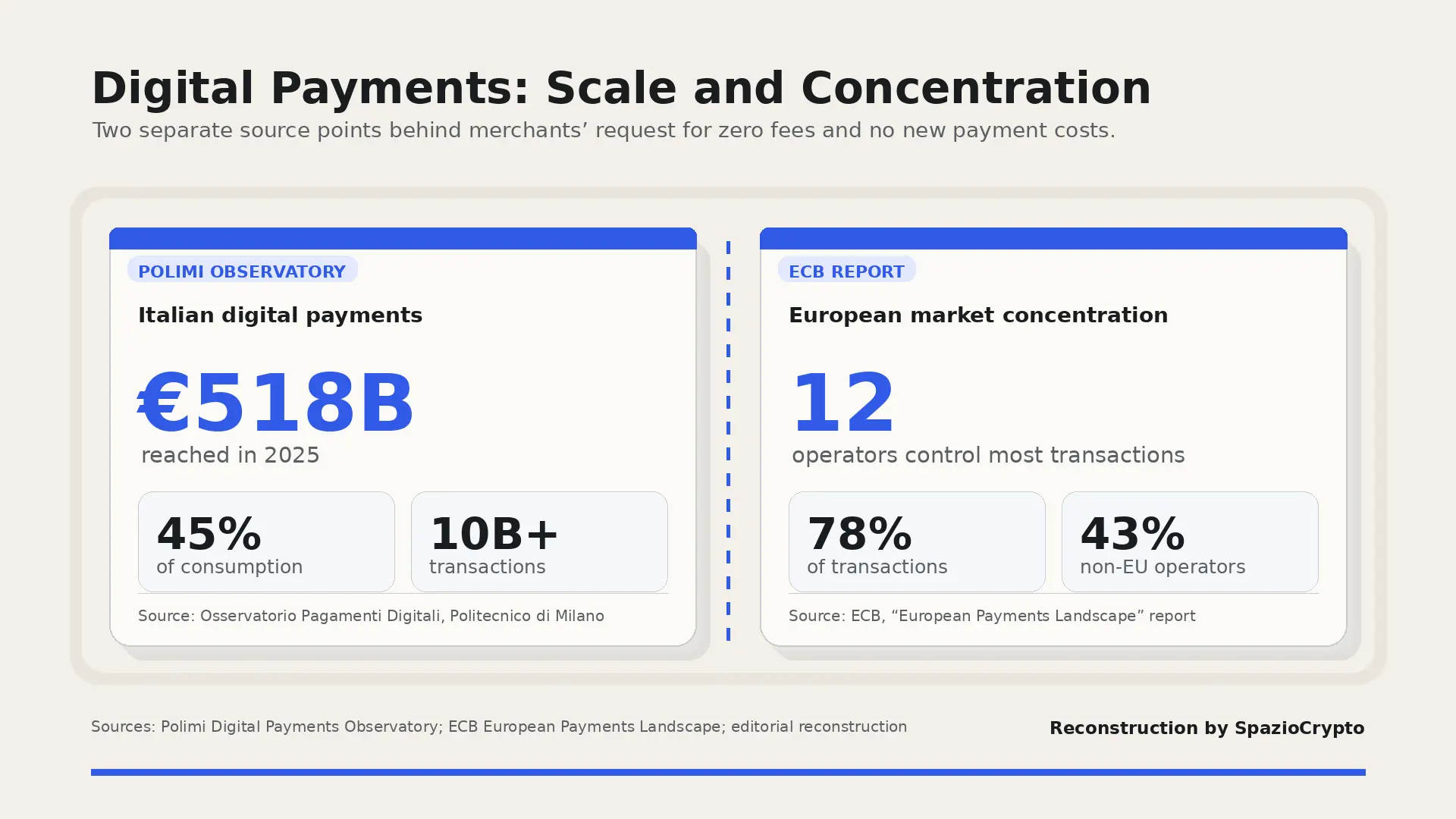
The demands are backed by precise figures. According to the Digital Payments Observatory of the Politecnico di Milano, the value of digital transactions in Italy reached 518 billion euros in 2025, covering forty-five percent of total consumption and surpassing cash for the first time, with more than ten billion operations processed at payment terminals according to Banca d'Italia data. A second figure, drawn from the European Central Bank's “European Payments Landscape” report, reveals the other side: Europe's payments market is concentrated in the hands of just twelve large operators controlling seventy-eight percent of transactions, with forty-three percent attributable to non-European players. That concentration, the associations argue, disproportionately weakens the bargaining power of micro and small businesses relative to large retailers.
The Two Signals from September 25
What emerged on the same day. Source: Banca d'Italia, FIPE, Confcommercio, 2026
- Banca d'Italia: the digital euro is a payment tool, not an alternative to bank deposits.
- Merchants: zero fees on micropayments and integration into 4 million existing POS terminals.
- The context: 12 operators control 78% of European payments, 43% of which are non-EU.
Why Micropayments Are the Real Battleground
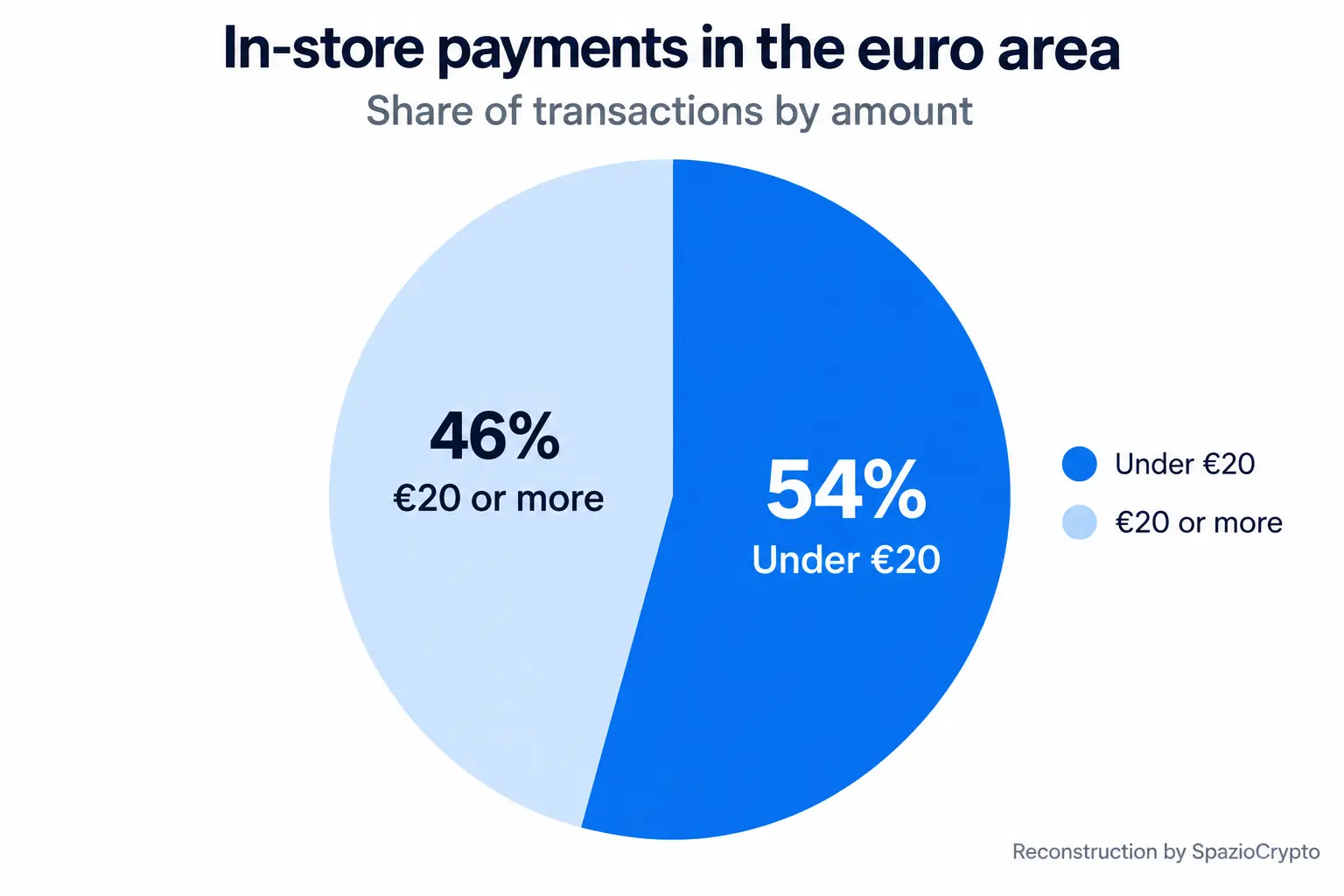
One figure cited on September 25 explains why trade associations are pushing so hard on micropayments specifically. According to ECB data, fifty-four percent of in-store payment transactions across the euro area involve amounts below twenty euros. Even a small fixed fee applied to each of these low-value transactions would hit small merchants proportionately much harder than large retailers, who process far greater volumes that dilute the same fixed cost across a wider base.
The issue fits into a broader question about how central bank digital currencies must coexist with the existing private payments infrastructure. It's a balance the ECB has already had to navigate in other contexts, including the launch of Pontes, the ECB infrastructure for wholesale settlement in central bank money, and the subsequent ECB proposal to revise MiCA rules on private stablecoin reserves. In all three cases, the same European institution is balancing digital monetary innovation against the stability of the traditional banking system.
What This Means for the Broader CBDC Debate
Together, these two developments shift the digital euro discussion from the abstract to the concrete economic model. The question is no longer whether a European central bank digital currency is a good idea in principle. Now it is about how much can be held, how much it will cost merchants to accept, and how European regulators will prevent it from draining deposits out of the traditional banking system and, by extension, impairing banks' capacity to lend to the real economy.
For observers tracking the European digital currency project, the takeaway is twofold. The fact that both monetary authorities and trade associations are negotiating this level of operational detail months before the European regulation is even finalized signals that the project has entered a genuinely mature phase. At the same time, the tension between the central bank's financial stability concerns and merchants' cost concerns makes clear that the digital euro's final shape will be a negotiated compromise, one that the Brussels trilogue text must ultimately resolve. Readers looking for broader context on these technologies can start with our guide on what cryptocurrencies are and how they relate to the evolving landscape of digital money.