


Prediction market platform Kalshi committed $2 million over two years to the National Council on Problem Gambling (NCPG), a U.S. nonprofit dedicated to preventing gambling-related harm. The deal triggered a crisis: four state organizations left the NCPG, and executive director Heather Maurer resigned on September 26. The donation and the resignation are confirmed by official statements; the link between the two events and the accounts of internal tensions come from journalistic reconstructions, and no wrongdoing has been established in any of the sources reviewed.
The Barron’s investigation at the center of this story was not directly accessible to our team, so this article draws on Fortune’s October 9 coverage as a secondary source, together with official NCPG statements and reporting from Legal Sports Report, SBC Americas, Covers, Casino.org, and ON360. None of those outlets include responses from Kalshi or the NCPG addressing the specific allegations Barron’s raised.
 National Council on Problem Gambling
What Is Confirmed: The Donation
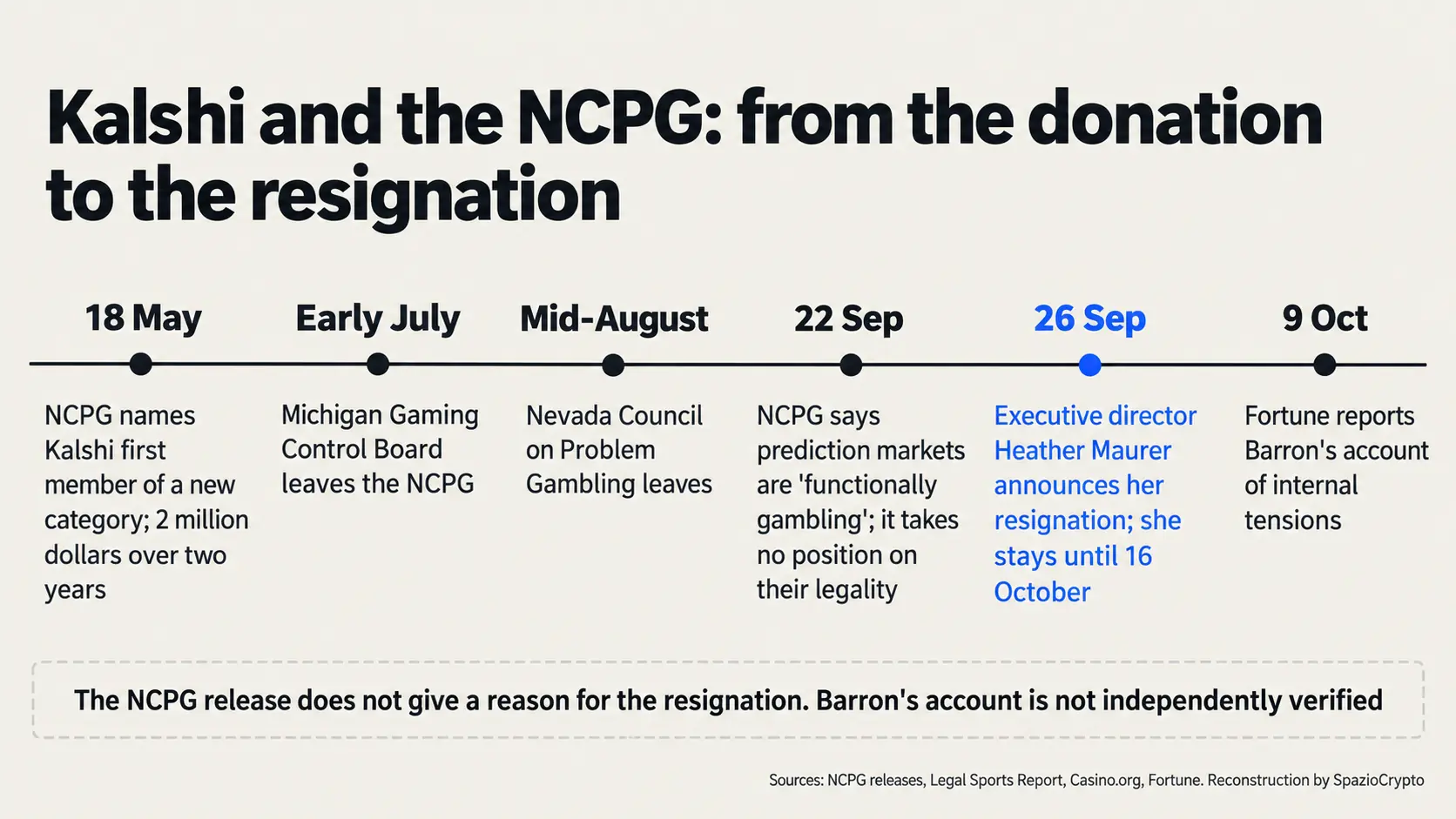
On May 18, the NCPG announced Kalshi as the first member of a newly created subcategory called “Financial Services & Trading,” with a two-year, $2 million commitment toward a trader health and safety initiative, according to Legal Sports Report. CEO Tarek Mansour spoke of investments in tools, education, and protections for healthy participation, as Nevada Current reported. To put the figure in context, Nevada Current noted that $2 million is roughly half of what the state of Nevada allocates annually for problem gambling. According to ON360, citing Gambling Insider, a platinum NCPG membership costs around $15,000 while the Leadership Circle tier runs approximately $100,000 per year.
In June, the NCPG reiterated its neutral stance on the legality of prediction markets and clarified that membership or funding does not constitute an endorsement, per Legal Sports Report. On July 3, Maurer stated that the organization considers it “its responsibility to understand” the risks posed by new products, as Casino.org reported.
The Departures and the Resignation
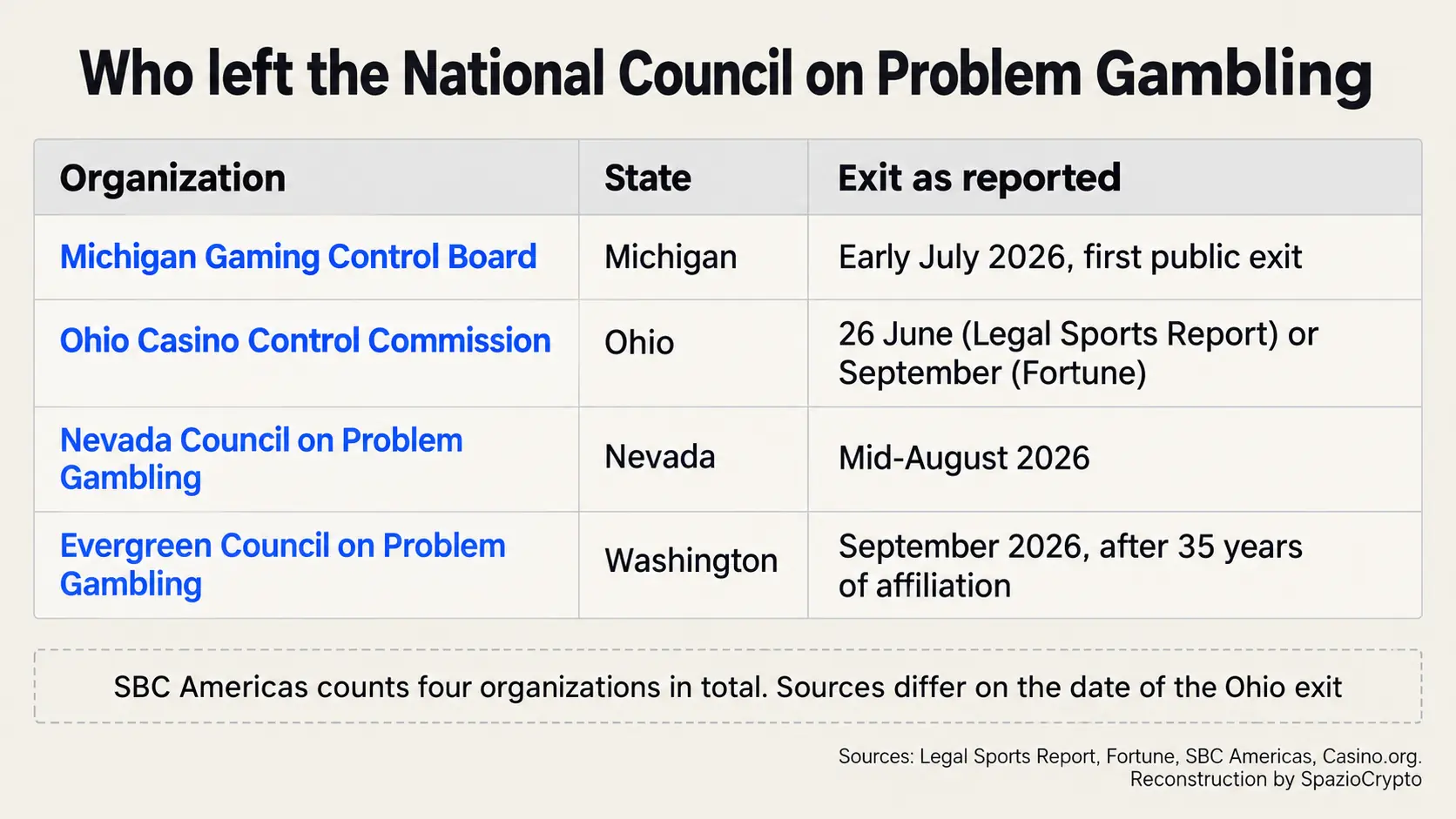
The first public departure came from the Michigan Gaming Control Board in early July. Director Henry Williams wrote that remaining in the NCPG was “incompatible” with the agency’s mission, and that the partnership was helping Kalshi “reshape” the gambling industry. Following Michigan, three more bodies cut ties: the Ohio Casino Control Commission, the Nevada Council on Problem Gambling, and, according to Fortune, the Evergreen Council on Problem Gambling of Washington State, which had been affiliated for 35 years. SBC Americas counts four total departures across Michigan, Nevada, Ohio, and Washington. Sources disagree on Ohio’s exit date: Legal Sports Report places it in June, Fortune in September.
On September 26, the NCPG announced Maurer’s resignation, with her remaining in post through October 16 to support the transition. The statement gives no reason for her departure and does not mention Kalshi. Board president Derek Longmeier pledged continuity of advocacy, programs, and services during the search for a successor. Days earlier, Jaime Costello, the NCPG’s director of programs, had also left. Fortune cited internal disagreements with leadership, while SBC Americas pointed to a September 22 LinkedIn post in which Costello wrote that “the environment had changed in ways I could no longer reconcile” and that her last day arrived earlier than expected, “not by my choice.” Kalshi features in the headlines of Legal Sports Report and SBC Americas as the implied reason, but that framing is a journalistic interpretation, not a statement from the organization itself.
What the Barron’s Investigation Claims
According to Barron’s, as relayed by Fortune, Maurer finalized the deal without prior board approval and had board members sign nondisclosure agreements before revealing the donation at an April conference. When members reportedly asked whether Kalshi had committed to funding safety measures or promoting helplines, she allegedly acknowledged it had not, setting off months of internal backlash. Barron’s also reported that the NCPG created a separate donor category specifically to distinguish Kalshi from established sportsbook operators like DraftKings and FanDuel. Fortune noted that these accounts are not independently verified and that no statements from Maurer, the NCPG, or Kalshi addressing the allegations appear in the piece.
Two questions remain open. The April conference disclosure and the May 18 public announcement could represent two separate moments, but the sources don’t clarify that. And it’s not explained how Kalshi’s public promise to invest in tools and protections squares with the admission, as reported by Barron’s, that no commitment to fund safety measures or helplines actually existed.
Prediction Market or Gambling: Why the Distinction Matters
On September 22, the NCPG declared that it considers prediction markets “functionally gambling,” adding that while it takes no position on their legality, it is not neutral on harm prevention “wherever it occurs.” The statement cited a Harris Poll commissioned by the NCPG, according to which 85% of Americans believe these platforms can generate problem behaviors and 84% think they should be regulated like gambling for consumer protection purposes. Minimum standards the NCPG flagged include responsible gambling tools, self-exclusion, age verification, risk warnings, and helplines.
Kalshi, for its part, maintains that it operates as a federally regulated financial exchange rather than a gambling business, according to Casino.org and Fortune. Kalshi is registered with the CFTC, which is preparing new federal rules for retail margin and leveraged trading on crypto exchanges. The courts are split: per CryptoBriefing and KuCoin, the Third Circuit on April 6 upheld New Jersey’s ban on Kalshi’s sports event contracts. The Ninth Circuit on August 28 sided with Nevada. In May, Nevada Current reports, Minnesota banned prediction market platforms outright and the CFTC sued to block the law.
For users of these platforms, classification directly determines which consumer protections apply, and that is the core issue here. Nevada Current notes that these platforms admit users as young as 18, while the NCPG supports a universal minimum age of 21. Fortune reports that Kalshi and Polymarket allow betting from age 18 on nearly any event, particularly sports, with combined valuations exceeding $20 billion according to CoinGecko and company disclosures. The federal regulatory picture remains unfinished: the Senate blocked the CLARITY Act on a 49-to-50 vote, and prediction markets themselves became a live barometer of that debate, as our coverage of the vote on 126 amendments showed by tracking approval odds in real time. Retail investor protections for high-volatility products are also at stake in the SEC’s approval of 3x leveraged Bitcoin and Ethereum ETPs, which have yet to launch.
Who funds whom: the classification problem
Industry funding of the NCPG is not new. Fortune reports that DraftKings has given over $2 million to state councils and affiliates since 2022, and that FanDuel donated $100,000 directly to the NCPG in March 2023. The organization states that many members and donors are gambling operators, that its finances are publicly auditable, and that membership, funding, or partnerships give no party control over research, advocacy, policy positions, or public statements. The real tension, as we read it, is not about accepting industry money per se, but about the label attached to it and the safeguards that follow. A “Financial Services & Trading” category exists precisely to assert that Kalshi is not a bookmaker, yet the NCPG itself says these markets are functionally gambling.
The Kalshi and NCPG case at a glance
What is confirmed, what is not. Sources: NCPG press releases, Fortune, Legal Sports Report, SBC Americas
- Confirmed: a $2 million, two-year deal announced May 18; Heather Maurer’s resignation communicated September 26 (effective October 16); NCPG’s September 22 statement classifying prediction markets as functionally equivalent to gambling; departure of four state affiliate organizations.
- Not disclosed: the stated reason for the resignation; official responses from Kalshi and the NCPG to the allegations; independent verification of the Barron’s account; how the donation will be spent.
- To watch: the appointment of a new NCPG executive director after October 16; Kalshi’s ongoing federal court litigation; any further affiliate departures.
What about other jurisdictions?
This case turns on U.S. rules and federal courts, and we have not verified whether Kalshi is accessible to residents outside the United States. Consumer protection tools in other markets follow their own logic: against unauthorized financial services, for instance, regulators like Consob block unlicensed websites, while age verification and client identity checks remain the operational focus of KYC and AML providers serving European CASPs.
The bigger picture
This case illustrates how a product’s legal classification determines who oversees it and who bears the cost of harm. If a prediction market is a financial exchange, CFTC-regulated market protections apply. If it’s gambling, state laws govern, with self-exclusion programs, age limits, and helplines. When a platform funds the organization meant to monitor the harms its product may cause, the classification debate and the independence question collide, and that is exactly the situation the NCPG is navigating right now. This is our reading, but it aligns with the NCPG’s own position that donor support does not equal endorsement of donor practices.
The concrete signals to track: who leads the NCPG after October 16; whether the organization and Kalshi respond publicly to the Barron’s allegations and clarify how the donation will be used; whether additional affiliates resign; and the outcome of Kalshi’s federal court challenges over sports contracts. Until those questions are answered, what we have is a governance crisis and a definitional dispute, not a confirmed legal violation.