


Imagine a savings account you can only unlock on weekdays: if you need the money on Sunday, you have to withdraw it Friday and let it sit idle for two days. That's still how corporate treasury liquidity works for many companies, and it's the exact problem that Uber's tokenized treasury pilot set out to address. On October 30, HSBC Bank USA, Franklin Templeton, Tradeweb, and Fireblocks announced that Uber had completed a pilot on Canton Network, buying shares of a tokenized money market fund using HSBC Tokenized Deposits and redeeming a portion over the weekend. It remains a test: no commercial launch, no disclosed amounts, and no independently verified results have been announced.


This article is based on the joint press release published by Canton Network on October 30. The Tradeweb version was inaccessible with our tools. Transaction timing details come from Bloomberg, as cited by crypto.news and CoinEdition. For broader context, we drew on HSBC and Canton press releases from April, plus coverage by Decrypt and Cointelegraph.
What Did Uber Actually Do?
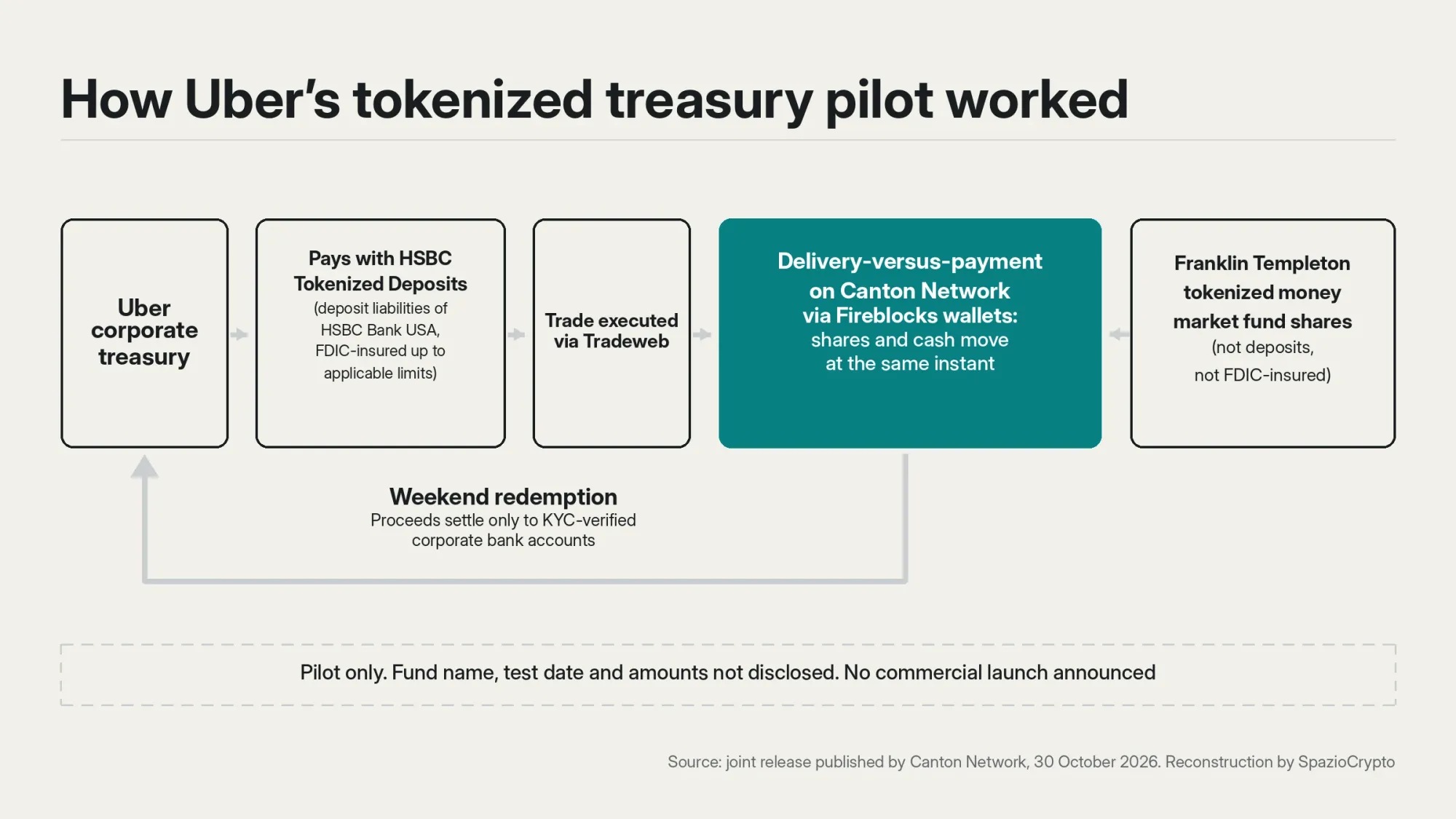
According to the Canton Network press release, Uber purchased shares of a Franklin Templeton tokenized money market fund on Tradeweb, paying with HSBC Tokenized Deposits, the digital-form deposits issued by HSBC Bank USA. The exchange settled on Canton Network via Fireblocks wallet technology in delivery-versus-payment mode: shares and cash change hands simultaneously, or the transaction does not happen at all. The specific fund, the test date, and the invested amounts were not disclosed.
The detail that makes the pilot genuinely interesting is the weekend dimension. The press release states that Uber was able to redeem a portion of its fund shares during the weekend, continuing to earn yield right up until the moment the cash was actually needed. The redemption proceeds, the announcement clarifies, can only reach verified corporate bank accounts that have passed standard know-your-customer procedures. This is a closed loop, not an open wallet exposed to external parties.
Odette Rodrigues, Uber's Vice President for corporate finance, treasury, and capital markets, described the pilot as “an important first step” toward a more efficient model for managing working capital around the clock. Uber had already been looking in this direction: as reported by CoinEdition and Genfinity, CEO Dara Khosrowshahi said in 2025 that stablecoins were still under study as a potential way to cut international payment costs.
Why the Weekend Matters So Much
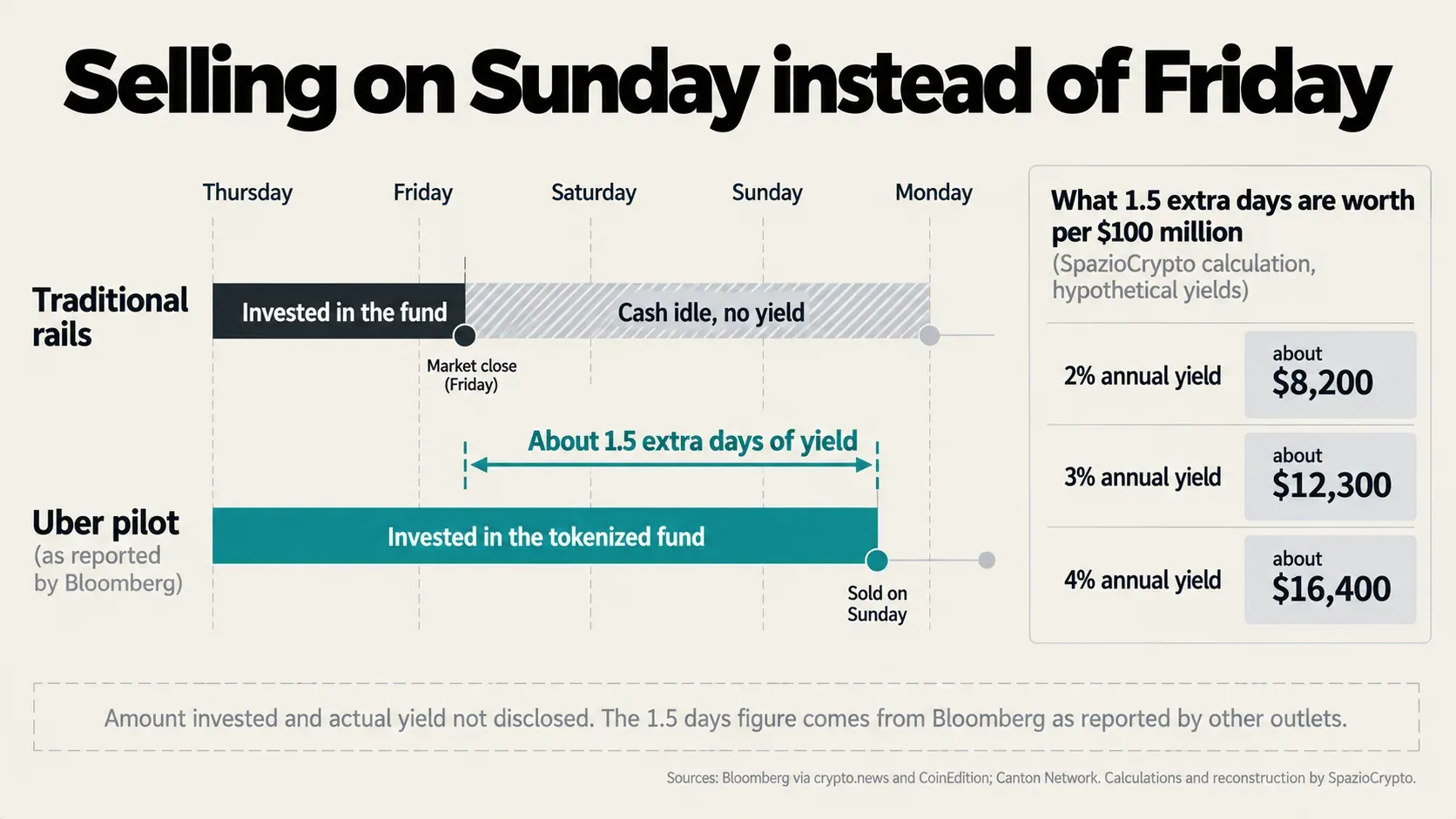
A money market fund is where corporate treasuries park cash they don't need immediately: it invests in ultra-short-duration instruments, earns a modest return, and can normally be redeemed quickly, but only on business days. If a payment falls on a Sunday, the treasury has to sell by Friday's close and leave the cash sitting idle on the account until then. Two days of interest lost, every single time.
According to Bloomberg, as cited by crypto.news and CoinEdition, Uber bought the fund shares on a Thursday and sold them on a Sunday. Compared to a standard Friday redemption, Uber captured roughly an extra day and a half of yield. That's not a higher rate; it's simply more days of interest at the same rate. Neither Uber nor its partners disclosed the invested amount or the dollar value of that gain.
To put the scale in perspective: on every $100 million left invested for an additional day and a half, the extra return amounts to roughly $4,100 per percentage point of annual yield. At a 4% fund return, that's approximately $16,400. This is an indicative calculation using hypothetical returns, not figures provided by the pilot participants. On a single weekend the number is modest. The real value, in our reading, comes from repetition: Uber processes payments and collections seven days a week.
Tokenized Deposit vs. Stablecoin: What's the Difference?
They look similar, but they are not the same thing. A tokenized deposit is a bank account that has learned to travel on a blockchain. A stablecoin is a token issued by a private company that promises to redeem it for dollars. According to the Canton Network press release, HSBC Tokenized Deposits are deposit liabilities of HSBC Bank USA and carry FDIC deposit insurance protection up to applicable limits. A stablecoin, by contrast, depends entirely on the reserves held by its issuer, and the differences between issuers matter considerably, as our comparison of USDT and USDC shows.
A money market fund is a third category entirely. Fund shares are not deposits, they carry no FDIC guarantee, and, as the press release itself notes, the fund seeks to maintain one dollar per share but cannot guarantee it. The pilot therefore combines bank money, fund shares, and a network on which to exchange them atomically. HSBC is pursuing the same theme in the UK, where it is among the banks involved in interbank tokenized deposit trials alongside Lloyds, Barclays, and NatWest.
 Canton

Who Does What in This Relay?
Each participant contributes a distinct piece. HSBC brings the money: its tokenized deposit service reached the United States on April 13 and, according to the press release issued that day, was already live in Hong Kong, Singapore, Luxembourg, and the United Kingdom. On the same day, Canton announced that HSBC had completed a pilot on the network simulating the issuance, transfer, and settlement of its own tokenized deposits.
Franklin Templeton brings the fund: in November 2025, according to Decrypt, it extended the Benji platform to Canton, issuing and recording fund shares in tokenized form. Tradeweb brings the market and coordinates execution and settlement; according to Cointelegraph, in June 2025 it co-led alongside DRW a $135 million round in Digital Asset, the firm that created Canton.
Fireblocks brings the wallets, with configurable signing rules and permissions: a vault with multiple keys, each assigned to a specific role. This is the institutional version of a question that matters to individual users too, namely how to custody crypto assets. Canton, for its part, is described by its backers as a public network for regulated institutions with configurable privacy. The choice of network is never a minor technical detail, as the case of Coinbase halting USDC on Noble made clear.
What We Still Don’t Know
Quite a lot. The fund has no disclosed name, the exact test date was not shared, and neither the invested amount nor the additional yield were specified. No independent party has verified the results, and there is no timeline for a commercial service. Manish Kohli, HSBC’s head of global payments, spoke in the press release about demonstrated interoperability, not a product launch.
Bloomberg coverage doesn’t even agree on the next step. Per crypto.news, HSBC wants to extend the solution to other US corporate clients and funds beyond Franklin Templeton’s offerings; per CoinEdition, Kohli stated that other US clients are already using this capability. Michael Shaulov, CEO of Fireblocks, expects hundreds of companies to adopt similar models within 18 months. That is a forecast, not a confirmed figure.
The Uber Pilot: What’s Confirmed and What’s Not
A quick breakdown of the known facts
- Confirmed: purchase of shares in a Franklin Templeton tokenized money market fund using HSBC Bank USA tokenized deposits, settled delivery-versus-payment on Canton via Tradeweb and Fireblocks; redemption of a portion of shares over the weekend; proceeds directed only to verified corporate accounts.
- Not disclosed: fund name, test date, amounts, additional yield value, independent verification, commercial launch timeline.
- To watch: expansion to other corporate clients and funds, first publicly reported volumes, moves by other banks and corporate treasuries.
The Bigger Picture
Our reading is that the Uber pilot shifts the blockchain conversation from money to time. Stablecoins already proved that value can move at any hour, and major asset managers have followed suit, as the stablecoin launched by Fidelity illustrates. The question here is different: what is it actually worth, for a corporation, to stop waiting until Monday. Banks are answering with tokenized deposits that remain within deposit guarantee schemes, while stablecoin issuers keep expanding their reach, as seen with Circle bringing USDC to 40 emerging markets.
Three signals are worth tracking: whether HSBC genuinely opens the service to additional clients and funds, whether verifiable volume figures eventually emerge, and whether other large corporates start demanding round-the-clock settlement from their own banks. Until those data points arrive, the Uber test shows the mechanism works. It does not yet show how well it pays off.