

BANCOMAT has brought Milan-based fintech Hercle into the EUR.BANK stablecoin project, adding liquidity management, multi-currency conversions, and connectivity between banking systems. The announcement came on October 29, one year after EUR.BANK first made headlines. Nine Italian banks are already in technical testing, but the project is still missing an issuer, regulatory approval, a launch date, and any operational conditions for end users.
This article draws on the ANSA newswire dispatch (12:38), the extended release published by Teleborsa, BANCOMAT's own testing announcement, and the French financial markets regulator AMF's public registry, which confirms Hercle's authorization. The joint Consob and Banca d'Italia statement from June 30 and Hercle's standalone release were inaccessible via our tools.
Who Is Hercle, and Why Does It Matter
Hercle S.r.l. holds a MiCA-compliant license granted by Consob, Italy's securities regulator, as a crypto-asset service provider. The AMF registry in France confirms four covered services: custody, exchange of crypto-assets for fiat, crypto-to-crypto exchange, and transfer of assets on behalf of clients. Since July 10, Hercle has been authorized to offer those services in France as well. Checking an operator's regulatory status in a public registry like the AMF's is the first line of defense against scams that impersonate exchanges and regulators.
Hercle's self-reported financials give some sense of scale. According to a Business Wire press release from October 2025, the company raised $60 million: a $10 million equity round led by F-Prime Capital, plus a $50 million credit facility. The company also states that its platform has processed more than $20 billion in transactions spanning stablecoins, digital assets, and traditional currencies since launch. These figures come from Hercle's own communications and have not been independently verified.
What Hercle Will Do Inside EUR.BANK
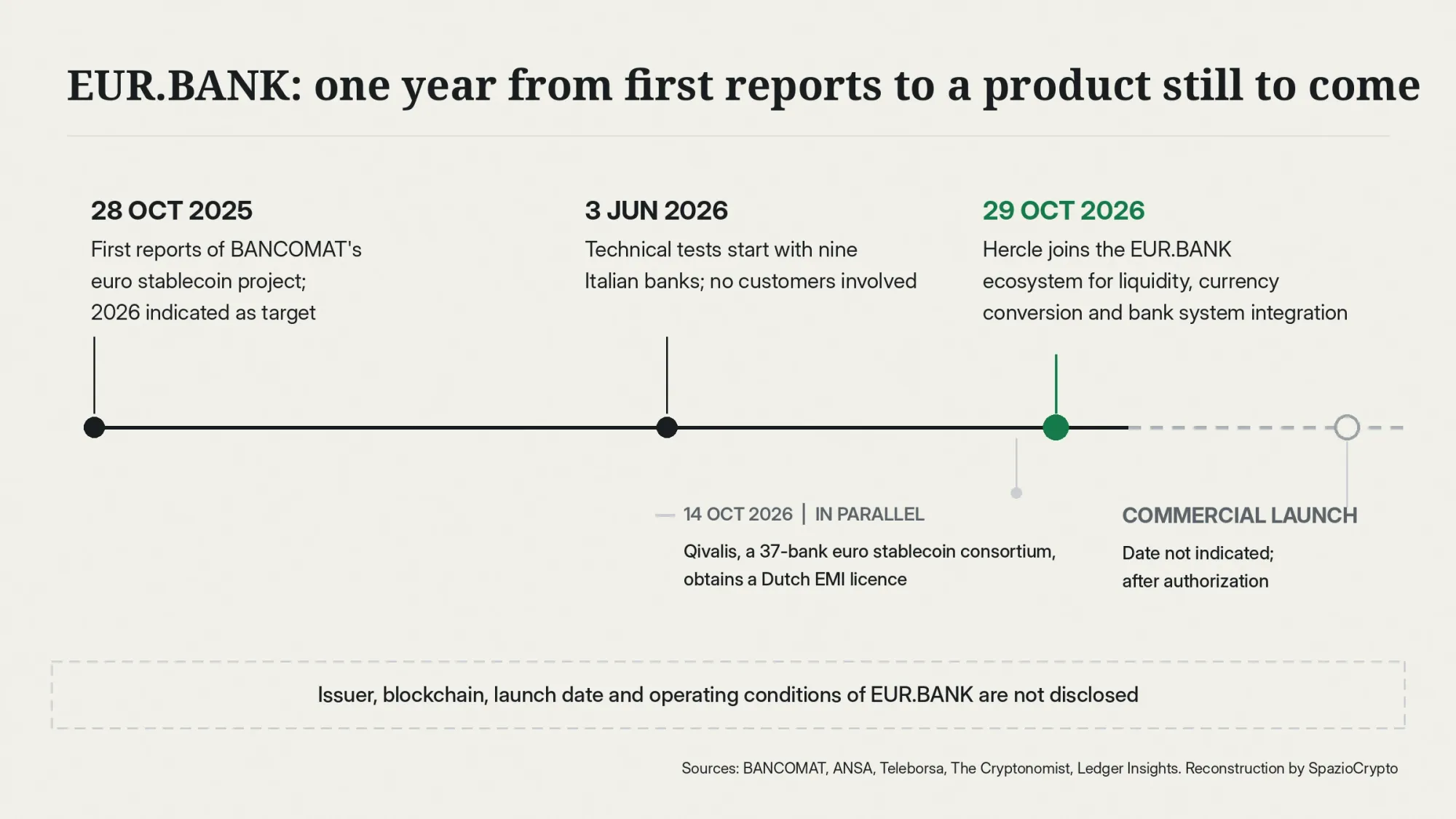
According to the release republished by Teleborsa, Hercle will provide connectivity services for liquidity management, currency conversions. Integration across banking systems. The stated goal is to link EUR.BANK to international liquidity pools, counterparties, and markets. Hercle becomes the first Italian fintech to join the EUR.BANK ecosystem. Sources reviewed by SpazioCrypto describe potential cross-border payment applications, not a defined pilot program.
Both CEOs framed this as infrastructure-building, not a product launch. Fabrizio Burlando, CEO of BANCOMAT, said in remarks reported by ANSA that the initiative is about laying the groundwork “in anticipation of the commercial launch.” Gabriele Sabbatini, CEO and co-founder of Hercle, described the partnership as connecting institutional finance to next-generation digital asset infrastructure.
Where EUR.BANK Actually Stands
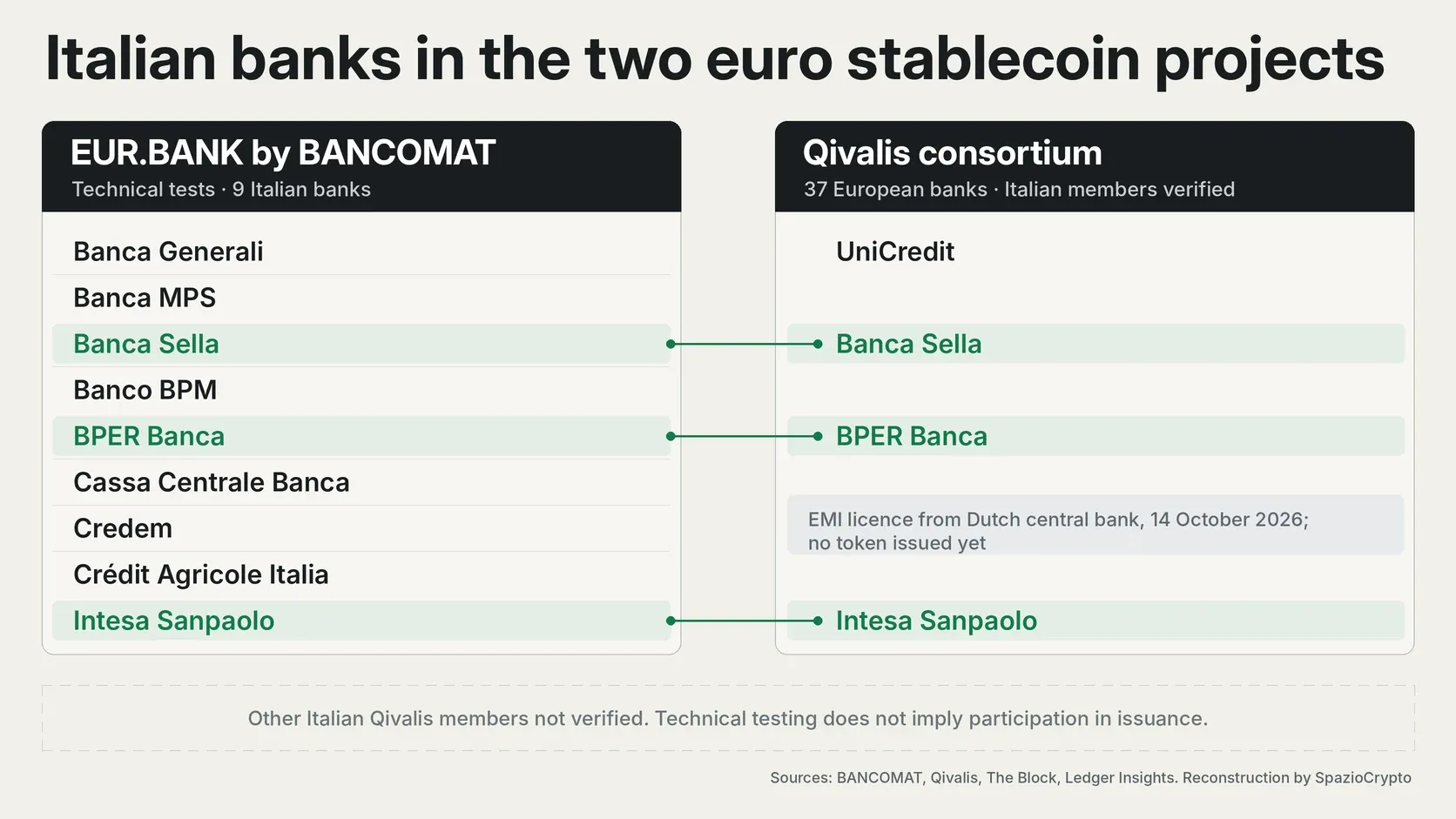
The project's first press coverage dates to October 28, 2025, when Corriere della Sera reported on plans to convert cash into a transferable digital token, with 2026 named as the target launch year. On June 3, 2026, BANCOMAT announced the first phase of technical tests with nine banks: Banca Generali, Banca MPS, Banca Sella, Banco BPM, BPER Banca, Cassa Centrale Banca, Credem, Crédit Agricole Italia, and Intesa Sanpaolo. No customers are involved in any of these tests.
Three areas are under investigation: the tokenization of financial instruments including sovereign debt, round-the-clock on-chain payments and settlements, and support for companies managing cross-border cash flows. BANCOMAT states that reserves will remain inside the banking system to protect depositors. Neither the issuer nor the underlying blockchain has been named publicly. That choice carries more weight than it might seem: the case of Coinbase discontinuing USDC on the Noble network shows how much infrastructure decisions shape a stablecoin's reach.
The Regulatory Rulebook: MiCA and the Missing Issuer
Under MiCA, a stablecoin pegged to a single official currency, such as the euro, qualifies as an e-money token. Only banks and e-money institutions are permitted to issue one. That makes the issuer's identity the single most critical piece of missing information: the issuer determines which regulator grants approval and what disclosures must be published before any public offering. BANCOMAT says it is working in dialogue with ABI (Italy's banking association) and Banca d'Italia, and that operations will depend on clearance from competent authorities.
The banking sector has signaled support. Marco Elio Rottigni, Director General of ABI, said in the June communiqué that sector stablecoins can develop “in a complementary and coherent way with ongoing public initiatives.” That phrasing appears to reference the European Central Bank's digital euro project, though neither BANCOMAT nor ABI made that connection explicit.
Two Euro Stablecoin Projects, Two Banks in Both
EUR.BANK is not the only euro stablecoin backed by Italian banks. Qivalis, a consortium that according to The Block includes 37 European banks, among them UniCredit, Intesa Sanpaolo, and Banca Sella, obtained an e-money institution license from the Dutch central bank on October 14, according to Ledger Insights. Qivalis has not yet issued any token. Intesa Sanpaolo and Banca Sella therefore appear in both projects: as Qivalis consortium members and as EUR.BANK testing participants.
SpazioCrypto's reading is that these two projects are not necessarily in direct competition. Qivalis is building toward a European currency issued by a consortium; EUR.BANK is aiming for a national infrastructure integrated into the payments network Italians already use daily. A third model also exists: tokenized deposits, already tested by UK banks for interbank payments.
What Is Still Missing
The list is long, and it matters more than the announcements. Still unconfirmed: the issuer's name, final regulatory authorization, launch date, conditions for retail and corporate clients, the blockchain network the token will run on, and any data on expected volumes or costs. Hercle's e-money institution registration is mentioned in the press release, but SpazioCrypto could not find it in a public registry. No source provides a timeline for the cross-border payments pilot referenced in some coverage.
EUR.BANK: What's Confirmed and What Isn't
What is confirmed, and what is not
- Confirmed: Hercle's entry announced on October 29 for liquidity, currency conversions, and banking system integration; Hercle holds a Consob MiCA authorization as a crypto-asset service provider; technical testing with nine banks launched in June, no customers involved.
- Not yet disclosed: issuer, blockchain, launch date, operational conditions, regulatory approval status, timeline for any cross-border pilot.
- To watch: the authorization filing and the issuer's identity, Qivalis's first token issuance, and the possible entry of additional fintechs and banks into the EUR.BANK ecosystem.
The Bigger Picture: Distribution Beats Technology
SpazioCrypto's view is that the euro stablecoin race will be decided by distribution, not by technology. Today the stablecoin market is dominated by dollar-denominated tokens like USDT and USDC. U.S. issuers keep expanding: Circle is bringing USDC to 40 new markets. BANCOMAT holds an advantage no fintech can easily replicate: the banking network and brand recognition that Italian consumers use every day. Adding Hercle brings the international market connectivity that banks alone typically lack.
Three signals are worth tracking. First, the issuer's name and the formal start of the licensing process, which will determine when EUR.BANK can realistically launch. Second, Qivalis's first token issuance, which will set the European benchmark. Third, the continued entry of major asset managers and platforms into the stablecoin space, where even Fidelity has now launched its own token. For a currency that doesn't exist yet, time is a real cost.