

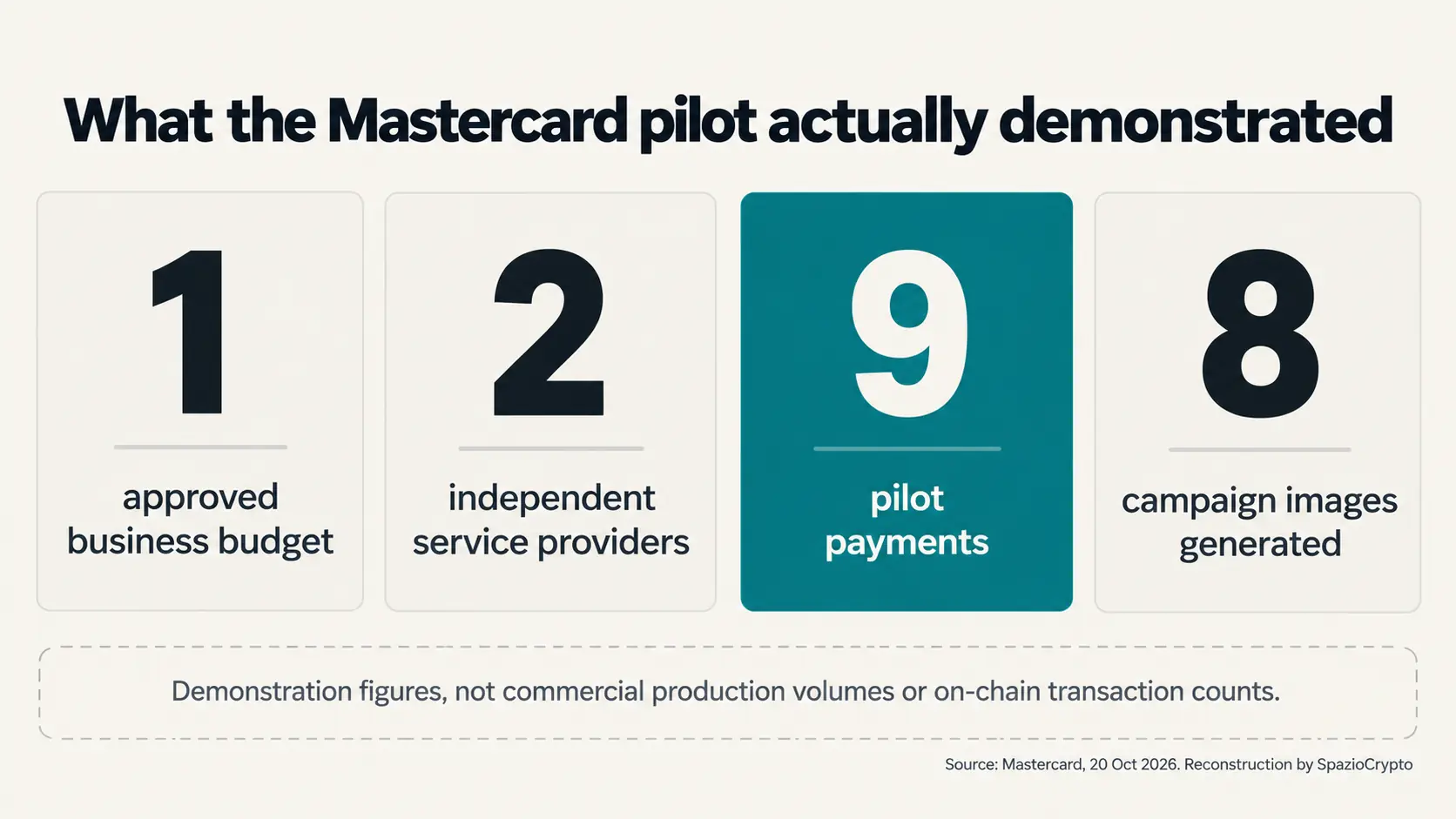
Mastercard opened early developer access to Agent Pay for Machines on October 20, 2026, the infrastructure that lets an AI agent purchase digital services within a company-approved budget. At Cloudflare Connect, the company demonstrated a concrete case: an AI agent commissioned social media research and generated eight campaign images, completing nine payments to two separate vendors under a single authorization.
This is not a general commercial launch. Mastercard first announced the product on June 10, 2026, with backing from more than thirty payments and technology operators. The October 20 update is about the operational demo and the first availability of APIs, documentation, and a sandbox environment for developers. That distinction matters.
The Demo: One Campaign, Two Vendors, Nine Payments
The case Mastercard presented involves Hype, an agency that deploys AI agents in its workflow. The demo assignment was to design a campaign for a protein bar launch. The agent identified two distinct services: AIsa for social media research and Cloudflare AI Gateway for generating campaign images. Hype approved the funding and confined the agent’s activity to a specific task and a set spending ceiling.
Once authorized, the agent could request services without opening a dedicated account for each vendor. Mastercard’s press release describes nine total payments across two independent operators, with eight images produced in the second phase. These figures describe the pilot as shown, not aggregate system usage, economic volume, or adoption by any commercial client base.
The value of the test lies in the continuity of the flow. The agency approves the budget, the agent selects external resources, verifies the quoted price, and proceeds until the task is complete. For each individual service purchased, the agent does not need to request a new human approval, provided it stays within the granted constraints.
How a Payment Without Checkout Works
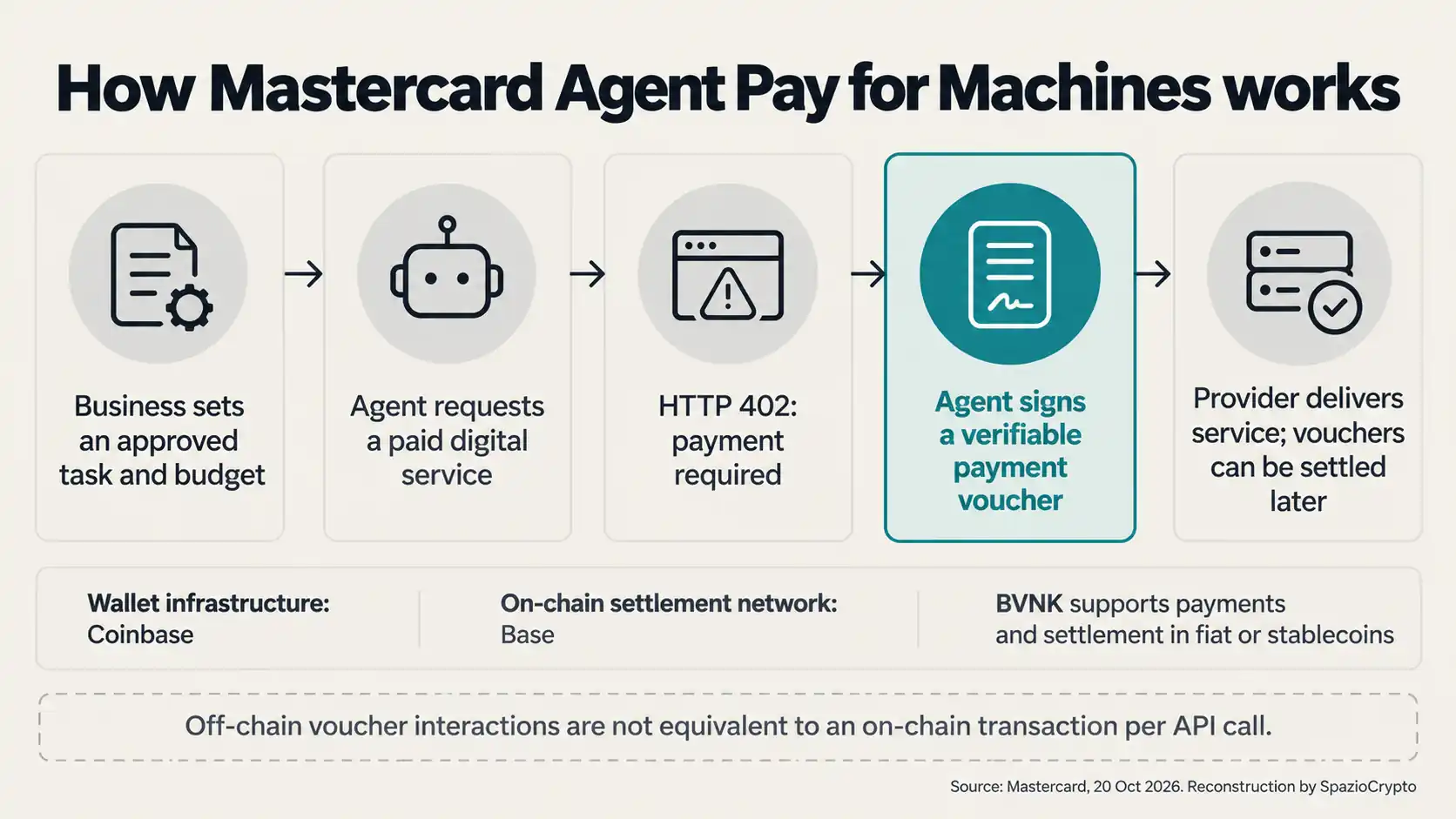
The mechanism builds on x402, an open protocol that uses the HTTP “402 Payment Required” response. When an agent tries to access a paid service, the provider can respond with a payment request. The agent then prepares a signed digital voucher attesting to its commitment to pay within the granted limits. The provider verifies the voucher and releases the requested resource.
Mastercard explains that these interactions can take place off-chain, at the speed of ordinary software requests. Vouchers can be collected and presented later for settlement. The agent does not need to wait for on-chain confirmation of each individual call before continuing its work, at least in the model described.
This separates three moments that are often conflated: advance authorization by the budget holder, immediate delivery of the service, and subsequent financial settlement. The first phase defines who can spend and how much. The second allows the provider to verify a signed payment promise. The third actually transfers value through the designated parties.
SpazioCrypto previously covered autonomous x402 payments in the Visa, Coinbase, and Nevermined project. The October 20 update is not the invention of the protocol, but Mastercard’s combination of signed vouchers, budget control, and deferred settlement within a complete pilot.
What Coinbase, Base, and BVNK Do
The demonstration involves several technical layers, each with a specific role outlined in Mastercard’s press release. Coinbase Developer Platform provides the wallet infrastructure used to fund the agent. Base supplies the network on which on-chain settlement can occur. BVNK acts as the agent’s wallet and uses Mastercard Global Money Platform to manage payments and settlements for both sides, in either traditional currency or stablecoin.
This does not mean that all nine payments were individually recorded on Base. Mastercard explicitly describes off-chain vouchers with downstream on-chain settlement. Without public data on individual operations, it would be inaccurate to present them as nine separate blockchain transactions or to assign them a volume in USDC, USDT, or any other token.
In the model described, the provider can receive value in whatever currency, token, or channel it prefers. This is one of the practical aspects of the collaboration: the purchased service does not need to be invoiced and settled in the same asset used to fund the agent’s wallet.
AIsa’s role is especially direct: the company provides the social media research the agent purchased. SpazioCrypto has previously reported on Tether’s investment in AIsa and AI agent spending controls. In this new test, the documented fact is not an additional funding round or a new stablecoin, but AIsa’s participation as a paid vendor within the demonstration flow.
The Real Control Is the Spending Mandate
An agent with a wallet is not automatically authorized to purchase any available resource. Mastercard frames spending capability as a matter of permissions, not just transfer technology. The enterprise must be able to define the task, the financial limit, and the conditions under which the software can execute purchases.
A signed voucher lets the provider verify that the request originates from the expected process. It does not resolve every possible problem on its own: an agent can select the wrong service, misread a price, or use an unintended vendor while still remaining within the approved monetary threshold. Access policies, recipient controls, and call traceability are also necessary.
Mastercard presents a solution that still needs thorough real-world testing. The press release does not report error rates, disputes, unit costs, or independent performance data. The nine payments in the pilot demonstrate the behavior described in the company’s own demo, not the economic reliability of the system at commercial scale.
What Changes With Early Access
The October 20 update makes the first APIs available for both buyers and sellers of services through Agent Pay for Machines, together with toolkits, a sandbox, and documentation. This is not the product’s first existence: Mastercard announced Agent Pay for Machines on June 10, 2026, with the support of more than thirty payments and technology industry operators.
Early access allows developers to test integrations without the framework being a fully deployed commercial platform. Geographic availability, commercial terms, pricing, admission requirements, error handling, and liability rules for different participants all remain to be clarified.
The setup also differs from the AWS, Coinbase, and Stripe tools for autonomous x402 payments. That architecture describes a separate integration of the same protocol. Here, the specific element is Mastercard’s verifiable, deferrable voucher. Both projects show that a common protocol can connect to different payment infrastructures without making those infrastructures interchangeable.
What Is Confirmed, What Is Not
Confirmed: Mastercard demonstrated on October 20 a pilot with nine payments, two vendors, and an approved budget. Early API access for developers is now open. Coinbase, Base, BVNK, AIsa, Cloudflare, and Hype each have described roles in the flow.
Not disclosed: the value of the nine payments, the number of commercial clients, error rates, product pricing, countries of availability, and the breakdown of settlement between traditional currency and stablecoin.
To watch: independent tests, production deployments with named clients, and information on liability, disputes, and authorization controls.
The Bigger Picture
The decisive shift in agent-to-agent commerce is not putting money in a wallet. It’s converting a human mandate into permissions that other systems can verify. Mastercard’s pilot separates the initial approval from the many small purchases required to complete a task. That separation is the technical contribution the demonstration makes concrete.
The test leaves open the most important question for any enterprise: how are errors, unknown vendors, and disputed transactions handled when an agent can purchase multiple services in seconds? Early access will let developers explore these questions, but a genuine maturity test will require data from actual commercial operations, not just a successful internal pilot.
Sources
- Mastercard, Agent Pay for Machines demo and Early Access launch, October 20, 2026.
- Mastercard, original Agent Pay for Machines announcement, June 10, 2026.
- Mastercard, official early access program page.