


Visa and Mesh announced on October 19 a partnership that would let consumers spend crypto and stablecoin balances directly at over 175 million merchant locations across more than 200 countries and territories, without selling assets first, without transferring funds to a bank account, and without carrying a dedicated crypto card. Mesh handles the funding and conversion behind the scenes; the merchant simply receives a standard Visa payment. The service has been announced but is not yet live: participating wallets, supported devices, launch countries, fees, and conversion rates have not been disclosed.
TL;DR: Visa and Mesh revealed an integration on October 19 that converts crypto or stablecoin wallet balances into Visa payments at the point of sale across 175 million merchants. Launch timing, fees, supported assets, and participating wallets are all still to be confirmed.
How a Payment Would Work
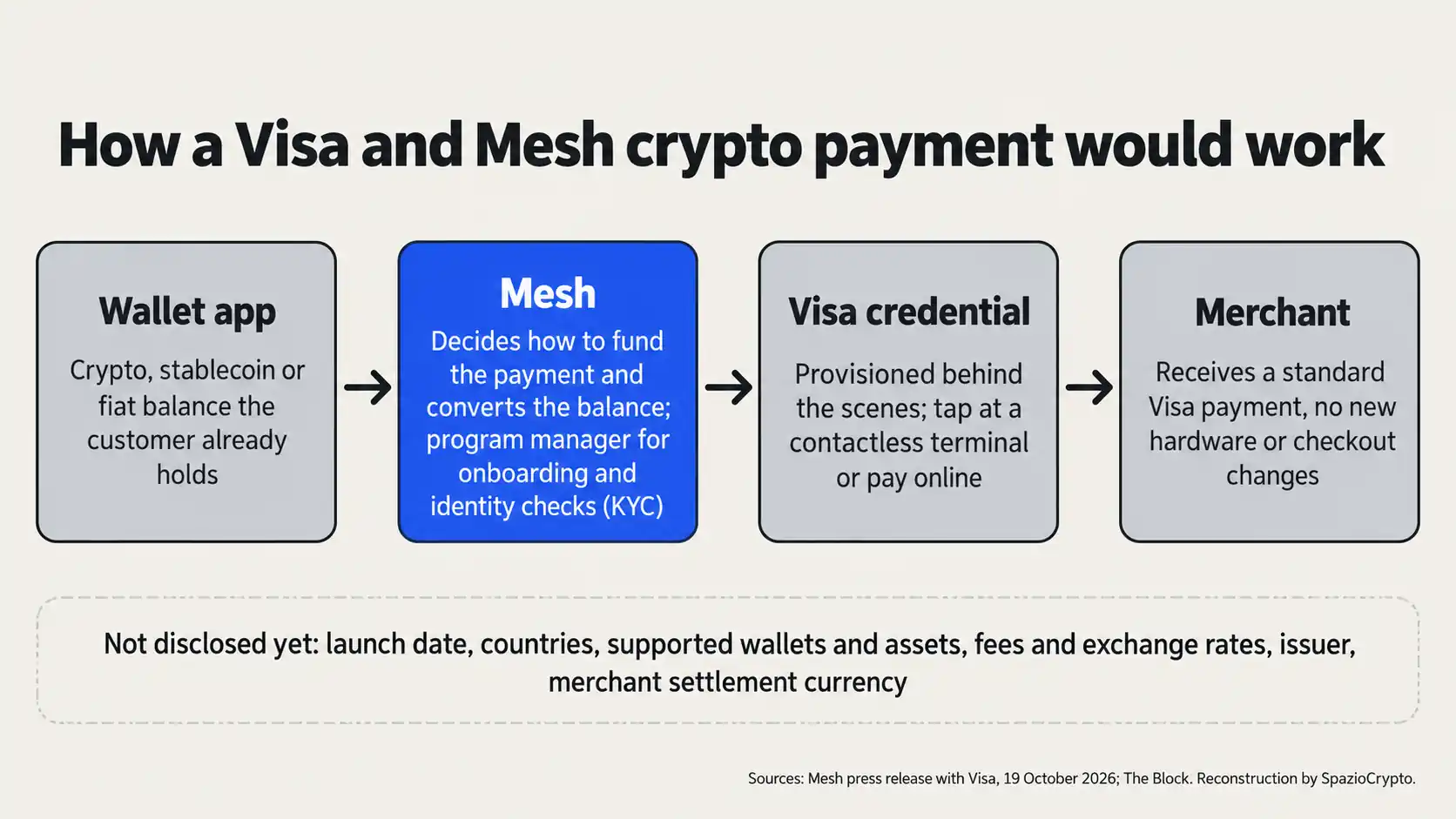
According to the press release distributed by Mesh via PR Newswire on October 19, the flow breaks down into four steps. The customer holds a balance in crypto, stablecoins, or traditional currency inside a participating wallet app. The customer pays with a tap on a standard contactless terminal or online. Mesh determines how to fund the transaction and which balance to draw from, then converts the amount. A Visa credential generated in the background completes the payment. The merchant receives a standard Visa payment and does not need to change their terminal or point-of-sale system.
Customers don't need to sell assets in advance, move funds to an account, or top up a card. Those holding balances across multiple wallets could potentially spend from each, according to the press release. For wallet platforms, the organizational appeal is clear: they integrate once with Mesh, which acts as program manager and handles customer onboarding and identity verification, without each platform needing to build its own card program. “Mesh handles the funding and conversion so that a balance becomes purchasing power at the moment of payment,” said Bam Azizi, co-founder and CEO of Mesh, in a statement included in the press release.
Who Is Mesh?
Mesh was founded in 2020 and bills itself as the first global crypto payment network, connecting hundreds of exchanges, wallets, and financial platforms. According to the press release, more than 200 companies sit on its network. Named partners include Kalshi, Félix Pago, Majority, KAST. Tools for Humanity, the company behind World Money, the financial app of the World project. Together, the press release claims, these partners reach “hundreds of millions of users.” They are presented as partners in the Mesh network, not as platforms already confirmed for the Visa service specifically.
According to The Block, Mesh is the company powering PayPal's “Pay with Crypto” feature. In January, as reported by The Block, Mesh raised $75 million in a Series C round led by Dragonfly at a $1 billion valuation, bringing total funding to over $200 million. On the card infrastructure side, Mesh's own blog indicates the company already provides Rain, a card issuer and principal member of Visa, with the system that funds stablecoin cards from balances held across hundreds of wallets and exchanges.
What Changes for Crypto Cards
Until now, spending crypto at a merchant typically meant either selling first and wiring the proceeds to a bank, or carrying a dedicated card tied to a single platform. Azizi calls this the last-mile problem. “Crypto has never had a spending problem; it has a last-mile problem, and solving it until now meant getting a separate card,” he said in the press release.
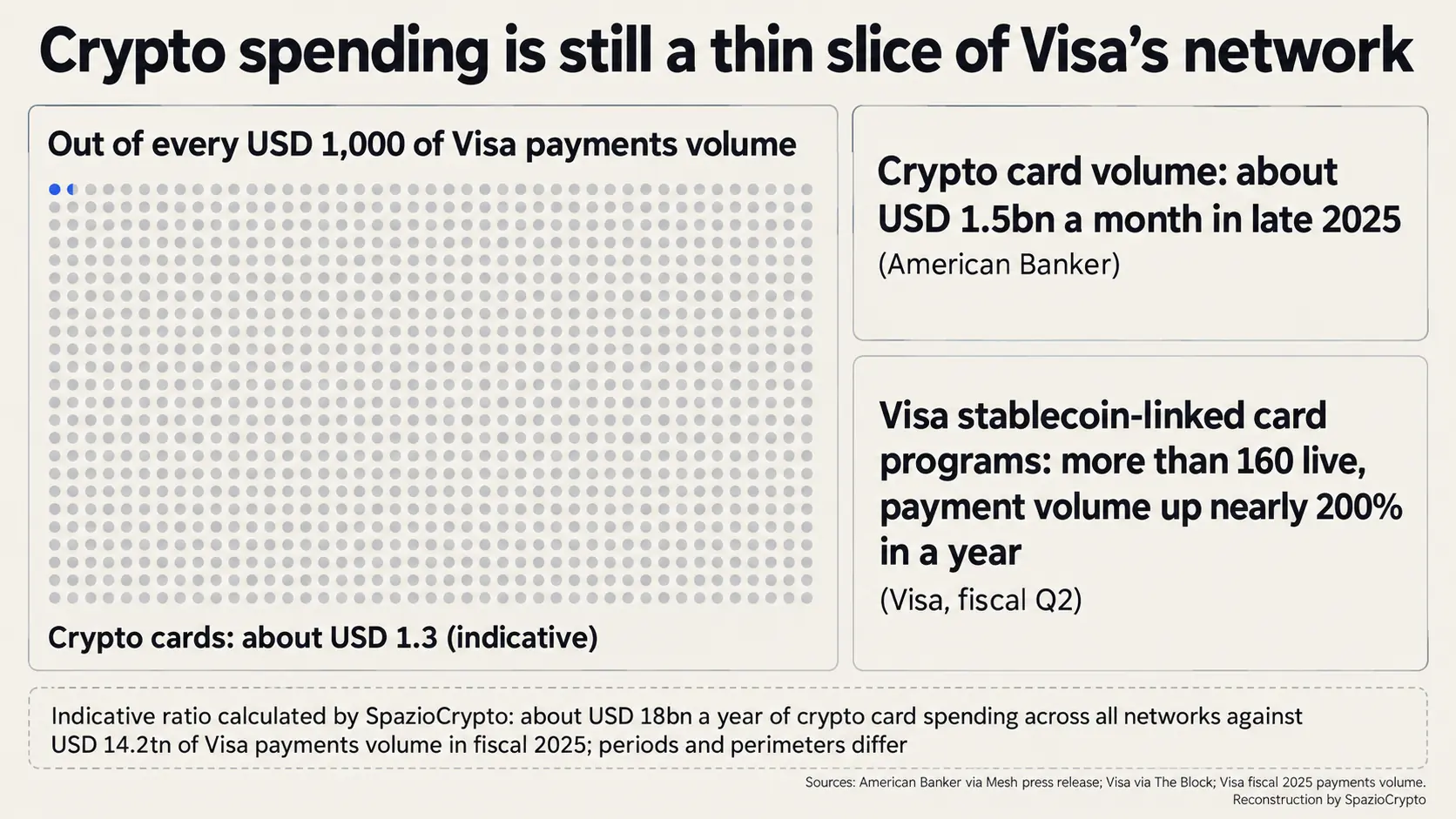
The crypto card market is growing, though it remains a small fraction of overall Visa volume. According to American Banker, cited in the Mesh press release, crypto cards were moving roughly $1.5 billion per month at the end of 2025. Artemis estimated annualized crypto card spending above $18 billion, according to The Defiant. Visa processed approximately $14.2 trillion in total payment volume in its fiscal year 2025, according to the company's own figures, so crypto card spend represents around $1.30 for every $1,000 of Visa volume. That ratio is our own indicative calculation; the periods and perimeters don't perfectly overlap.
Visa is not walking away from cards. In the second quarter of its current fiscal year, Visa had over 160 active stablecoin-linked card programs worldwide, with payment volumes up nearly 200% year-on-year, according to data cited by The Block. Stablecoin settlements on the Visa network surpass $20 billion per year, also per The Block. Visa is partnering with Bridge, the Stripe-owned company, to extend those card programs to more than 100 countries by end of 2026, according to The Defiant. In April, Visa and WeFi also announced a project to let users spend crypto held in self-custody wallets, according to The Block.
Our read, stated as such: the card doesn't disappear; it goes invisible. Behind every Visa-Mesh payment, there is still a Visa credential and a card program, now managed by Mesh rather than by each individual wallet platform. What changes is who builds the service and who controls the customer relationship. Traditional crypto cards lose the advantage of being the only bridge to merchants and will need to compete on rewards, fees, and services. Visa collects in either scenario.
What Is Still Missing Before Launch
The 175 million merchant locations figure describes the reachable network, not the stores where the service is already live. The press release defers everything else: initial availability, supported devices, and participating platforms “will be announced when launch details are finalized.” Missing from the announcement are the specific crypto assets and stablecoins that will be spendable, the launch countries, fees, and conversion rates. For anyone paying in crypto, conversion rates carry as much practical weight as the sticker price. The press release also doesn't identify the issuer of the Visa credential or the settlement currency the merchant receives.
One technical question also remains open. The press release refers to balances consumers already hold in their wallet apps but doesn't clarify whether the service will work with self-custody wallets or only with custodial platforms where a company holds the funds. The distinction is material: it determines who holds the keys, who executes the conversion, and who is accountable if something goes wrong.
What About the US and UK Market?
The press release doesn't mention specific launch markets. In January, Mesh told The Block that its Series C funding would partly be used to expand into Europe, but no timeline was given for any specific country or region. MiCA authorization is the key regulatory gateway for any such expansion across the EU. The UK's Financial Conduct Authority runs a parallel crypto registration and authorization regime under its own framework.
Tax treatment matters too, especially for US investors. The IRS treats the use of cryptocurrency to purchase goods and services as a disposal event subject to capital gains tax. Every crypto payment would trigger a taxable event requiring record-keeping. UK rules work similarly under HMRC guidance. For European users, the picture varies by country, and MiCA does not harmonize crypto tax treatment across the EU.
Visa and Mesh: Confirmed vs. Not Confirmed
What's confirmed, what isn't
- Confirmed: integration announced October 19; Mesh manages funding, conversion, customer onboarding, and identity verification; a Visa credential generated in the background; the merchant receives a standard Visa payment across a network of over 175 million merchant locations.
- Not disclosed: launch date, countries, participating wallets, supported crypto and stablecoins, fees and conversion rates, credential issuer, settlement currency, and whether self-custody wallets are supported.
- To watch: the first wallets and launch countries confirmed, the cost structure for payers, and whether a MiCA-compliant European rollout follows.
The Bigger Picture
Crypto payments may be transitioning from a standalone product into a function embedded in the wallet itself. If the Visa-Mesh integration reaches the market, the competitive ground shifts away from which crypto card a platform offers and toward the invisible conversion layer underneath. Mesh is positioning itself as that layer for hundreds of platforms simultaneously. Visa, for its part, remains the toll road: whether the prevailing model ends up being stablecoin-linked cards or background-generated credentials, the payment still runs on its network.
The concrete signals to track are straightforward: the first confirmed partner wallets, the fee and conversion rate structure, the launch countries, and the stablecoins approved for spending. In Europe, the public alternative is still in testing. The Eurosystem is recruiting online and in-app merchants for the digital euro pilot, scheduled to begin in the second half of 2027. The first real Visa-Mesh transaction will tell us how much of those 175 million merchant locations crypto can actually reach.