


An order of nine mini pizzas has become the test case for an AI agentic Pay by Bank pilot in the United Kingdom. On November 27, 2026, TrueLayer announced it had completed a trial with Papa Johns in which a digital assistant managed an order and initiated payment directly from the customer’s linked bank account. The work, conducted inside the Financial Conduct Authority’s (FCA) Supercharged Sandbox, involves UK banks including Lloyds and NatWest. The story isn’t really about pizza. It’s about the mechanism that lets a consumer authorise software to spend money without ever handing over banking credentials.
What Happened in the UK Trial
TrueLayer claims the first agentic Pay by Bank payment to an identified merchant in the United Kingdom. The company also reports the first use of Lloyds and NatWest variable recurring payment (VRP) APIs in this context. That claim has a precise scope: it does not equal the first purchase ever made by an AI, nor does it prove the technology is ready for broad consumer rollout.
The detail about nine mini margaritas comes from The Guardian. In the newspaper’s account, based on statements by TrueLayer CEO Francesco Simoneschi made on November 27, the customer confirmed the order proposed by the assistant. That distinction matters: this was not a purchase completed without any human intervention. The case adds to the growing body of digital payment experiments SpazioCrypto has covered, including the Mastercard machine-to-machine payment test.
The Customer Authorises, the Bank Controls
In the model described by TrueLayer, the consumer links their account to a Papa Johns profile and approves the mandate inside their banking app. Spending restrictions can be set by merchant and by time period. The bank checks each request against those limits and can reject it; the authorisation can be withdrawn through either the bank or the merchant. Banking credentials are never shared with the agent. The Guardian reports that in the Lloyds trial, per-transaction and monthly caps were in place.
The separation of roles keeps the order distinct from the payment instruction. The software interprets customer preferences and prepares the purchase; the payment service provider interacts with banking infrastructure; the bank applies the financial conditions. Public documentation does not describe every data point transmitted to the AI model, nor the exact technical permissions granted to each component. The absence of shared passwords does not mean the system handles no personal data, or that the agent receives no information needed to manage the order.
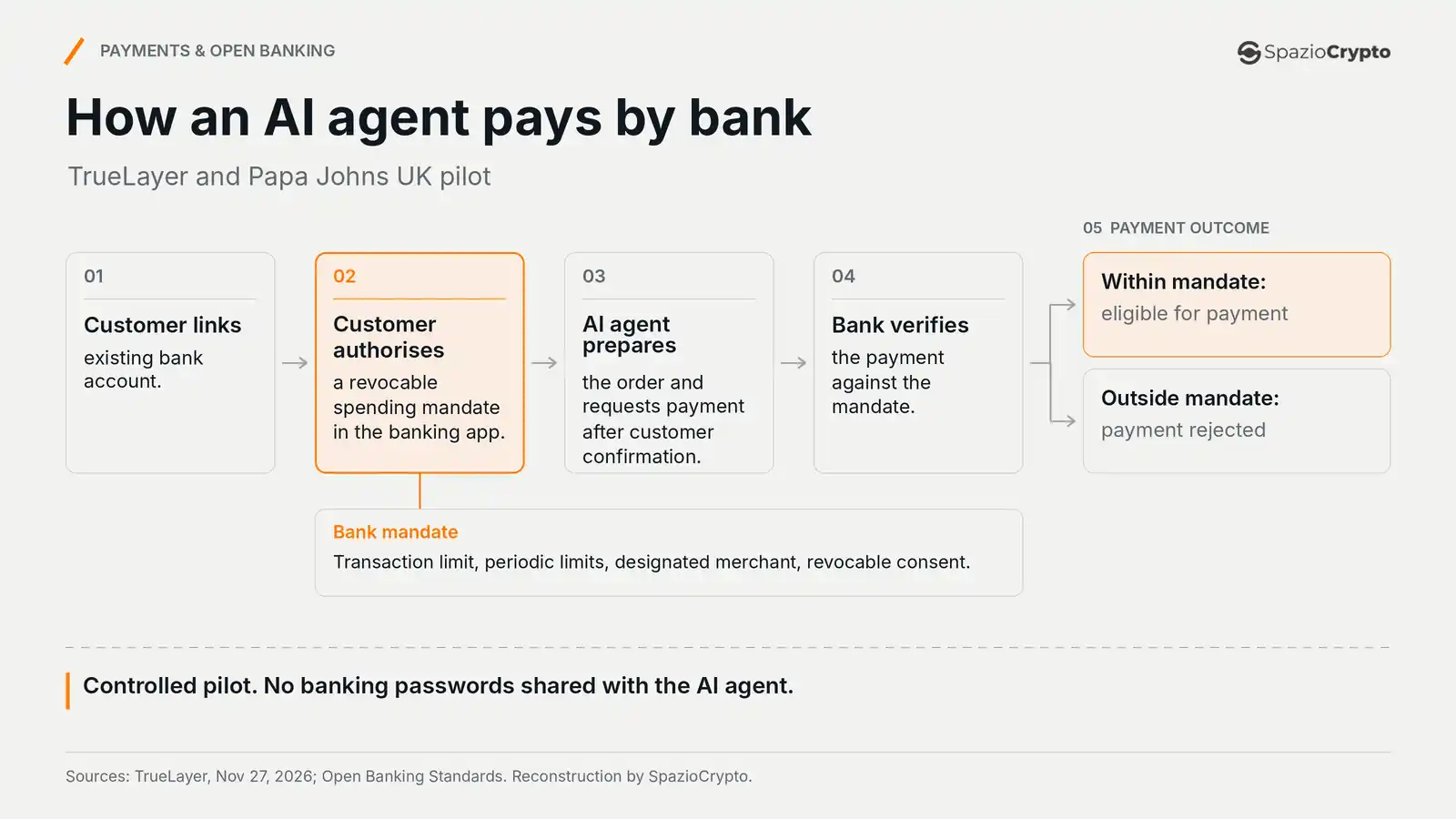
The question echoes one raised in our analysis of AIsa and agentic payments: before software can spend money, someone has to define which operations are permitted. Our read is that the bank mandate shifts part of the control outside the language model. You don’t have to rely solely on the assistant’s ability to follow instructions to block a payment above the authorised threshold.
The Rules of Variable Recurring Payments
Open Banking Limited distinguishes Variable Recurring Payments (VRP) used for transfers between accounts held by the same person from commercial VRPs, which allow payments to an organisation or business. In the commercial version, consent covers a series of transactions that can vary in amount, within agreed conditions. There is no need to define the exact value of each purchase in advance. The customer retains the right to withdraw consent at any time.
UK standards require strong customer authentication (SCA) at the point the mandate is set up. They also distinguish between subsequent payments that benefit from an SCA exemption and those where authentication is delegated. Not all VRPs therefore eliminate the need for a fresh consumer action. TrueLayer’s integration documentation lists configurable parameters that include the maximum value per instruction, the validity period, and periodic cumulative caps. The actual values chosen for the Papa Johns pizza test have not been disclosed.
For a merchant, the difference between a stored card and a bank mandate is not just the collection method. It changes the process by which a new request is validated. Other infrastructures pursue a similar objective with different tools, such as the x402 protocol for paid access to digital resources. That is a different authorisation mechanism entirely.
Three Models for Agentic Payment
Comparing two other November announcements clarifies the difference between delegation, custody, and authorisation. In the ChatGPT Wallet model SpazioCrypto covered at launch, the assistant prepares a purchase and the consumer approves each payment with a biometric check. With Wirex Navoka, the service operates dedicated financial instruments kept separate from the user’s personal accounts: an IBAN, a card, and stablecoin wallets. In the UK trial, funds stay in the customer’s existing account and requests reference the bank mandate.
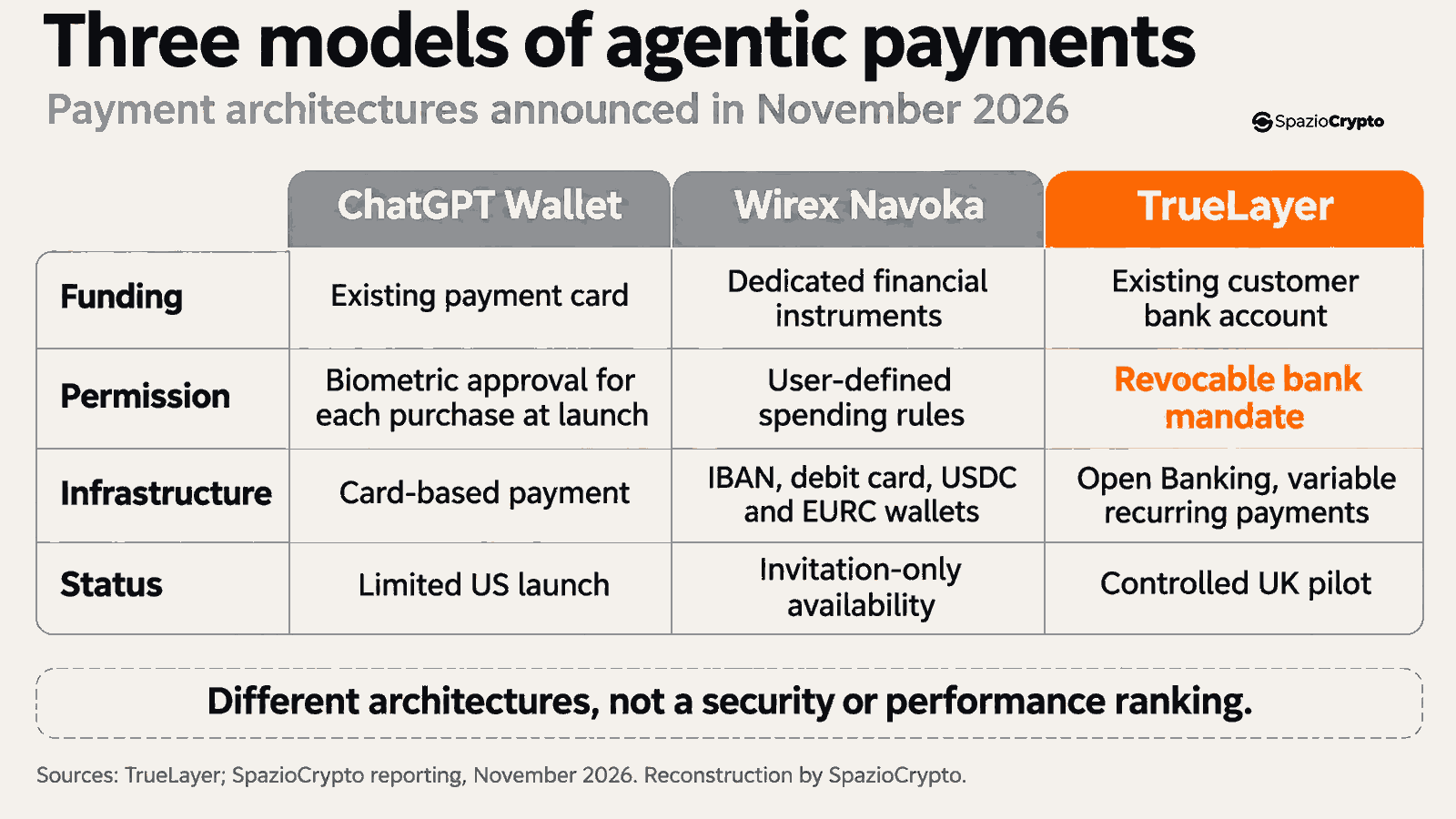
The comparison is about announced architectures, not a security or convenience ranking. A card payment can be constrained by rules; a separate wallet can limit exposure of personal funds; a mandate can reduce the need for repeated bank authorisations. None of those properties alone makes a system preferable to the others. Even stablecoin agentic payments require a clear distinction between the technical capacity to transfer value and the conditions that make spending legitimate.
The Mandate Perimeter and Residual Risks
An unwanted purchase could fall perfectly within budget. An assistant might misinterpret a quantity, select the wrong product, or repeat an order after a miscommunication. These are risk scenarios, not documented incidents from the Papa Johns project. A bank control on amounts is not designed to judge whether the product selected matches the consumer’s actual intent.
A complete assessment would require evidence on how the system handles duplicates, rejected requests, refunds, disputes, and mid-transaction revocation. It would also help to know the liability split between the assistant provider, the payment service provider, and the merchant, without assuming it mirrors other systems. The sources consulted do not publish results from these specific tests. The FCA notes that the group’s showcase took place on November 25 and 26, and that sandbox access closes on December 31, 2026. Participation does not constitute FCA approval, endorsement, or authorisation of the product.
What About Open Banking in Europe?
The UK trial is relevant beyond British borders because Open Banking is not a UK-only infrastructure. The EU’s Payment Services Directive (PSD2) already governs Payment Initiation Services (PIS) and Account Information Services (AIS) across the European single market, with authorised third parties accessing bank interfaces via certified credentials. The UK FCA framework and the EU PSD2 regime share structural similarities, though they have diverged since Brexit.
A service modelled on TrueLayer’s approach and aimed at consumers in other European markets would need to be evaluated against the roles of the parties involved, applicable rules, consent mechanisms, and agreements with payment service providers. No commercial launch of this specific project outside the UK has been announced. The existence of European banking APIs does not by itself make every experimental delegation scheme available to consumers across the continent.
TrueLayer and Papa Johns: What We Know
Confirmed, unconfirmed, and what to watch
- Confirmed: TrueLayer announces a Pay by Bank payment inside the FCA sandbox, with a bank mandate and revocable spending limits.
- Not disclosed: the AI model used, the exact transaction date and amount, the number of participants, error-test results, and any commercial launch timeline.
- To watch: conditions for wider rollout, consumer protections, refund procedures, and reliability data.
The Bigger Picture
Our read, stated explicitly as editorial opinion, is that competition in agentic commerce will also play out over who controls the payment delegation layer. The potential advantage of TrueLayer’s model is not unlimited agent autonomy, but the ability to separate the commercial decision from the financial verification. The bank retains a control point, the consumer retains a revocation right, and the software operates on a bounded mandate. The quality of the interfaces and the effectiveness of protections under real-world conditions remain to be tested.
The concrete signals to watch next are any public opening of the service, the publication of metrics on successful and rejected transactions, the dispute procedures put in place, and how commercial VRP rules evolve. Those details, rather than the number of pizzas ordered, will determine whether this experiment can become a payment method viable at meaningful scale.
Sources
Experiment: TrueLayer press release, November 27, 2026; The Guardian, November 27; The Next Web, November 27. Rules and infrastructure: FCA Supercharged Sandbox; Open Banking Limited, VRP and cVRP; Open Banking Standards, VRP; TrueLayer Bank on File integration guide. Sources consulted November 28, 2026.