Tether Capital announced a strategic investment in AIsa on October 15, 2026, backing a platform that lets AI agents autonomously purchase access to data, models, APIs, software, and compute resources. This isn't an unguarded wallet handed to a piece of software. AIsa combines pay-per-use logic, permissions, and enterprise spending limits, placing AI agent payments in stablecoin at the center of the deal while also supporting fiat settlement.
We reviewed Tether's and AIsa's official press releases, the prior round documentation, and operational information published on the platform. Tether has not disclosed the specific amount it invested. User counts, transaction figures, and catalog size are AIsa's own declarations and have not been independently verified.

What Tether Actually Funded
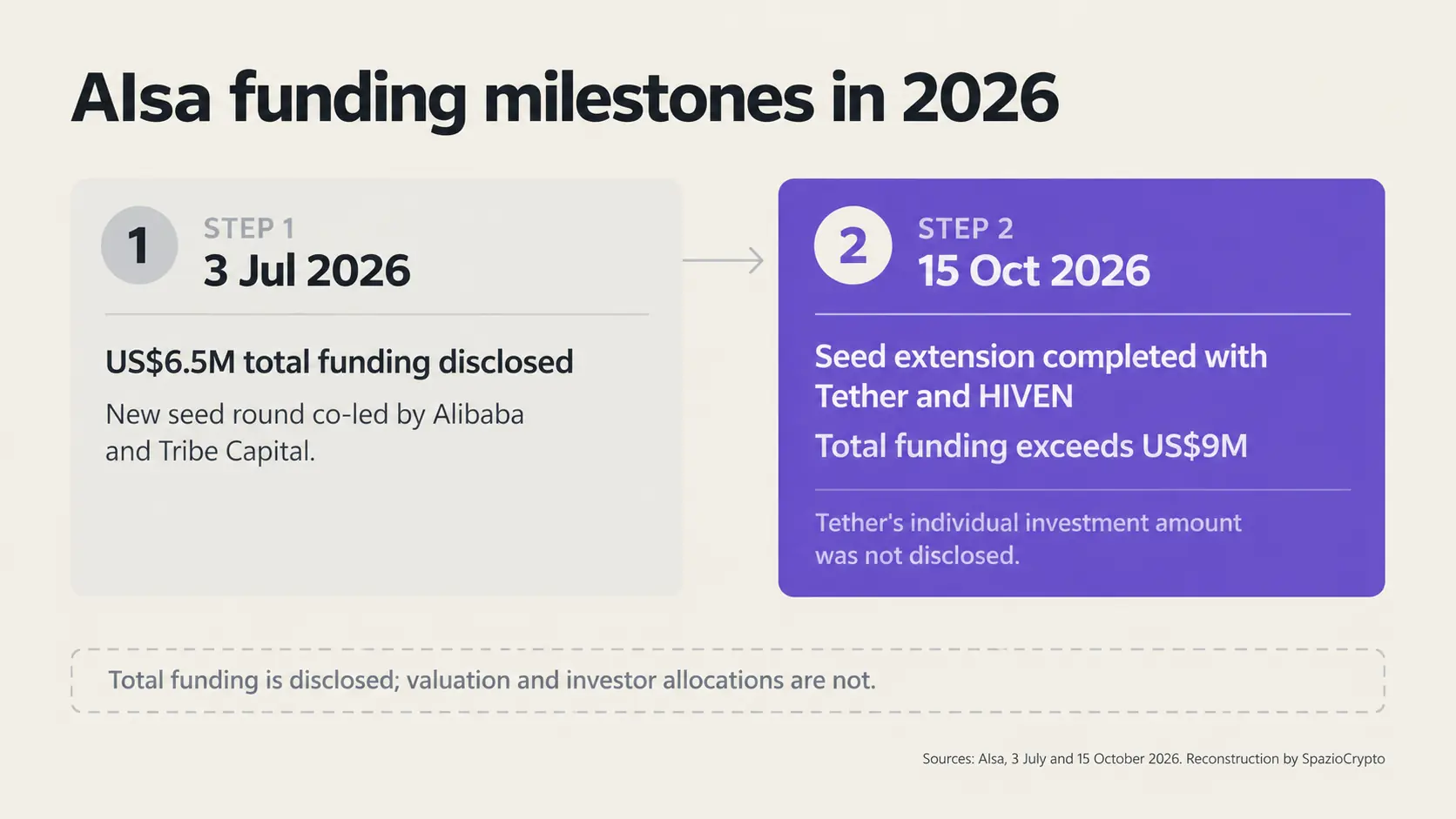
AIsa closed a seed extension with Tether and HIVEN joining as new strategic investors. According to AIsa's announcement, total fundraising now exceeds $9 million. In July 2026, the company had disclosed $6.5 million raised in a round led by Alibaba and Tribe Capital alongside other investors.
Tether frames the move as an extension of its strategy in artificial intelligence and programmable money. The connection to Tether's broader positioning is genuine, though it does not mean USDT becomes mandatory in every payment. AIsa's documentation describes settlement in fiat or stablecoin, and the platform's website also references USDC and the x402 protocol.
What is verifiable is the infrastructure itself: an AI agent can call a digital resource through a single interface, receive a per-use fee, and complete the payment within rules set by the enterprise. Valuation, the stake acquired by Tether, and economic terms of the extension have not been disclosed.
One Key Instead of Dozens of Contracts
To understand AIsa, start with a simple friction point. An AI agent can analyze a market, search documents, or run a specialized model, but every provider demands separate credentials, billing arrangements, and terms of service. These processes were designed for human procurement teams, not for software selecting resources in real time.
AIsa attempts to unify access and payment in one layer. The platform claims more than 5,000 APIs, skills, and models behind a single key, priced per call. The logic is close to what we covered with the x402 standard for micropayments between agents: a resource publishes a price, the software pays, and access is granted without the agent subscribing to a separate service contract for each provider.
The difference is that AIsa goes beyond a bare payment protocol. It offers an aggregation, routing, metering, and control layer. That shifts the question from whether an agent can pay, to who decides what the agent is allowed to spend, how much, and on which resources.
Large Numbers, Read as Self-Reported Figures
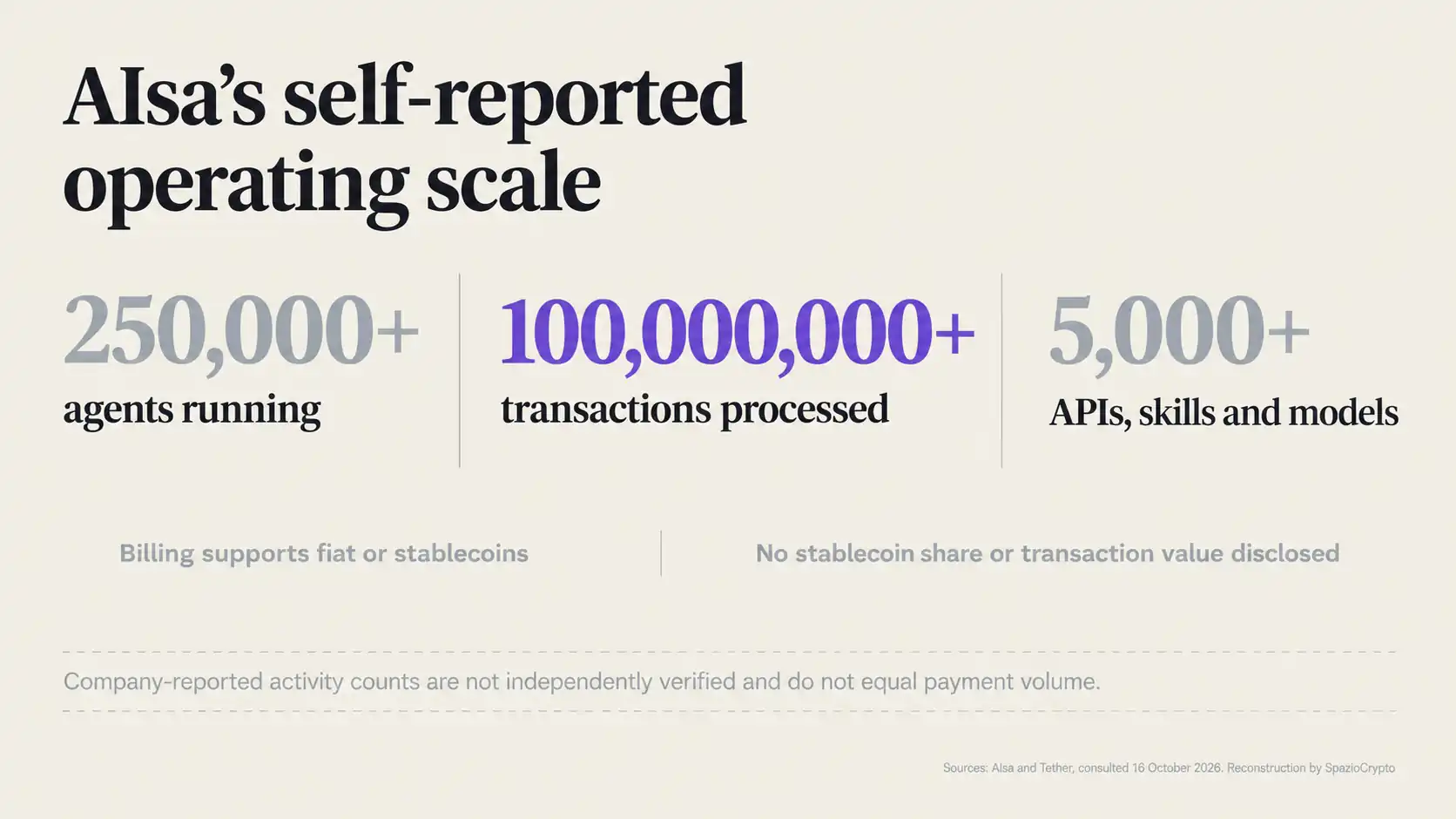
AIsa self-reports more than 250,000 agents running on the platform and over 100 million transactions processed. The catalog lists more than 5,000 resources. In July 2026, the company had communicated 50,000 registered agents and 150x user growth between February and June, with API calls and transactions reportedly up 200x over the same period.
These figures describe technical activity, not monetary volume. A single transaction can be a low-cost API call, and AIsa does not disclose total value settled. We don't know how many operations used stablecoins, which tokens dominated, or what share of the 250,000 agents is active on any given day.
That distinction matters. The launch of the x402 Foundation already showed tens of millions of transactions processed. High technical call counts can coexist with still-modest economic values. Measuring real adoption will require settlement volumes, paying customers, usage frequency, and the actual share settled in stablecoin rather than fiat.
Autonomous Does Not Mean Unsupervised
In Tether's press release, the company emphasizes spending limits set by the enterprise. AIsa lists permissions, budgets, approval workflows, and audit logs as core product features. That boundary is the defining one. An agent can execute a payment without asking a human each time. It operates inside a mandate defined in advance.
This question surfaced sharply in the dispute between banks and software providers. JPMorgan challenged the use of customer credentials by external agents, drawing a line between data access, the ability to move funds, and liability. The restrictions JPMorgan imposed on AI agents show that payment is only the final step in a longer authorization chain.
AIsa tries to make that chain visible inside the product. Open questions remain: how is provider identity verified, who is liable for an erroneous purchase, how does a business dispute a non-conforming call, and what controls prevent a compromised agent from exhausting a budget within formally valid limits.
Why Stablecoins Fit Micropayments
Stablecoins can be transferred with programmable logic, operate outside banking hours, and settle very small amounts. AIsa gives the example of microservices purchased at $0.001 per call. That figure illustrates a possible use case, not the average price across the catalog.
Traditional cards and bank accounts can enter the same flow. The earlier project involving Visa, Coinbase, and Nevermined showed how an agent can use x402 alongside existing payment rails within user-set caps. Stablecoins and card networks aren't necessarily opponents here. The likely outcome is a software layer that picks the most appropriate settlement method for each transaction.
For Tether, the investment creates a potential distribution channel into what the industry calls the machine economy. Tether had already linked its wallet infrastructure to local AI and robotics use cases. We covered the vision of USDT as currency for robots and autonomous agents. AIsa adds a case closer to enterprise software: paying for data and digital services on a per-call basis.
What This Means for US and Global Enterprises
AIsa is headquartered in San Francisco, and the deal is international in scope. For US and UK enterprises, the Tether investment surfaces a practical governance question: if an AI agent is authorized to purchase compute or data, who owns the audit trail, who is liable when a call goes wrong, and which compliance framework applies to automated stablecoin settlement?
These aren't abstract questions. Under MiCA, European businesses deploying AI agents that settle in stablecoin will face questions about e-money licensing and transaction reporting. In the US, stablecoin legislation moving through Congress in 2026 could impose reserve and disclosure requirements on any platform routing significant settlement volume in tokens. An agent that buys $0.001 of data per call isn't a compliance problem. One routing millions of calls per day might be.
Tether and AIsa: What Is Confirmed
Confirmed facts versus open questions
- Confirmed: Tether and HIVEN join the seed extension; AIsa self-reports total fundraising exceeding $9 million.
- Not disclosed: Tether's invested amount, company valuation, stablecoin share of settlements, and total economic volume processed.
- To watch: named enterprise pilots, on-chain controls, tokens actually used, and independently verifiable usage data.
The Bigger Picture
Our editorial read is that the next contest in agent payments won't be decided at the wallet layer. The competitive advantage will be in control: granular permissions, audit trails, resource provenance, spending limits, and error handling. Programmable money enables the transfer; the actual product is the digital mandate that defines what the agent is allowed to do.
The signals worth tracking are concrete: total value settled, stablecoin share of that volume, identified enterprise customers, error and dispute rates, and adoption of approval workflows. Until those figures become public, Tether's investment marks a strategic direction and a platform with self-reported activity, not confirmation that stablecoins have already become the dominant settlement layer for the agent economy. Watch for AIsa's next operational disclosure and any named enterprise pilots beyond October 15, 2026.