


On September 29, the Banca d'Italia published a new technical study addressing one of the most pressing questions in digital payments: how to build systems that protect user privacy without making regulatory oversight impossible. The document, number 93 in the zero-knowledge proof research series “Markets, Infrastructures, Payment Systems,” surveys cryptographic tools developed primarily in the blockchain ecosystem. It deserves a careful read, because the subject is far more concrete than the title suggests.
One important clarification upfront: the Banca d'Italia is not announcing the adoption of this technology in any live payment system. This is a technical study analyzing the state of the art and possible design trade-offs, not an operational decision. Here is what it contains, and why it matters for anyone following the crypto space.
 Banca d'Italia
The Problem the Study Addresses
The document starts from a fundamental conflict that becomes more visible as digital payment systems evolve. On one side, transactions should shield users from unjustified monitoring and misuse of personal data. On the other, regulatory compliance demands mechanisms for traceability, control, and accountability. Balancing these two goals is especially complex in institutional payment infrastructures, where public trust and regulatory responsibility must coexist within the same architecture.
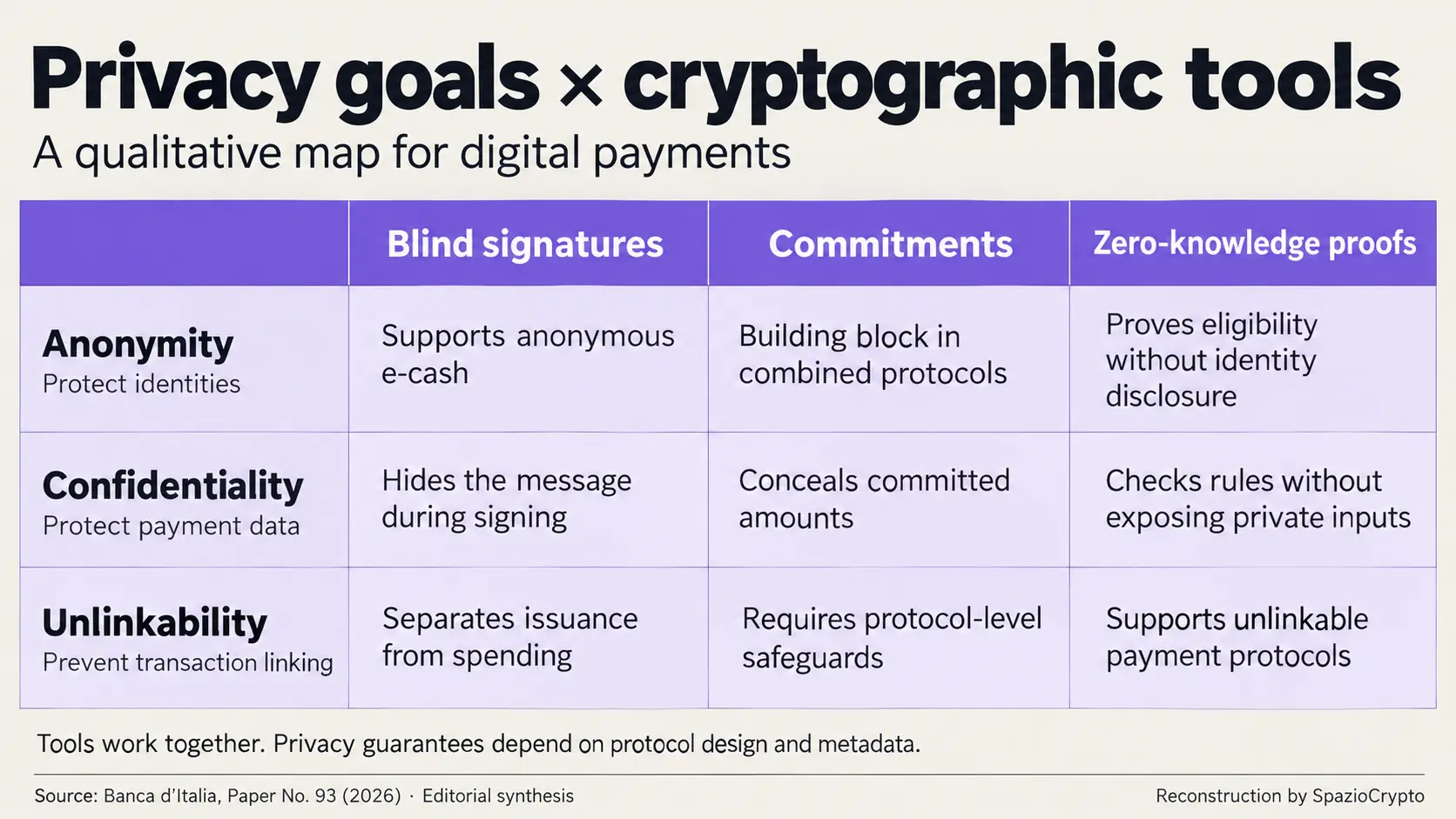
The study explicitly examines both decentralized architectures, typical of the blockchain world, and centrally managed infrastructures like traditional payment systems. It identifies three distinct privacy objectives a payment system can pursue: anonymity, data confidentiality, and unlinkability, meaning the inability to connect multiple distinct transactions to the same individual simply by observing them.
The Cryptographic Tools: What They Are and How They Work
To pursue these privacy objectives, the study examines three families of cryptographic tools. Blind signatures allow one party to digitally sign a document without reading its content, a technique that lets an intermediary authorize a payment transaction without knowing exactly what it is authorizing. Cryptographic commitments allow a party to “commit” to a value today that will only be revealed at a later point, guaranteeing the value cannot be altered in the meantime while remaining hidden until disclosure.
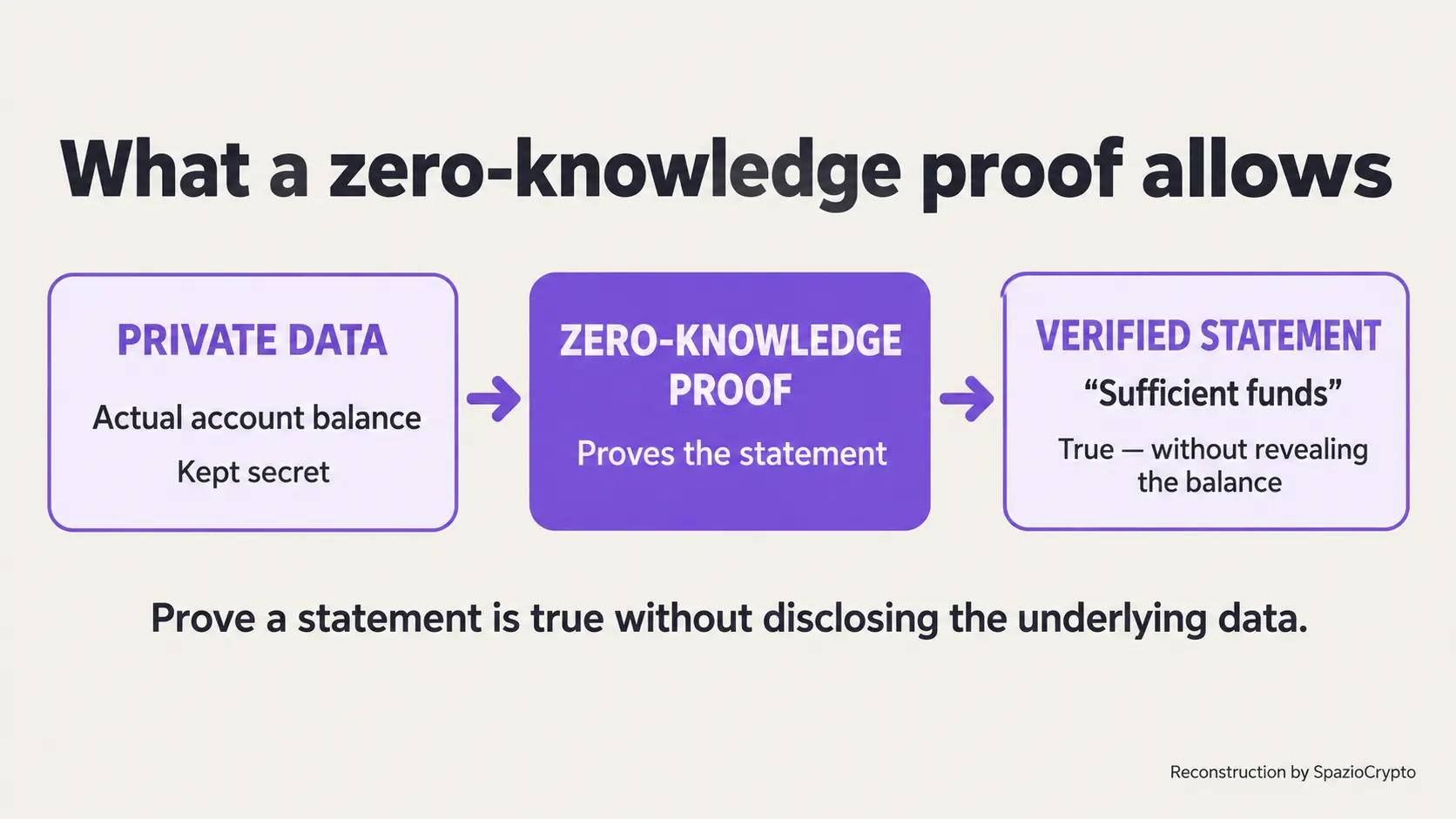
Zero-knowledge proofs, the most sophisticated of the three, allow one party to mathematically demonstrate that a statement is true without revealing any information beyond the bare fact that the statement is true. Applied to payments, this means proving that an account holds sufficient funds for a transaction, or that a transaction respects specific regulatory limits, without ever disclosing the actual account balance or the specific transaction details to whoever verifies the proof.
The Study at a Glance
Key contents. Source: Banca d'Italia, No. 93, September 29, 2026
- The problem: user privacy versus transaction traceability and regulatory accountability.
- The tools: blind signatures, cryptographic commitments, zero-knowledge proofs.
- Not a deployment decision: this is a technical research paper, not the adoption of any specific technology.
Selective Controls, Not All or Nothing
The most interesting element of the study concerns verifiability mechanisms that allow selective oversight without forcing a binary choice between total privacy and total surveillance. In practice, these tools make it possible to build systems where a transaction remains private for the general public but can be made visible to a specific authority under specific, predefined circumstances. Think of a money laundering investigation: the relevant transaction becomes visible to regulators without requiring all other users to sacrifice their privacy in every other case.
This approach differs sharply from the most widely used public blockchains, where every transaction is visible to anyone by design. It differs equally from traditional banking systems, where full traceability toward the intermediary is simply the norm. The study therefore suggests that a middle ground exists, technically achievable today, capable of offering more privacy than traditional banking without eliminating the selective oversight that public blockchains cannot provide. This conversation is taking place precisely as the same central bank works actively on multiple fronts of digital payment infrastructure, as seen with Pontes and the ongoing debates around the digital euro.
The Bigger Picture
This study illustrates how cryptography born to make cryptocurrencies possible is steadily crossing the boundaries of its original ecosystem and becoming a subject of serious inquiry at the most traditional financial institutions. Zero-knowledge proofs, refined over years in decentralized finance protocols and privacy-oriented blockchains, are now being examined by a central bank as a potential tool for solving a very concrete problem in tomorrow's institutional payments.
The lesson is twofold. First, the gap between crypto's cryptographic innovation and the design requirements of traditional finance is closing faster than most observers realize from the outside. Concepts developed in an ecosystem that institutional investors once viewed with deep skepticism are now being analyzed with academic rigor by the Italian central bank. Second, the trade-off between privacy and control remains one of the most delicate design challenges for any future digital payment system, whether that system is a digital euro, a private stablecoin, or an entirely new infrastructure still to be conceived. Whether and how these technologies find concrete application in upcoming pilot projects is worth watching closely. For a broader understanding of the technologies involved, our guide on what cryptocurrencies are remains a useful starting point.