


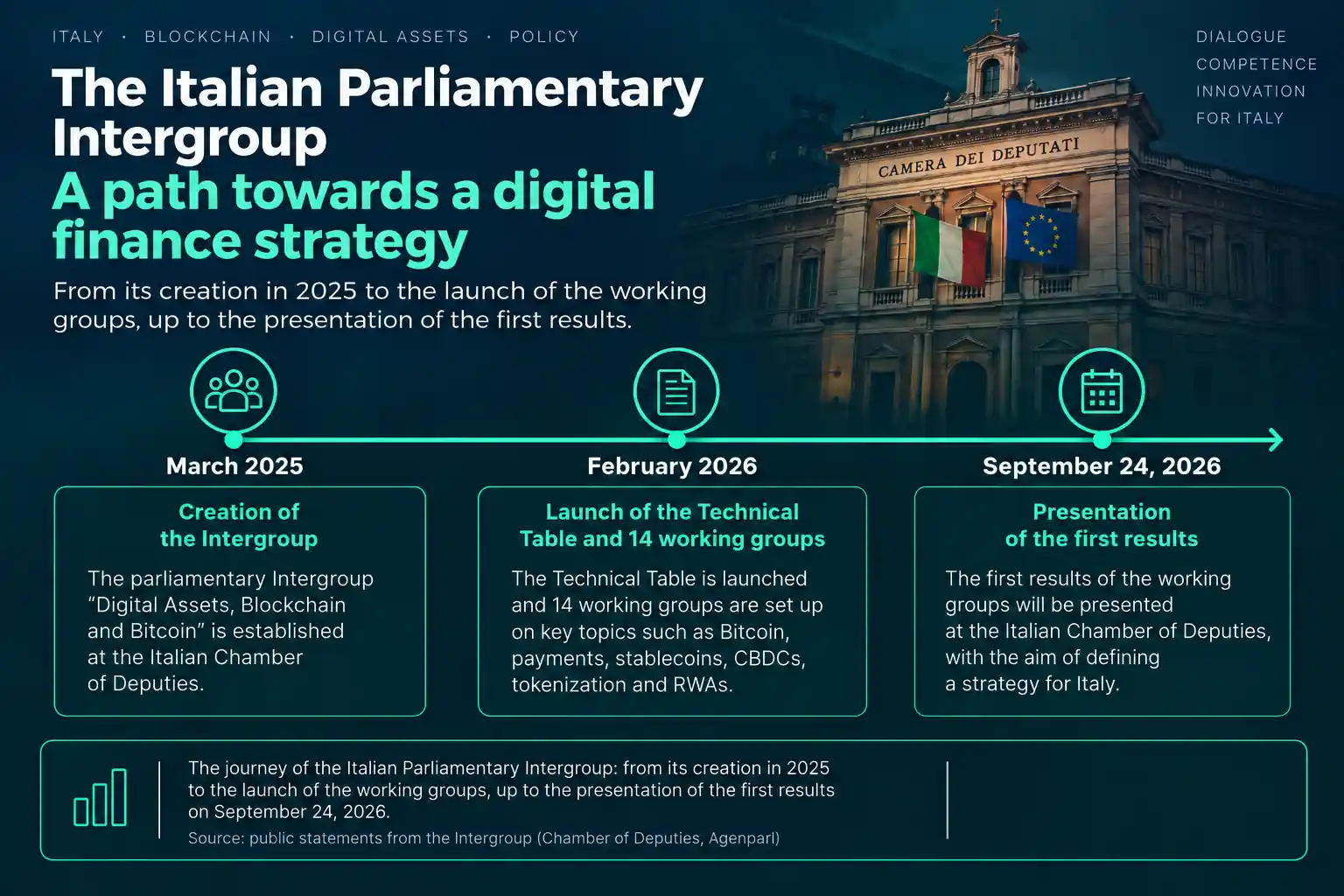
Italy is attempting something more ambitious than simply implementing EU crypto rules. On September 24, the Chamber of Deputies will host a formal presentation by the cross-party Parliamentary Intergroup on Digital Assets, Blockchain and Bitcoin, unveiling the initial findings of fourteen specialist working groups that have spent months preparing an independent Italian strategy on Bitcoin, tokenization and digital payments. For a country that has largely followed Brussels’ lead on crypto regulation, this marks a genuine shift in posture.
One clarification upfront: this is not a legislative announcement. What gets presented on September 24 is a set of technical analyses, reports and policy recommendations, not a ready-to-vote bill. Still, the process itself deserves attention, because it signals a change in how Italy’s political class is approaching the digital asset space.
What Is Happening at the Chamber of Deputies
The Parliamentary Intergroup on Digital Assets, chaired by MP Marcello Coppo, has existed since 2025, but in recent months it entered a far more structured phase of work. A Technical Committee was formed, drawing on dozens of experts from business, the legal and tax professions, investment, the public administration, academia and law enforcement. Its stated objective, as underlined by the Intergroup’s own promoters, is to give Parliament “concrete evaluation tools” on blockchain’s potential, deliberately avoiding simplifications and ideological framing.
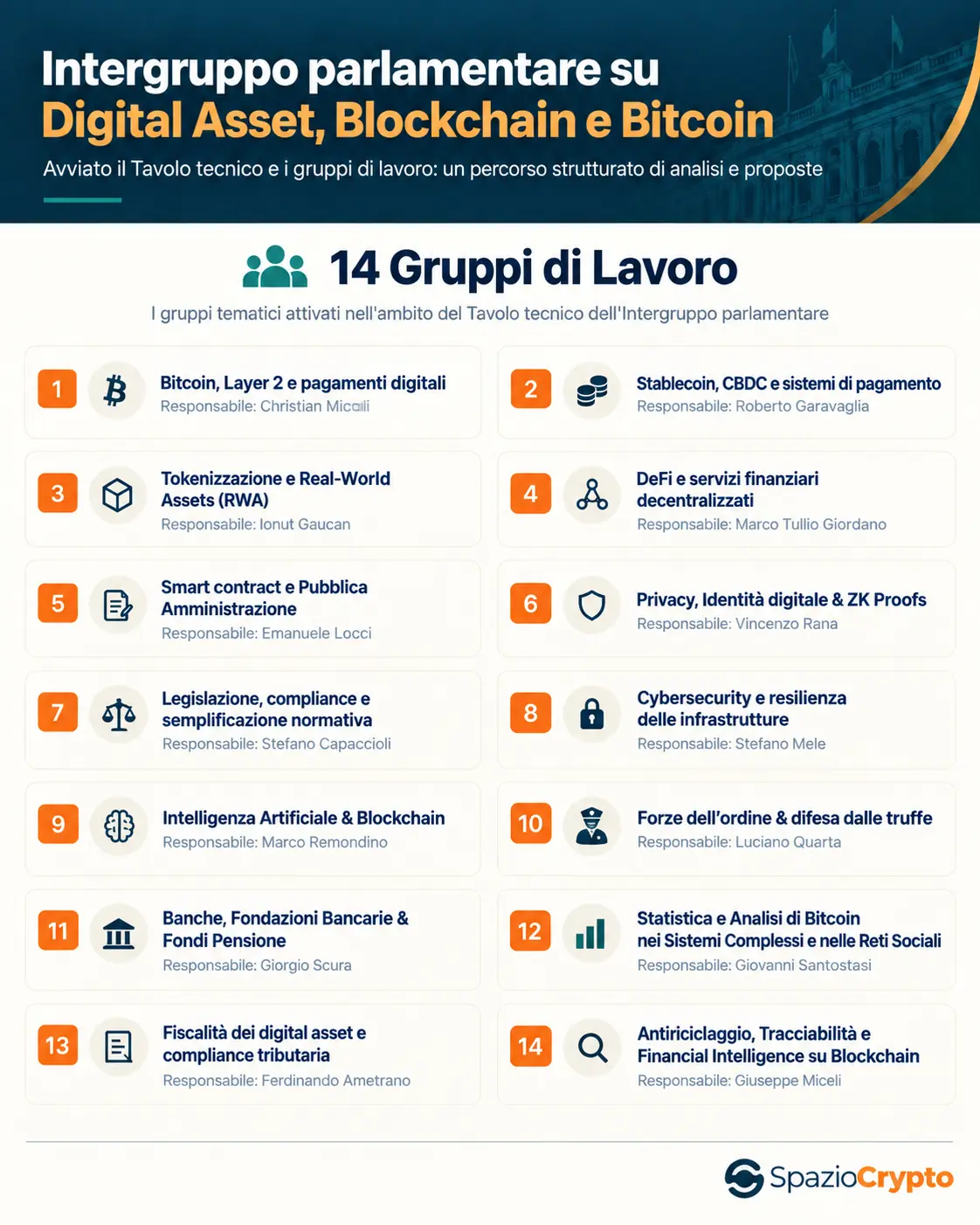
Given the cross-cutting nature of digital assets, which span finance, technology and law, the work was divided into fourteen thematic groups, each tasked with a specific area of analysis. On September 24, in the Chamber’s Parliamentary Groups Hall, those initial conclusions will be presented at an event titled “Digital Finance, Markets and Monetary Sovereignty”. The title is deliberate: the Intergroup’s promoters argue the stakes go well beyond technical rule-making.
 Antonio Annino
The Topics That Matter Most for the Crypto Ecosystem
Among the fourteen working groups, several address areas that European crypto investors are watching closely. Dedicated groups cover Bitcoin and digital payment infrastructure, stablecoins and the potential digital euro from the European Central Bank, and one group is specifically charged with analyzing tokenization and real-world assets, the so-called RWA space. Cybersecurity and other ecosystem components round out the list.
Tokenization is probably the area to track most carefully over the coming months. Italy’s major banks are already moving in this space: the country has seen its first tokenized bond settled in central bank money, the tokenization of non-performing loans by doValue and Weltix, and the recent involvement of large banking groups in the European consortium building a euro-denominated stablecoin. Seeing Parliament organize a structured response to precisely these topics, while Italy’s private sector is already running live experiments, suggests the legislature is trying to keep pace with a transformation already underway.
Why This Approach Is Different from the Past
To appreciate what makes this initiative notable, it helps to look at how Italy has handled crypto regulation until now. The dominant mode has been transposition: taking rules decided at the European level, from MiCA to transfer-traceability requirements, and implementing them domestically. Consob and Banca d’Italia have tightened compliance obligations on crypto operators, as seen most recently with enhanced transaction monitoring requirements that Banca d’Italia imposed on crypto service providers. Necessary work, but essentially reactive, adapting to decisions made elsewhere.
What the Parliamentary Intergroup is attempting is different in kind. Rather than just receiving rules from Brussels and transposing them into Italian law, the Intergroup is trying to build an independently Italian strategic position: how Bitcoin, digital payments, tokenization and monetary sovereignty fit into the country’s economic future. That shift, from compliance follower to strategic actor, is worth noting even before the September 24 event takes place.
The Bigger Picture
This parliamentary initiative tells a broader story about how Italian institutions are reframing digital assets and financial innovation. Crypto is no longer treated as a marginal phenomenon to be managed and contained. Instead, at least within this parliamentary forum, it is being positioned as terrain where a share of Italy’s future economic competitiveness will be determined, something deserving dedicated and structured strategic attention.
Two observations stand out for anyone watching this space. First, the breadth of the Technical Committee, pulling in experts from law, tax, academia, the public sector and finance, reflects a methodological seriousness that is not always present in parliamentary crypto initiatives elsewhere in Europe. Second, the timing is not coincidental: Italy’s private sector and its legislative branch appear to be moving in the same direction at roughly the same moment. Whether this coordination, still informal and parallel rather than orchestrated, produces concrete legislative proposals that genuinely position Italy competitively within the post-MiCA European landscape is the question to watch. The September 24 presentation is the next waypoint, and SpazioCrypto will be following the results closely.