

Canton Coin has received a no-action letter from the SEC's Division of Corporation Finance, dated November 3, 2026, stating that staff considers it a digital commodity and will not recommend enforcement action against those who generate it as described by Digital Asset. This is the first no-action response of its kind since the joint SEC-CFTC taxonomy issued in March 2026. The letter matters for a blockchain built for banks and capital market infrastructure, but its scope is narrow: it reflects the staff's position on the specific facts presented, not a ruling by the Commission, and not a law.
We reviewed the SEC's response, Digital Asset's request letter dated October 30, the coverage by The Block, and the CFTC's press release on the March interpretation. All network figures cited here are those declared by Digital Asset to the SEC.
TL;DR: The SEC Division of Corporation Finance told Digital Asset on November 3, 2026, that Canton Coin qualifies as a digital commodity and staff won't recommend enforcement under Sections 5 and 12(g). The no-action letter applies strictly to the facts presented and can be withdrawn if Canton's governance or token distribution changes.
What the Letter Actually Says
The response was signed by Jonathan A. Ingram, deputy chief counsel of the division's Office of Chief Counsel. Staff concluded that Canton Coin is “intrinsically tied” to the programmatic operation of the Canton Network, deriving its value from supply and demand and the network's functioning, not from an expectation of profits generated by the managerial efforts of others. Based on the representations received, the network has no “central party”: no single entity holds operational, economic, or voting control.
From that finding flows the operative part. Staff will not recommend enforcement action to the Commission if Canton Coin is generated programmatically by Super Validators, validators, and application providers in the manner described, without registration under Section 5 of the Securities Act or Section 12(g) of the Exchange Act. In plain terms: those who run the network and receive tokens as compensation do not need to treat them as a securities offering.
The Limits Are the Real News
A no-action letter is not a law, not a regulation, and does not bind the Commission. It expresses only the division staff's position on one narrow question: whether to recommend enforcement. The letter spells this out in two sentences. First, different facts or conditions could lead staff to different conclusions. Second, the response does not express any legal conclusion on the matters presented.
The SEC has not legally determined that Canton Coin is not a security. The letter does not apply to other tokens. It holds only as long as the network operates as Digital Asset described. If governance, token distribution, or Digital Asset's role were to change, the protection could evaporate. That's the difference between a broad safe-harbor framework, like the one we covered in our analysis of the proposed Regulation Crypto Assets safe harbor, and a case-specific answer tied to a single dossier.
The March Taxonomy: The Reference Point
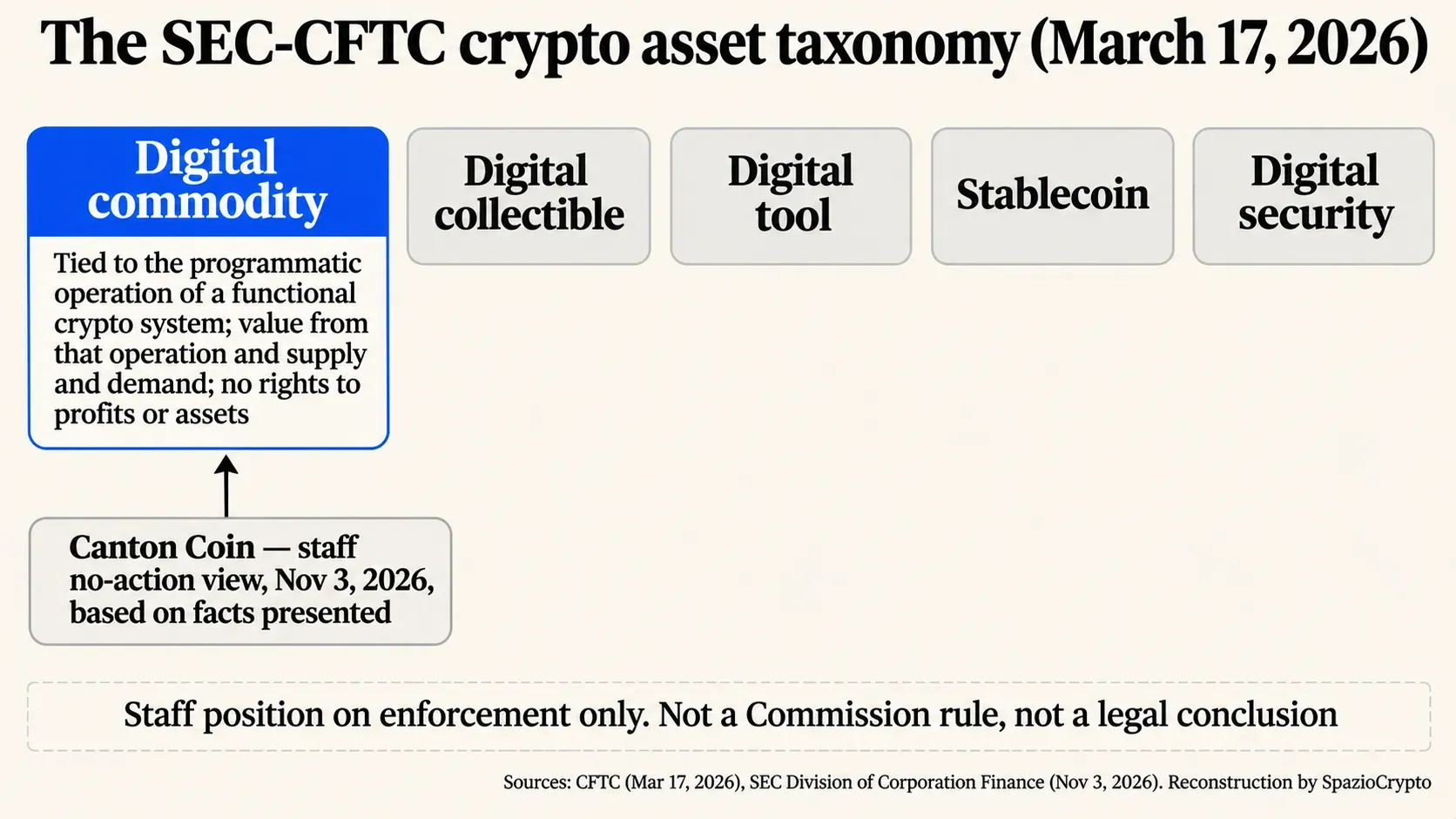
The letter applies a specific framework. On March 17, 2026, the SEC adopted an interpretive release on the definition of a security as applied to crypto assets, and the CFTC joined by declaring it would apply the Commodity Exchange Act consistently with that framework. The document divides tokens into five categories: digital commodity, digital collectible, digital tool, stablecoin, and digital security. A digital commodity is a token tied to the operation of an already-functioning cryptographic system, without rights to profits or assets of an enterprise.
The step forward here is that staff took that definition and applied it to a specific token, based on a dossier filed by the technology issuer. Miles Jennings, partner at a16z, commented on X, according to The Block, that the March taxonomy and the subsequent FAQs had created a clear pathway for network tokens.
How Digital Asset Built the Case
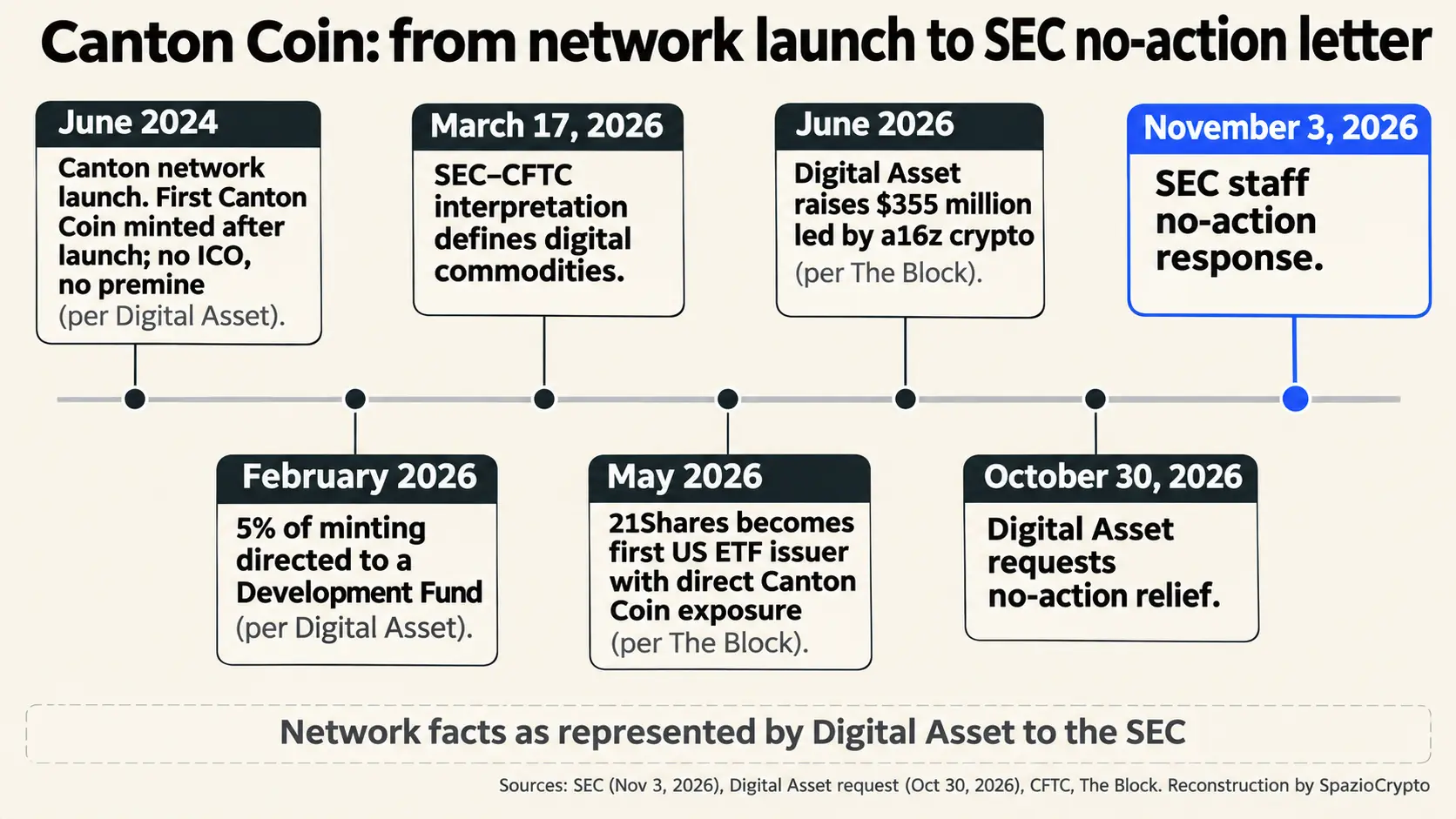
The request letter, signed by Jeffrey T. Dinwoodie on behalf of Digital Asset Holdings, rested on three pillars. First: no initial offering, no pre-allocation, and no token sales before the network launched in June 2024. Tokens were generated only after launch, under identical rules for all participants, Digital Asset included. Second: the token pays network fees, which are burned. New tokens are minted at programmatic intervals as compensation for contributors. As of February 2026, 5% flows to a development fund.
The third pillar is governance. According to the letter, decisions require two-thirds of the 13 Super Validator node operators, with one vote each. Digital Asset controls two of those slots and sits on the Canton Foundation council, a 22-member body co-chaired by DTCC and Euroclear, without the ability to decide unilaterally. Digital Asset also states it does not promote the token as an investment and does not support its price. These are the company's representations: staff took them as the factual basis but did not independently verify them.
Why It Matters for Institutional Finance
Canton is built for institutions, with transactions visible only to the parties involved. According to Digital Asset's representations to the SEC, as of September 30, the network counted approximately 60 Super Validators, more than 700 validators, and more than 120 applications, settling an average of more than $7.1 trillion per month in U.S. Treasury repo transactions. In June, Digital Asset raised $355 million in a funding round led by a16z crypto, as reported by The Block, and in May, 21Shares became the first U.S. ETF issuer with direct token exposure.
For the banks operating on the network, regulatory uncertainty about the native token was a concrete obstacle: a validator receiving tokens that could potentially qualify as securities faces real legal exposure. The letter reduces that risk for Canton's token specifically. Institutional tokenization is advancing on other fronts too. In Europe, the Eurosystem has activated Pontes for settlement in central bank money, without relying on native tokens at all.
The Letter and the Law That Doesn't Exist Yet
The backdrop is a stalled Congress. The CLARITY Act, the market structure bill that would divide responsibilities between the SEC and CFTC, failed in the Senate in September with 49 votes against 50. Without legislation, regulators move through interpretations, consultations, and letters, much like the CFTC preparing federal rules for crypto exchanges.
The weakness of this approach is permanence. A no-action letter can be withdrawn, and a differently composed Commission might read the same interpretation differently. That's why the crypto industry spent tens of millions in midterm elections, as we documented in our piece on the $176 million spent by crypto PACs. Letters help navigate the present, but only a statute provides durable clarity.
What About Europe?
Europe has no equivalent to the no-action letter. MiCA, the EU's crypto-asset regulation, classifies tokens by type, not through case-by-case judgment calls by a supervisory authority. A token like Canton Coin, which is not a stablecoin, would fall under the “other crypto-assets” category, triggering disclosure obligations for anyone offering it or seeking its admission to trading. For U.S.-focused institutional participants watching from London or Frankfurt, the SEC letter is a meaningful signal, but it creates no equivalent pathway under MiCA.
Canton Coin and the SEC: What Is and Isn't Confirmed
Key points, clearly separated
- Confirmed: On November 3, Division of Corporation Finance staff considered Canton Coin a digital commodity and stated they will not recommend enforcement action against Super Validators, validators, and application providers who generate it as described, without registration under Section 5 and Section 12(g).
- Not established: A legal conclusion by the SEC that Canton Coin is not a security, a Commission-level position, or independent verification of the network figures declared by Digital Asset.
- To watch: No-action requests from other network tokens, any governance changes at Canton, and the fate of the CLARITY Act in the new Congress.
The Bigger Picture
Our read, stated as such: the SEC has turned the March taxonomy into a practical instrument. A project can now present its dossier, demonstrate that the network is functional, that no central party exists, and that the token carries no economic rights over enterprise assets, and receive a written response. For institutional infrastructure builders, that's a meaningful shift: it moves the question from “is the token a security?” to “does the network operate as declared?”. The risk is that the industry reads this as a general green light, when it's a conditional clearance tied to one specific case.
Three concrete signals are worth tracking. How many other networks file for similar letters, and what results they get. Whether the SEC publishes rejections, which would reveal where the boundary actually sits more clearly than approvals do. And whether the next Congress converts this case-by-case approach into durable law.
Sources
Official documents: SEC, Division of Corporation Finance, no-action response on Canton Coin, November 3, 2026; Digital Asset Holdings, request letter, October 30, 2026; CFTC, press release on joint interpretive release with SEC, March 17, 2026. Press: The Block, November 3, 2026.