

Polymarket US will stop offering sports-related contracts to Michigan residents. The Michigan Gaming Control Board (MGCB), the state’s gaming regulator, announced the move on October 28, 2026, a day after a stipulation approved by the federal court for the Western District of Michigan was filed. The halt to Polymarket’s sports contracts in Michigan matters because it comes without a ruling on the merits: the lawsuit in which the platform challenges the enforcement of state laws is still open on appeal. The state has secured the commercial outcome before the decision.
We read the MGCB press release, the company’s record at the CFTC, the federal derivatives regulator, and the accounts published by InGame and RG.org. The full text of the stipulation is not available to our tools, and neither are the SBC Americas and Detroit News articles: the terms of the agreement are those reported by the regulator. In the sources we read, Polymarket has not issued a public response.
What did Polymarket US agree to?
The company signing the agreement is QCX LLC, which operates under the name Polymarket US. According to the MGCB press release, it has made three commitments. It will not offer new sports contracts to Michigan customers. By the end of November 25, 2026, Eastern Time, it will close any residents’ sports positions that have not been closed voluntarily before then. In return, the state undertakes not to bring enforcement action against the company as long as it complies with the agreement.
The scope is narrow and needs to be read precisely. The measure covers sports contracts offered to residents of a single state. It does not affect Polymarket US’s other markets, Polymarket’s international platform or any other U.S. state. Readers who want to understand how these instruments work, contracts that pay one dollar if an event happens and zero if it does not, will find the mechanism explained in our guide to prediction markets.
Why would a federal exchange give way to a state?
This is the heart of the matter. QCX LLC is a Designated Contract Market, a derivatives exchange designated by the CFTC on July 9, 2025, according to the regulator’s official record. Polymarket bought it that summer to return legally to the U.S. market, as we reported while following the negotiations over its return to the United States. In these lawsuits, CFTC-registered operators argue that federal oversight rules out the application of state gambling laws to their contracts.
Michigan sees it differently. For the regulator, a contract on the outcome of a game is a sports bet, and it requires a state license. Henry Williams, executive director of the MGCB, puts it bluntly: “If you want to offer sports betting to Michigan residents, you need a Michigan license.” Attorney General Dana Nessel describes a state calling “the national sports betting industry” to comply with Michigan law. It is the same clash between federal and state authority that we saw in New York’s lawsuit against Kalshi.
How did it come to this?
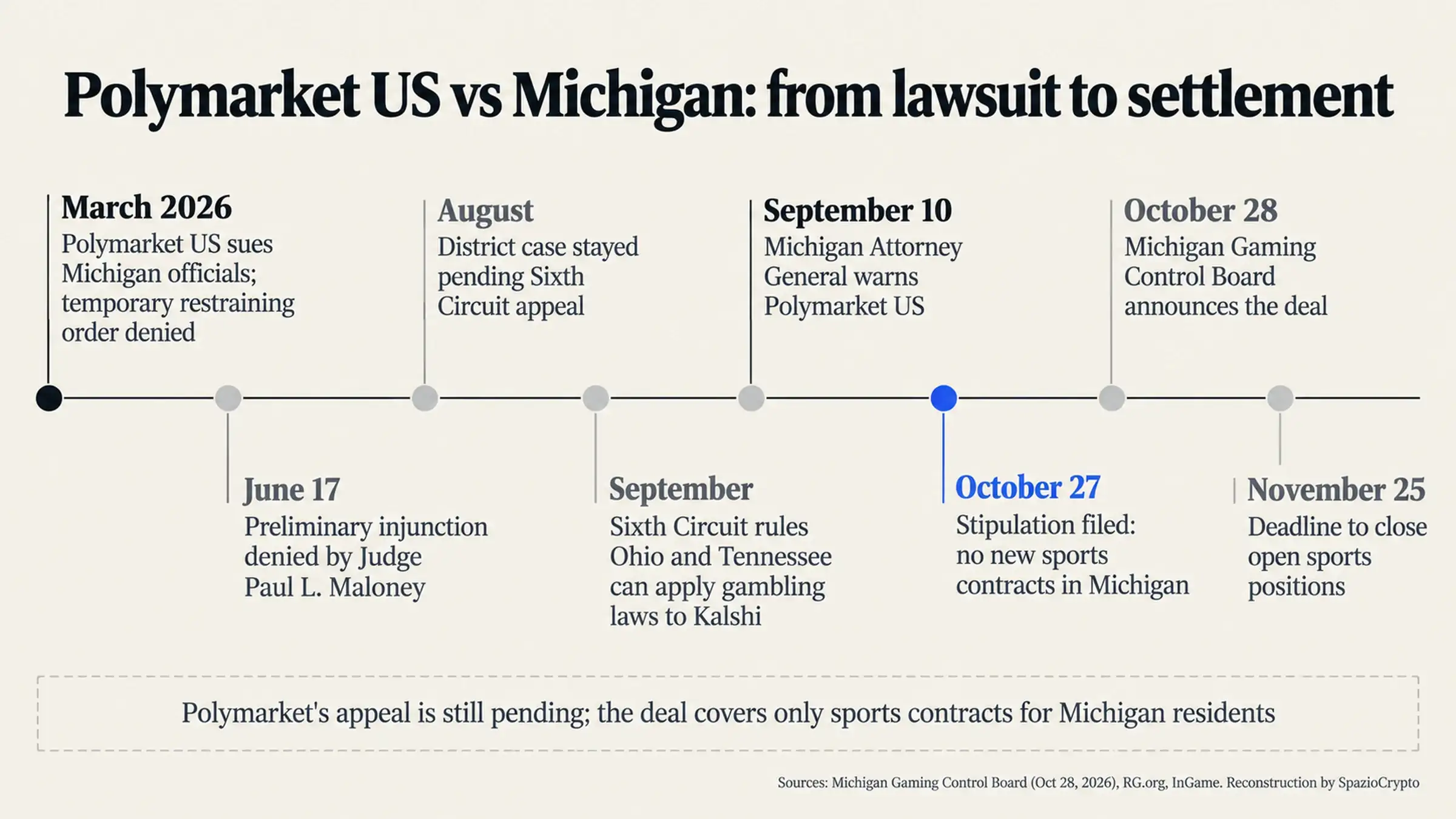
The timeline helps explain why Polymarket chose to sign. According to the MGCB and RG.org, in March 2026 the company sued the attorney general, the MGCB director and the board members to block enforcement of the gambling laws. Judge Paul L. Maloney denied the request for emergency relief in March and the motion for a preliminary injunction on June 17. In August, the trial court proceedings were stayed pending the appeal before the Sixth Circuit, the federal appeals court with jurisdiction over Michigan.
On September 10, the attorney general’s department warned Polymarket US that it would take legal action if the offering did not stop. Also in September, according to InGame, the Sixth Circuit itself ruled that Ohio and Tennessee can apply their own gambling laws to Kalshi’s sports contracts. An appeals court’s decisions apply to every state in its circuit, Michigan included. Facing an unfavorable precedent in the very court that has to rule on its case, Polymarket opted for an agreement that spares it sanctions while the appeal goes on.
Who else has had to stop in Michigan?
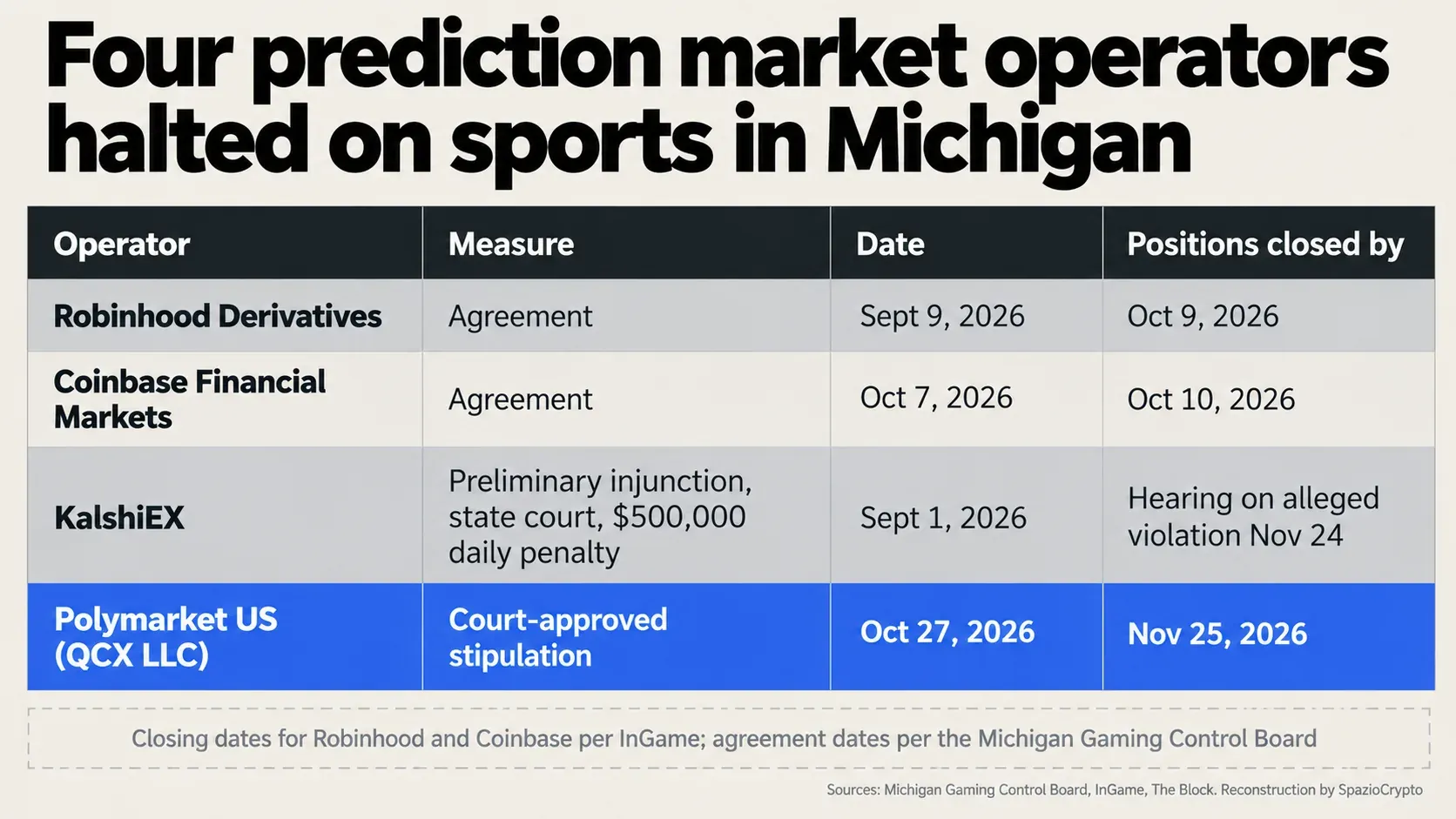
Polymarket is the fourth operator to halt sports contracts in the state. According to the press release, Michigan has obtained agreements or orders covering Kalshi, Robinhood, Coinbase and Polymarket. Robinhood Derivatives was the first to accept the halt, with the agreement announced on September 9 and positions closed by October 9, according to InGame. Coinbase Financial Markets followed on October 7, with positions closed by October 10.
Kalshi took a different path and ended up before a state court. On September 1, Judge Rosemarie E. Aquilina of the Ingham County Circuit Court turned the June emergency order into a preliminary injunction, requiring the company to block residents through geolocation and setting a penalty of $500,000 a day for violations, according to The Block. The state argues that Kalshi is violating the injunction by advertising to residents, and a hearing is set for November 24, InGame reports. The differences between the two models are laid out in our comparison of Kalshi and Polymarket.
Is the rest of the United States moving in the same direction?
Not uniformly, and that is the problem for anyone building a national product. According to InGame, Michigan, Nevada and Washington have won rulings that keep sports contracts out. Among the appeals courts, the Sixth and Ninth Circuits have sided with the states, and the Third Circuit with Kalshi. In September, New Jersey asked the Supreme Court to take up the case. Polymarket, RG.org reports, has also sued officials in Louisiana.
The picture is one of fragmentation that no ruling has yet resolved. The federal front, meanwhile, has its own internal conflicts, as shown by CME’s lawsuit against the CFTC over Kalshi’s perpetual futures. Until the Supreme Court rules, every operator has to decide state by state whether to fight in court or stand down.
What about Italy?
In Italy the issue has taken a more radical form. In early July, the Customs and Monopolies Agency (ADM) added Polymarket’s website to its list of unauthorized gambling sites to be blocked. In early August, the administrative court rejected the request for urgent suspension, and at the end of the month Polymarket withdrew its request for interim relief while keeping its appeal on the merits, as we reported in our piece on the Italian block and the battle over the merits.
The difference with Michigan is one of method, not substance. In the United States, the state targets one category of contracts, sports contracts, and leaves the rest alone; in Italy, the entire website was blocked. In both cases the question is the same: is a contract on a sporting event a derivative or a bet? And in both cases the practical answer, for now, has come from the gambling regulator.
Polymarket and Michigan at a glance
What is confirmed and what is not
- Confirmed: a stipulation filed on October 27 and announced by the MGCB on the 28th: Polymarket US will not offer new sports contracts to Michigan residents and will close open positions by November 25; the state refrains from enforcement action as long as the agreement is respected. Polymarket’s appeal remains pending before the Sixth Circuit.
- Not disclosed: the full text of the stipulation, the number of customers and positions involved, a public response from Polymarket.
- To watch: the closing of positions on November 25, the Kalshi hearing on November 24, the Sixth Circuit’s decision and New Jersey’s petition to the Supreme Court.
The bigger picture
Our reading, which we flag as such: U.S. prediction markets are discovering that a federal license is not enough to guarantee a national market. Registration with the CFTC remains an advantage, but every state can turn legal uncertainty into an immediate cost, and sports is the most exposed segment because it is the one that most resembles betting and the one that generates the most volume. Michigan has shown the method: lawsuits, injunctions and agreements one at a time, without waiting for the Supreme Court.
There are four signals to watch. The Sixth Circuit’s decision on Polymarket’s appeal, which faces an uphill battle after the Ohio and Tennessee precedent. The Supreme Court’s response to New Jersey, the only one that can settle the split between the circuits. The number of states that will follow Michigan’s model. And the operators’ choice between fighting in court, like Kalshi, or signing agreements, like Robinhood, Coinbase and now Polymarket.
Sources
Michigan regulator: Michigan Gaming Control Board, press release of October 28, 2026. Federal case: QCX LLC v. Nessel docket (not read). Federal registration: CFTC, Designated Contract Market record for QCX LLC. Press accounts: InGame, October 28, 2026; RG.org, October 28, 2026; SBC Americas, October 28, 2026 (not read); Detroit News, October 28, 2026 (not read).