


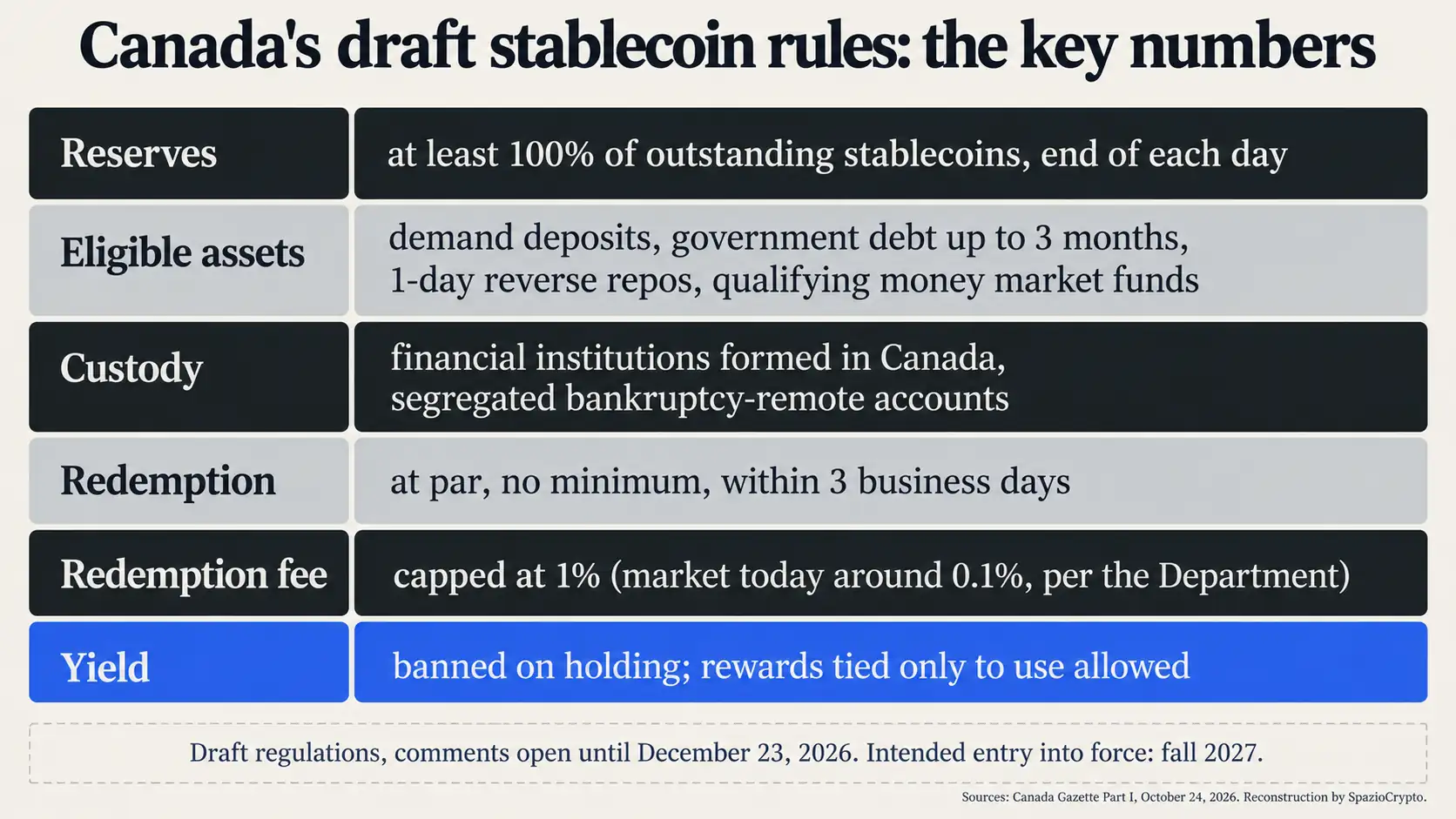
Canada's proposed stablecoin regulations require 100% reserves held at Canadian institutions, redemption at par within three business days, fees capped at 1%, and a blanket ban on yield for holders. The Department of Finance published the draft on October 24 in the Canada Gazette, implementing the Stablecoin Act that received Royal Assent in March 2026. Public consultation runs until December 23, with full enforcement targeted for autumn 2027.
We reviewed the full text of the proposed regulation and its accompanying impact analysis, alongside the Department of Finance's overview of the Canadian framework. For market context we draw on CoinDesk's October 26 report, which also cites a statement from the Canadian Bankers Association sourced by The Logic.
What the Regulation Actually Says
The Stablecoin Act received Royal Assent in March 2026 as part of Canada's first Budget 2025 implementation bill. What arrived on October 24 are the operational rules that make the Act enforceable. The framework covers domestic and foreign issuers that are not already prudentially supervised financial institutions: banks, trust companies, insurance firms. Credit unions are explicitly excluded. Supervision falls to the Bank of Canada, with which issuers must register, while the Department of Finance retains policy authority.
Reserves must equal or exceed outstanding stablecoin supply at end of day, denominated in the same reference currency. Eligible assets include demand deposits, government securities with up to three months to maturity, overnight repos on those securities, and money market funds holding only eligible assets. Reserves cannot be pledged as collateral, must sit in a segregated bankruptcy-remote account, and must be held at a financial institution incorporated in Canada. The Bank of Canada will receive a monthly auditor-reviewed reserve report.
The Yield Ban Has a Deliberate Side Door
Section 13 prohibits the issuer from promising or paying interest or yield, directly or indirectly, to stablecoin holders. Section 14 then clarifies that a reward is not a yield if it is not linked to the balance held. The impact analysis is explicit: the government intends to permit transaction-based rewards while maintaining the ban on balance-based returns. Holding the stablecoin earns nothing. Using it to pay can.


The distinction is not a footnote. In the United States, the OCC's final rule on the GENIUS Act removed the automatic presumption on third-party arrangements, leaving the yield ban to be assessed case by case. Canada writes the criterion directly into the regulation. The boundary between payment cashback and disguised interest will still generate interpretive disputes for supervisors.
Banks pushed hard for the ban. According to CoinDesk, the Canadian Bankers Association told The Logic in June that it strongly supported the prohibition on yield “both direct and indirect.” The concern mirrors the debate in the United States: customers moving money out of deposit accounts, leaving banks with less funding to lend.
Three Days and 1%: Looser Than Europe, by Design
Every holder must be able to request redemption at par, with no minimum amount, and receive it within three business days. The fee cannot exceed 1% of the redeemed amount, and any introduction or increase requires at least seven days' notice published on the issuer's website. Daily redemption limits are permitted when market liquidity is insufficient.
The impact analysis explains both choices. The three-day window accommodates reserve asset settlement cycles and operational processing time. The 1% cap is a deliberate compromise: the document acknowledges that market fees currently sit around 0.1%, but argues a lower ceiling could be unduly restrictive for small or new issuers. Under MiCA, the European framework, redemption is required at any time, at par, with zero fees. The Banca d'Italia highlighted that contrast in its comparison of MiCA and the GENIUS Act.
A Small Market, with Big-Market Rules
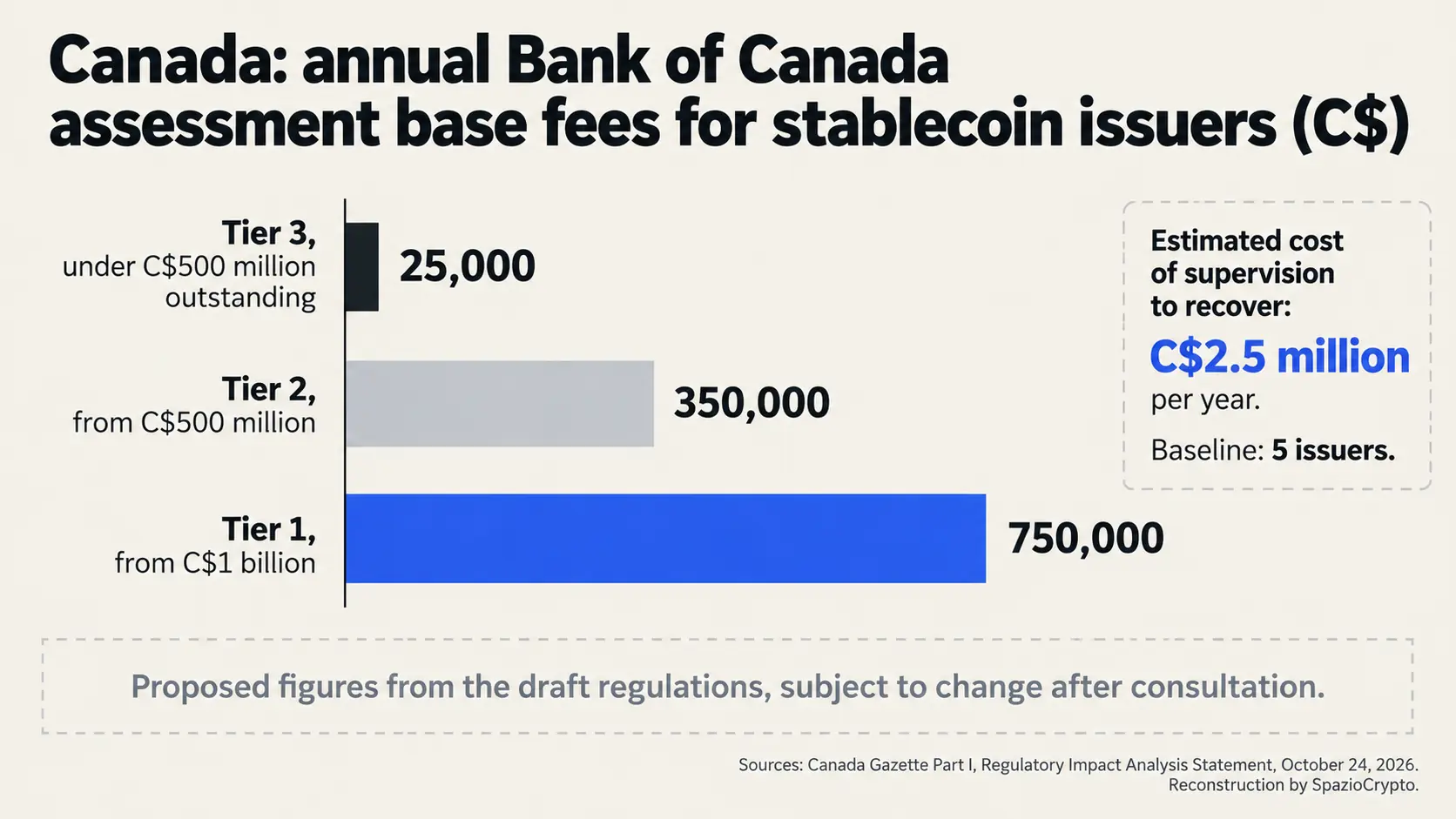
The impact analysis puts the current market in perspective. The baseline scenario counts five issuers and names QCAD by Stablecorp, CADC by Loon Technology. USDC by Circle as current operators. The estimated annual compliance cost for issuers is CAD 88,521 across the sector, roughly CAD 17,704 per issuer. Related amendments would bring approximately 30 new payment service providers under the Retail Payment Activities Act.
The Bank of Canada estimates CAD 2.5 million per year in supervisory costs, recovered through a three-tier levy: CAD 25,000 for issuers with less than CAD 500 million in circulation, CAD 350,000 from CAD 500 million, and CAD 750,000 from CAD 1 billion. Administrative penalties reach CAD 1 million for serious violations and CAD 10 million for very serious ones. A political filter also applies: the Minister of Finance has 60 days (extendable) to decide whether to refer an application for national security review, and the review itself can run up to 180 days (also extendable). Foreign issuers are caught if they offer stablecoins to persons in Canada. The Bank of Canada may exempt issuers subject to a substantially equivalent regime, with details deferred to future guidelines.
Banks Are Outside the Law, Not Outside the Story
The central paradox of the Canadian framework is that the Stablecoin Act does not apply to banks, yet banks are present at every stage of the story. They act as reserve custodians, lobbied for the yield ban, and are simultaneously developing their own products. According to CoinDesk, in September Canada's six largest banks disclosed they were studying a tokenized Canadian dollar system for interbank payments. On September 10, the banking regulator OSFI stated that tokenized deposits are not legally distinct from traditional deposits.
Also per CoinDesk, the market is already moving. Coinbase Canada received approval from the Ontario Securities Commission this year to offer yields on eligible tokens, with risk disclosures and a clear note that the funds are not covered by deposit insurance. Tetra Trust launched CADD in May, a Canadian dollar stablecoin approved by Alberta regulators. These are details reported by the press that any federal framework will need to accommodate: issuers already operating will have 30 days from the effective date to submit an application, along with an exit plan if their application is rejected.
And What About Europe?
For anyone operating in Italy, the Canadian text changes nothing directly, though it serves as a useful reference point. MiCA already prohibits interest on e-money tokens and mandates par-value redemptions with no fees, and enforcement is tightening: Consob has required CASPs to delist non-compliant stablecoins within three months. On reserves, the European debate is actually moving in the opposite direction from rigidity: the ECB and national central banks have proposed scrapping the requirement to hold 30-60% of reserves in bank deposits. Canada, for its part, sets no composition limits among permitted assets, a choice that its impact analysis presents as a direct response to fintech requests for flexibility.
The Canadian document states that it examined the regulatory regimes of the United Kingdom, the United States, the European Union, Singapore, Hong Kong, and Japan, and describes its own requirements as “largely consistent” with those of other jurisdictions. That phrasing points in the direction the Financial Stability Board has urged, having warned the G20 that national supervision alone is insufficient for global stablecoins.
Department of Finance Canada
Canada's Stablecoin Rules: A Summary
What is confirmed, and what isn't
- Confirmed: the draft published on October 24 requires reserves at least equal to tokens in circulation held at Canadian financial institutions, par-value redemption within three business days with fees capped at 1%, a ban on yield for holders, and rewards permitted only for usage.
- Not specified: the exact effective date, the criteria for recognizing foreign regimes, and the practical boundary between usage rewards and disguised yield.
- To watch: public comments due by December 23, the final text, and Bank of Canada guidelines, with a stated target of autumn 2027.
The Bigger Picture
Our reading, stated plainly as such, is that Canada has written a rule that protects banks without naming them. Non-bank issuers gain a regulated space with contained costs and redemption windows broader than those under MiCA, but they lose the strongest lever for attracting balances: yield. They can reward usage, not holding. A stablecoin designed as a payment instrument rather than an interest-bearing account, while tokenized bank deposits remain full deposits in every legal sense.
There are a few specific signals worth watching. The first is who submits comments by December 23, since responses will be published in the Canada Gazette. The second is whether the final text adjusts the 1% fee cap or the three-day redemption window. The third is how the Bank of Canada treats foreign issuers, starting with USDC. How much room it leaves for reward programs.